
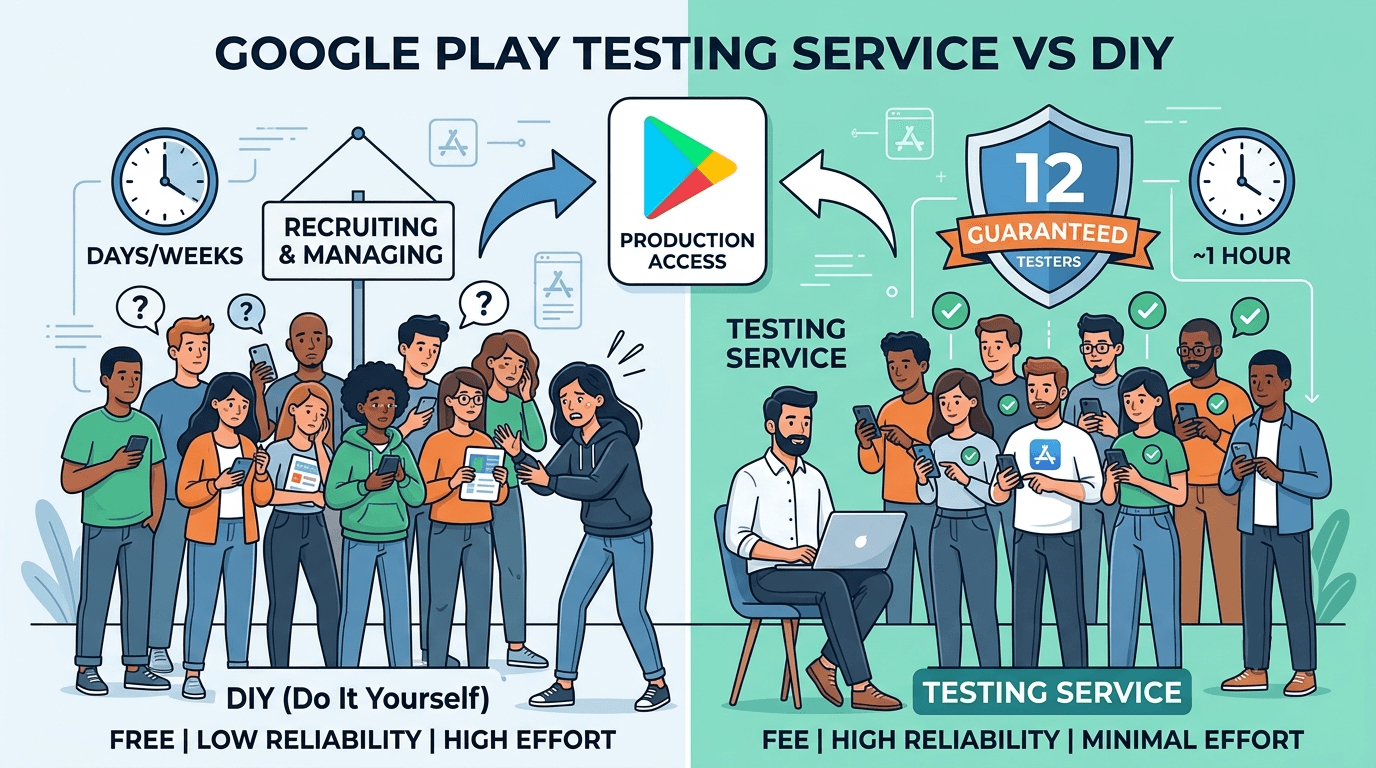
Every developer facing the 12-tester requirement makes one core decision: recruit testers yourself, or use a service. Both can get you to production access, but they differ sharply in time, effort, and reliability. This Google Play testing service vs DIY comparison lays out the honest trade-offs so you can choose confidently.
Contents
Quick answer
Featured answer: DIY testing is free but slow, effort-intensive, and prone to dropouts, making it best when you have time, a network, and no deadline. A testing service costs a one-time fee but delivers real testers fast with managed retention, making it best when your time or launch date is valuable. Both are policy-compliant with real testers.
The DIY approach
Doing it yourself means recruiting testers through your network and free communities — Reddit, forums, Telegram, and Facebook groups. The upside is zero cash cost and direct contact with testers. The downside is significant: it takes time, most channels expect reciprocation (you test their apps too), reliability varies widely, and you personally manage dropouts to stay above 12 for all 14 days. See the pros and cons in Reddit testers pros and cons and tips in getting 12 without friends or family.
The service approach
A service assigns real testers to your closed track and keeps them active for the full window, for a one-time fee. The upside is speed (testers within about an hour), reliability (managed retention), no reciprocation, and often feedback. The downside is the fee. For most developers on a timeline, the certainty is the point. See how a testing service works.
Tip: The single biggest DIY risk is your launch date slipping because recruiting is slow. A service removes that risk. Submit your app to start immediately.
Side-by-side comparison
| Factor | DIY | Testing service |
|---|---|---|
| Cash cost | Free | One-time fee |
| Time cost | High | Low |
| Speed to 12 | Days to weeks | ~1 hour |
| Reciprocation | Usually required | None |
| Retention | You manage it | Managed |
| Feedback | Variable | Structured |
How to choose
Choose DIY if you have time, an engaged network, no deadline, and enjoy community involvement. Choose a service if your time is valuable, you have a launch date to protect, you lack a ready network, or you have already struggled with slow recruiting and dropouts. Many developers even combine both — using community feedback while relying on a service to guarantee the core count. Because real testers from any source count, this hybrid is entirely valid.
Key takeaways
- DIY is free but costs time and carries dropout and delay risk.
- A service costs a fee but delivers speed and reliability.
- Both are compliant when testers are real and opt in via Play.
- Choose based on the value of your time and your deadline.
- You can combine both approaches.
The hybrid approach in practice
The choice is not strictly binary. Many developers get the best of both worlds by combining approaches: they post in a developer community for genuine, technical feedback while using a service to guarantee they hit and hold the required twelve testers. Because real testers from any source count toward the requirement, there is no conflict in mixing them — the community provides insight and goodwill, and the service provides certainty.
This hybrid is especially sensible when you value community engagement but cannot afford to gamble your launch date on it. You get the qualitative feedback that engaged developers often provide, without exposing your timeline to the churn and reciprocation demands that make pure DIY unreliable. If you are unsure which side to lean on, start with the service for the compliance-critical core, then layer community testers on top for extra coverage and feedback.
Two paths to the same requirement
Every developer launching on a new personal Google account must satisfy the same rule: at least 12 real testers, active for 14 continuous days, before production access. There are only two fundamental ways to get there — do it yourself, or use a service — and they represent a classic trade-off between money and time. DIY costs no cash but demands your hours and carries real risk; a service costs a fee but delivers speed and reliability. Neither is universally right; the best choice depends on your circumstances.
Understanding both paths clearly, rather than defaulting to "free must be better," is what leads to a good decision. Free is not free if it costs you a week of effort and a delayed launch. A fee is not wasteful if it saves you both. The sections below lay out each path honestly so you can match it to what you actually value most: saving money or saving time and certainty.
The DIY path, honestly assessed
Doing it yourself means personally recruiting your testers, getting them to opt in correctly, and keeping them engaged across the full two weeks. Its appeal is obvious: no cash outlay beyond the $25 Google fee, and full control over who tests your app. If you already have a dozen willing friends or followers with varied Android devices, DIY can work well and even give you testers who care about your success.
The honest downsides are time and risk. Recruiting enough device-diverse, committed people can take days, and keeping them active requires ongoing nudging. The real danger is dropout: if testers lose interest partway, your count can fall below 12 and reset the continuous-day clock, delaying your launch by weeks. DIY also tends to produce whatever devices your network happens to own, which may not give you meaningful device coverage. For most solo developers without a ready audience, these downsides are significant.
The service path, honestly assessed
| Factor | DIY | Service |
|---|---|---|
| Cash cost | None | A fee |
| Time cost | High | Minimal |
| Reliability | Variable | High |
| Speed to start | Slow (recruit first) | Fast |
| Device diversity | Limited to your network | Broad by design |
| Dropout risk | You absorb it | Buffered for you |
A service flips the trade-off: you pay a fee and, in return, verified real testers begin quickly, stay engaged for the full window, span diverse devices, and are buffered against dropout so you never fall below the threshold. You hand off the entire tester side and focus on your app and launch. The cost is money; the benefit is speed, reliability, and freedom from managing a fragile group of volunteers. You can submit your app to see how fast the service path can be.
How to decide between them
Match the path to your situation. Choose DIY if you have plenty of time, a ready network of device-diverse, committed testers, and no pressing launch date — for a hobby project, the effort is minor and the savings are real. Choose a service if your launch has a deadline, your time is valuable, you lack a reliable network, or you have already been burned by swap groups that fizzled. The decisive factors are how much your time is worth and how costly a delay would be.
A useful gut check: if the thought of recruiting and babysitting a dozen testers for two weeks fills you with dread, or if a launch delay would genuinely hurt, the service almost certainly pays for itself. If it sounds manageable and you enjoy the control, DIY is a fine choice. Either way, the goal is the same — 12 real testers, 14 days, production access — so pick the path that gets you there with the least cost to what you value. See what closed testing really costs.
Key takeaways
- There are two paths: DIY (free, slow, risky) or a service (fee, fast, reliable).
- "Free" DIY still costs time and carries dropout/delay risk.
- A service buys speed, reliability, device diversity, and a dropout buffer.
- Choose DIY with time and a ready network; choose a service with a deadline or valuable time.
- Decide based on the value of your time and the cost of delay.
The hidden costs of "free" DIY
The word "free" does a lot of misleading work when it comes to DIY closed testing. Yes, recruiting your own testers costs no cash, but cash is rarely the scarcest resource for a launching developer. The genuine costs of DIY are your time and your risk, and both can be substantial. On time: assembling a dozen device-diverse, committed testers typically takes days of asking, posting in communities, and following up, then ongoing effort to keep them engaged across two weeks. That is real work with real opportunity cost.
On risk: a self-recruited group is fragile. Volunteers lose interest, uninstall, or simply forget, and if enough drop off you fall below the 12-tester threshold and can reset the continuous-day clock — potentially delaying your launch by weeks. DIY also gives you whatever devices your personal network happens to own, which often means thin device coverage. So "free" DIY actually costs time, carries delay risk, and may deliver weaker testing. Recognizing these hidden costs is essential to a fair comparison.
When DIY genuinely wins
None of this means DIY is always the wrong choice — for the right person, it is excellent. If you already have an engaged audience or a group of friends with varied Android devices who will happily test for two weeks, DIY costs you little and gives you testers who actively care about your success. If you have no launch deadline, the time cost is not really a cost at all, and the hands-on experience of running your own test can be genuinely useful. For hobby projects and developers rich in time and network, DIY is often the sensible default.
The key is honesty about which situation you are in. DIY wins when your time is abundant, your network is ready and device-diverse, and your timeline is flexible. It struggles when any of those is missing — when you are short on time, lack a ready group of testers, or have a date you cannot slip. Matching the method to your real circumstances, rather than defaulting to "free," is what leads to the right decision.
A note on the hybrid approach
| Your reality | Best fit |
|---|---|
| Time-rich, ready network, no deadline | DIY |
| Time-poor or no network | Service |
| Firm launch date | Service |
| Some testers but not enough | Hybrid: top up with a service |
It is worth noting that the choice is not strictly binary. Some developers have a few reliable testers of their own but cannot reach the twelve-tester minimum with a safe buffer. In that case a hybrid approach works well: use your own testers and top up the rest through a service, getting the reliability of a full, buffered roster while keeping the engaged testers you already have. This blends the strengths of both paths and can be the most economical route for developers who are partway there.
Whatever mix you choose, the destination is identical — 12 real testers active for 14 continuous days. The only question is which combination of money, time, and risk suits you best. If the reliable path appeals, you can submit your app and have verified testers fill any gap quickly. For the full cost breakdown behind this decision, see what closed testing really costs.
Frequently asked questions
Is DIY testing really free?
In cash yes, but it costs significant time and risks launch delays.
Is a service worth the fee?
Usually, if your time or launch date is valuable.
Which is more reliable?
A service, thanks to real testers and managed retention.
Can I combine both?
Yes. Real testers from any source count toward the requirement.
Which is faster?
A service, typically within about an hour versus days for DIY.
Is DIY ever the better choice?
Yes, when you have time, a network, and no deadline.
Conclusion
DIY and a testing service both lead to production access; they simply trade money for time in opposite directions. If you have time and a network, DIY works. If your time and launch date matter, a service is the smarter choice — and you can always blend the two. Ready to skip the recruiting grind? Submit your app today.
Expanded for topical authority — additional practical sections below. Original guide content above is unchanged.
Real-world scenarios: who this matters for
The guidance in this article on Google Play Testing Service vs DIY: Which Should You Choose? applies across many Android product types. Use these scenarios to map the advice to your situation.
| Developer type | Typical challenge | Practical focus |
|---|---|---|
| Indie / solo | Limited tester network and time | Start closed testing early; keep a buffer above 12 opted-in testers; parallelize listing + Data safety work |
| Startup | Launch deadline vs 14-day rule | Treat the window as fixed; recruit in parallel with QA; avoid last-minute track setup |
| Agency / white-label | Multiple client apps, each needing its own test | One closed test per app; standardize opt-in onboarding; track eligibility dates per client |
| Flutter / React Native | Cross-platform build + Play Console quirks | Ship a signed AAB to closed testing; verify installs from Play, not sideload; watch vitals on mid-range devices |
| Native Kotlin | Device/API fragmentation | Cover API levels and OEMs in your tester mix; fix crashes before requesting production |
| Game / Unity | Performance + retention during 14 days | Keep testers engaged so count never dips below 12; monitor ANRs and battery |
| E-commerce / fintech | Policy + payment flows | Test checkout, permissions, and declarations carefully before production access |
| Healthcare / kids / education | Sensitive policies (Families, data) | Align listing, privacy, and content rating with real app behavior during the test window |
Visual placeholder: Scenario matrix infographic — Indie / Startup / Agency / Cross-platform paths for Google Play Testing Service vs DIY: Which Should You Choose?.
Comparison: DIY recruitment vs managed closed testing
When your goal is Google Play production access, the path you choose for testers affects time, risk, and feedback quality. Use this comparison while deciding how to apply Google Play Testing Service vs DIY: Which Should You Choose?.
| Approach | Time to 12 opted-in | Cost | Dropout risk | Feedback quality | Best when |
|---|---|---|---|---|---|
| Friends & family | Days–weeks | $0 | High | Mixed | Tiny MVP, flexible timeline |
| Reddit / Discord / Telegram | Unpredictable | $0–low | High | Variable | You can manage onboarding daily |
| Peer community exchange | Variable | $0 | Medium | Developer-biased | You can test others’ apps in return |
| Managed closed testing (e.g. Fast Testers) | ~1 hour after valid link | $15 one-time / app | Low (buffer of 15) | Real Play installs | You need speed + continuity for 14 days |
Decision tip: If a broken streak would delay revenue or a client deadline, prioritize reliability over $0 recruitment. DIY is fine when you already have engaged testers and can monitor Play Console daily.
Visual placeholder: Comparison diagram — DIY vs community vs managed testing for Google Play Testing Service vs DIY: Which Should You Choose?.
Common mistakes (and how to avoid them)
These mistakes repeatedly show up when developers work through Google Play Testing Service vs DIY: Which Should You Choose?:
- Confusing invited vs opted-in testers — Only testers who open the opt-in link and install from Play count toward 12. Check the opted-in number in Play Console, not your email list.
- Recruiting exactly 12 with no buffer — One uninstall can break continuity. Aim for ~15 active opted-in testers.
- Starting the counted clock late — Listing assets, Data safety, and privacy work should run during the 14 days, not after.
- Using sideloaded APKs or fake installs — They do not satisfy Play’s closed testing expectations and can create account risk.
- Ignoring tester feedback until day 14 — Crashes that drive uninstalls threaten your streak and your review outcome.
- Requesting production access before the continuous streak completes — Eligibility checks fail even if calendar time has passed.
Troubleshooting checklist
If something feels “stuck” while applying Google Play Testing Service vs DIY: Which Should You Choose?, walk this list before changing strategy:
| Symptom | Likely cause | Fix |
|---|---|---|
| Console shows < 12 testers | Invites sent but not opted in | Resend opt-in link; confirm install from Play |
| “Not eligible” after 14 calendar days | Count dipped below 12 mid-window | Restore 12+ and complete a full continuous streak |
| Tester cannot join | Wrong account, Group lag, or track not published | Verify Google account, Group membership, track release |
| App fails to install | Device/API mismatch or signing issue | Check AAB, minSDK, Play App Signing |
| Production still rejected after testing | Policy, declarations, or stability — not the clock | Read the exact reason; fix that category completely |
Visual placeholder: Troubleshooting flowchart for Google Play Testing Service vs DIY: Which Should You Choose?.
Action checklist
Use this checklist alongside the rest of this guide on Google Play Testing Service vs DIY: Which Should You Choose?:
- ☐ Closed testing track created with a signed release (AAB)
- ☐ Opt-in link tested on a fresh Google account
- ☐ At least 12 testers opted in (prefer ~15)
- ☐ Daily check that opted-in count stays ≥ 12 for 14 continuous days
- ☐ Core flows exercised (login, main feature, permissions, offline/online)
- ☐ Crashes / ANRs triaged from tester reports and vitals
- ☐ Store listing, screenshots, and feature graphic drafted
- ☐ Privacy policy + Data safety + content rating aligned with real behavior
- ☐ Production access requested only after eligibility is green
- ☐ Staged rollout plan ready for first public release
Additional FAQs developers ask about Google Play Testing Service vs DIY: Which Should You Choose?
Quick answer: what should I do first?
Confirm you are on a closed testing track with real opted-in installs, keep 12+ testers for 14 continuous days, and fix policy/stability issues in parallel. Then use the detailed sections above for Google Play Testing Service vs DIY: Which Should You Choose?.
Does this apply to organization (company) accounts?
The classic 12×14 closed testing gate is primarily associated with new personal developer accounts. Always verify your account type and current Play Console eligibility messaging for your app.
Do friends and family count as testers?
Yes — if they opt in via your closed testing link and install from Google Play. They only help if they stay opted in for the continuous period.
Can I update the app during the 14 days?
You can usually push updates on the closed track, but unstable releases that cause uninstalls can threaten your tester count. Prefer polishing via internal testing first when possible.
What if production access is still rejected?
Read the exact reason. Incomplete testing is only one category — policy, Data safety mismatches, and crashes are common. Fix the cited issue fully before reapplying.
Is paying for testers allowed?
Using real people who install from Play is what matters. Avoid fake install farms. A one-time managed service that supplies real closed testers is a practical option when DIY recruitment is too slow.
How is Fast Testers different from free communities?
Free communities trade time and mutual availability. Fast Testers assigns about 15 real testers after you submit a valid closed testing link (one-time $15 per app) and includes a production access guarantee under its refund terms.
Where should I go next?
Review the related guides below, then either finish DIY recruitment or start closed testing if you need speed and continuity.
Sources, updates, and how to use this guide
This article on Google Play Testing Service vs DIY: Which Should You Choose? is maintained for Android developers preparing Google Play closed testing and production access. Always cross-check eligibility text inside your own Play Console, because Google’s UI labels and account rules can vary by account type and date.
- Primary official references: Google Play closed testing help, Developer Program Policies, and Play Console eligibility messaging for your app.
- Practical experience lens: guidance here reflects common failure modes indie developers and agencies hit when recruiting testers, maintaining the 14-day streak, and recovering from production-access rejections.
- Last reviewed focus: 12×14 closed testing continuity, real vs fake testers, and parallel listing/compliance work during the window.
Related guides and next steps
Continue building topical depth around Google Play Testing Service vs DIY: Which Should You Choose? with these Fast Testers resources:
- Closed Testing Vs Open Testing On Google Play
- Google Play Closed Testing Service
- Google Play Internal Testing Vs Closed Testing
- How To Choose A Google Play Testing Service
- Ad Supported Apps And Google Play Ad Policy Testing
- Agency Guide Testing Client Apps On Google Play
- Android Tv Apps And Google Play Testing Tracks
- Common Google Play Closed Testing Mistakes
- Pricing — $15 closed testing
- How Fast Testers works
- FAQ
- Developer reviews
- Case studies
- Submit your app / start closed testing
Need reliable testers so your 14-day streak does not stall? Educate first with the guides above, then start when you are ready — one-time pricing, real Play installs, dashboard tracking.
Further expansion — case study, decisions, and expert recommendations. Prior sections remain unchanged.
Case study: indie app that needed 12 testers in under a day
Problem: A Flutter indie developer had a client demo in three weeks. Friends-and-family recruitment stalled at 6 opted-in testers after five days of chasing messages.
Solution: They kept DIY outreach running, but also submitted a valid closed testing opt-in link to a managed service to reach ~15 real Play installs quickly. They used this guide on Google Play Testing Service Vs DIY: Which Should You Choose? to brief testers on what to exercise (onboarding, permissions, offline mode) and monitored Play Console daily so the continuous streak would not break.
Result: Opted-in count stabilized above 12 within hours of assignment; 14 continuous days completed; production access requested on schedule.
Lessons learned:
- Recruit a buffer early — waiting until day 10 is the expensive mistake.
- Real Play installs beat large invite lists.
- Managed testing is a timeline tool, not a substitute for fixing product quality.
Decision guide: what should you do next?
Use this decision path when applying Google Play Testing Service Vs DIY: Which Should You Choose?:
- Is your account a new personal developer account that still needs production access?
If yes, plan for closed testing with 12+ opted-in testers for 14 continuous days. If no, still test — but confirm the exact eligibility text in Play Console. - Do you already have 12+ reliable people who will install from Play and stay for two weeks?
If yes, DIY can work — add a buffer and monitor daily. If no, use community exchange or a managed closed testing service. - Is your build stable enough that testers will not churn?
If no, run internal testing first. Entering the counted window with crash loops is how streaks die. - Are Data safety, privacy policy, permissions, and listing aligned with real behavior?
If no, fix during the window so production review does not bounce you after the clock. - Has production access been rejected?
Classify: eligibility vs policy vs declarations vs stability. Fix that category completely, then re-test / re-request.
Visual placeholder: Decision tree diagram for Google Play Testing Service Vs DIY: Which Should You Choose? (DIY vs managed vs fix-and-retry).
Expert recommendations
- Instrument the streak: Check opted-in count daily for the first week; replace dropouts same day.
- Brief testers once: Send a short checklist (install from Play, open app daily, try core flow, report crashes). Silent testers still count if opted in — engaged testers protect quality.
- Never “solve” recruitment with fake installs: It fails the intent of closed testing and can create account risk.
- Ship a boring-stable build to closed testing: Save experimental features for internal tracks.
- Educate first, then accelerate: If your blocker is simply finding real testers fast, a one-time managed option (Fast Testers: 15 testers, $15/app) is often cheaper than slipping a launch.
For hands-on setup after reading about Google Play Testing Service Vs DIY: Which Should You Choose?, see how it works and pricing, or submit your closed testing link when you are ready.
Internal navigation hub — added to strengthen topical connections. Original article content above is unchanged.
Topic cluster: Testing Services & Comparisons
Pillar guide: Start with Google Play Closed Testing Service: What It Is and How It Works for the full overview, then use the supporting guides below.
- Google Play Closed Testing Service: What It Is and How It Works (pillar)
- How to Choose a Google Play Testing Service
- How Much Does Google Play Closed Testing Cost?
- Is Buying Google Play Testers Worth It?
- FastTesters vs Reddit Testers: Which Is Better?
- FastTesters vs Telegram Communities for Testing
- FastTesters vs Facebook Groups for App Testing
- Why Professional Testers Improve Production Approval Chances
Continue learning
- Closed Testing vs Open Testing on Google Play — Learn about testing track differences for Google Play closed testing. Complete guide for Android developers pu.
- Google Play Closed Testing Service: What It Is and How It Works — What a Google Play closed testing service does, how it works, what to expect, and how it helps you get 12 real.
- How to Choose a Google Play Testing Service — How to choose a Google Play testing service: the criteria that matter — real testers, retention, speed, feedba.
- Agency Guide: Testing Client Apps on Google Play — Learn about agency multi-app testing for Google Play closed testing. Complete guide for Android developers pub.
- Fitness Apps and Google Play Beta Testing Rules — Learn about health app testing for Google Play closed testing. Complete guide for Android developers publishin.
- Google Play Testing for Startups on a Deadline — Google Play testing for startups on a deadline: how to meet the 12-tester, 14-day requirement without derailin.
Next steps
- Ready to run closed testing with real Android testers? Submit your app or see pricing ($15 one-time).
- Compare options on our testing service comparison page, or read developer reviews and case studies.
- Still deciding? Review how Fast Testers works and the FAQ.