
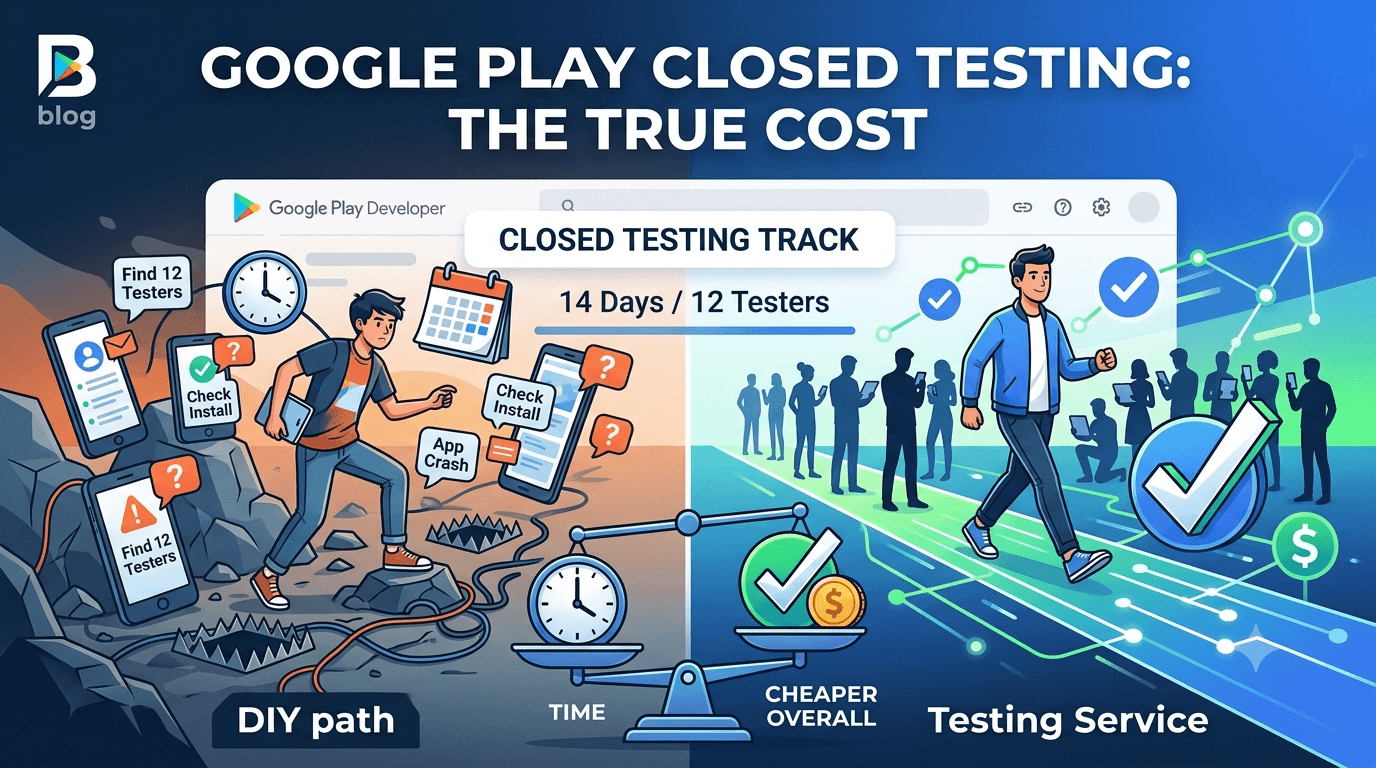
Before you choose how to run your closed test, it helps to understand what it actually costs — not just in money, but in time. The question "how much does Google Play closed testing cost?" has two answers: the direct price of a testing service, and the hidden cost of doing it yourself. This guide breaks down both so you can budget realistically.
Contents
Quick answer
Featured answer: Google itself charges only a one-time developer registration fee; closed testing has no separate Google fee. The real cost is getting 12 testers for 14 days — either the significant time and effort of recruiting them yourself, or a one-time service fee that is typically modest compared to the hours DIY consumes.
What Google charges
Google's only mandatory cost is the one-time developer account registration fee. Creating a closed testing track, adding testers, and running the 14-day window cost nothing extra from Google. So when people ask about the "cost" of closed testing, they are really asking about the cost of obtaining testers — which Google does not provide.
The cost of doing it yourself
DIY testing looks free, but it carries a real, often underestimated cost:
- Your time: Hours spent posting in communities, swapping tests, and chasing installs.
- Reciprocation: Many free channels require you to test others' apps in return.
- Delays: Slow recruitment pushes back your launch, which has its own opportunity cost.
- Dropout risk: Testers who quit mid-window can reset your progress, costing more time.
For many developers, the hours spent recruiting and babysitting testers are worth more than the fee a service charges. See the detailed math in recruitment cost analysis.
The cost of a testing service
A closed testing service charges a one-time fee, usually per testing cycle, in exchange for real testers assigned quickly and retained for the full window. The value is not just the testers but the certainty: a predictable launch date, no reciprocation, managed dropouts, and feedback. See current pricing for specifics.
Tip: Think in terms of total cost, not just cash. A modest fee that saves days of effort and protects your launch date is often the cheaper option overall. Submit your app to see how fast it can be.
Cost comparison
| Approach | Cash cost | Time cost | Reliability |
|---|---|---|---|
| DIY (communities) | Free | High | Variable |
| Friends and family | Free | Medium | Low (often too few) |
| Testing service | One-time fee | Low | High |
Key takeaways
- Google charges only a one-time developer registration fee.
- Closed testing itself has no separate Google cost.
- DIY is "free" but costs significant time and carries delay risk.
- A service charges a one-time fee for speed and reliability.
- Compare total cost — time plus money — not just cash.
Budgeting realistically
When you budget for a launch, it is tempting to record closed testing as "free" because Google does not bill you for it. That accounting is misleading. The honest way to budget is to assign a value to your own hours and add the risk of a slipped launch. If recruiting and managing twelve testers realistically costs you, say, eight to fifteen hours of focused effort spread across two weeks, put a number on those hours at whatever your time is worth. Then add the cost of any delay — a launch that slips a week can mean a week of lost downloads, revenue, or momentum.
Set against that, a one-time service fee is usually small. The point is not that DIY is bad or that a service is always right; it is that a fair budget compares total cost to total cost. Once you account for time and delay honestly, the "free" option is rarely as cheap as it looks, and the paid option is rarely as expensive.
Breaking down the real cost of closed testing
The question "how much does closed testing cost?" has two answers, and confusing them leads to bad decisions. The direct cost from Google is simple: beyond the one-time $25 developer registration fee, Google charges nothing for running a closed test. But the direct cost is rarely the real cost. The true expense of satisfying the 14-day, 12-tester requirement is measured in your time, your launch timeline, and the risk of a failed or delayed test — costs that do not appear on any invoice but are very real.
Thinking clearly about cost means accounting for all three: the small fixed Google fee, the value of the hours you spend recruiting and managing testers if you do it yourself, and the opportunity cost of any delay to your launch. When you add these up, the "free" DIY route is often more expensive than it looks, while a paid service that seems like an added cost can actually be the cheaper option overall once your time and timeline are priced in.
The hidden cost of doing it yourself
Doing closed testing yourself is free in cash but expensive in the things that matter to a launching developer. First, there is the recruitment effort: finding 12+ people with varied Android devices who will genuinely install your app and stay opted in for two weeks can take days of asking, posting, and following up. Second, there is the management overhead: reminding testers to stay active, replacing those who drop off, and monitoring the count so it never falls below the threshold and resets your progress.
Third, and most costly, is the risk. If your self-recruited testers fizzle out on day 8, you may have to restart the 14-day clock, pushing your launch back weeks. For anyone with a deadline, an investor update, a marketing plan, or simply the desire to ship, that delay carries a real price. When you honestly value your hours and factor in this delay risk, DIY's true cost frequently exceeds what a reliable service charges.
What a service costs and what you get
| Cost component | DIY | Service |
|---|---|---|
| Cash outlay | $0 (plus $25 Google fee) | Service fee |
| Your time | High (recruit + manage) | Minimal |
| Reliability | Variable | High |
| Delay risk | Significant | Low |
| Device diversity | Whatever you can find | Broad by design |
A closed testing service charges a fee, but in exchange you get verified real testers, reliable engagement across the full window, device diversity, and freedom from managing any of it. The fee is predictable and one-time for the test, which makes budgeting simple. Compared with the uncertain, time-heavy DIY path, many developers find the service is the more economical choice once every cost is counted. You can submit your app to see how quickly the process can start.
How to think about the value
The most useful way to frame the cost is to ask what a smooth, on-time launch is worth to you, and what a two-week delay would cost. For a hobby project with no timeline, free DIY is perfectly reasonable and the effort is part of the fun. For anyone whose launch has stakes — a business, a client deadline, a funding milestone, or momentum you do not want to lose — paying for certainty is often trivially worth it. The service is not just buying testers; it is buying a predictable path to production access.
It also helps to remember that the testers a good service provides do more than satisfy a count. Real, device-diverse testers exercise your app across hardware you do not own, surfacing crashes and issues before the public sees them. So the fee buys both compliance and genuine pre-launch quality assurance — value that a bare-minimum DIY test scraping together the 12 least-engaged testers you could find may not deliver. See is buying testers worth it for more.
Key takeaways
- Google charges nothing for closed testing beyond the one-time $25 registration fee.
- The real cost is time, timeline, and risk, not cash.
- DIY is free in cash but expensive in hours and delay risk.
- A service fee buys reliability, device diversity, and a predictable launch.
- Frame cost against what an on-time launch is worth to you.
Common cost mistakes developers make
Developers routinely miscalculate the cost of closed testing in ways that lead to worse outcomes. The most common mistake is treating cash as the only cost and defaulting to "free" DIY without valuing their own time — then spending fifteen or twenty hours over two weeks recruiting and chasing testers, time that was worth far more than a service fee. The second mistake is ignoring delay risk: a DIY test that fizzles and resets can push a launch back weeks, and for anyone with a deadline that delay carries a cost that dwarfs any fee.
A third, dangerous mistake is chasing the cheapest possible "testers" — offers of bulk installs for a few dollars. These are almost always bots or incentivized fake accounts that Google detects and discounts, so you pay money, gain nothing toward the requirement, and may even flag your account for suspicious activity. The lesson is that the cheapest option in cash is frequently the most expensive in outcome. Cost should be judged on total value, not headline price.
Budgeting for your launch realistically
| Line item | Typical cost |
|---|---|
| Google developer registration | One-time $25 |
| Closed testing (Google) | $0 |
| DIY testers | $0 cash + significant time |
| Testing service | Predictable one-time fee |
When you budget for launch, account for the whole picture rather than just the Google fee. The registration is a trivial one-time cost, and Google adds nothing for the test itself. Your real decision is how to source testers, and here the honest comparison is DIY's hidden time-and-risk cost versus a service's predictable fee. Budgeting realistically means putting a value on your hours and on your launch date, then choosing the option that minimizes total cost — which for many developers with any timeline is the service.
Cost versus value at launch
Ultimately, the cost of closed testing should be weighed against the value of getting to launch smoothly and on time. An app represents weeks or months of work, and the closed testing requirement is the final gate before that work can start earning attention, users, or revenue. Viewed against that investment, the marginal cost of ensuring the gate is cleared reliably and quickly is small. Skimping here to save a modest fee, only to lose two weeks to a failed DIY test, is a poor trade for most people.
This does not mean everyone should pay — for a hobby project with no timeline, free DIY is entirely sensible and the effort is part of the journey. But for anyone whose launch has stakes, the right question is not "what is the cheapest way?" but "what is the most reliable way to protect my timeline?" Framed that way, paying for certainty often turns out to be the economical choice. You can submit your app to see the process in action.
Frequently asked questions
Does Google charge for closed testing?
No. Beyond the one-time developer registration fee, closed testing has no separate Google cost.
So why would I pay for closed testing at all?
You are not paying Google — you are optionally paying a service to supply real, engaged testers so you avoid the time and risk of recruiting a dozen of them yourself. The value is speed and certainty, not access to the test itself.
Is DIY testing really free?
In cash, yes, but it costs substantial time and risks launch delays.
How much does a testing service cost?
Usually a one-time fee per cycle — see pricing.
Why pay when I can recruit for free?
To save time, avoid reciprocation, protect your launch date, and eliminate dropout risk.
Is a service worth it for one app?
Often yes, if your time is valuable or your timeline matters.
Are there recurring costs?
Google's fee is one-time; service fees are typically per testing cycle.
Conclusion
The true cost of closed testing is measured in both money and time. Google's fees are minimal; the expense is getting and keeping 12 testers. Weigh the hidden time cost of DIY against the modest, predictable fee of a service. If your time and launch date matter, the choice is clear — submit your app today.
Expanded for topical authority — additional practical sections below. Original guide content above is unchanged.
Real-world scenarios: who this matters for
The guidance in this article on How Much Does Google Play Closed Testing Cost? applies across many Android product types. Use these scenarios to map the advice to your situation.
| Developer type | Typical challenge | Practical focus |
|---|---|---|
| Indie / solo | Limited tester network and time | Start closed testing early; keep a buffer above 12 opted-in testers; parallelize listing + Data safety work |
| Startup | Launch deadline vs 14-day rule | Treat the window as fixed; recruit in parallel with QA; avoid last-minute track setup |
| Agency / white-label | Multiple client apps, each needing its own test | One closed test per app; standardize opt-in onboarding; track eligibility dates per client |
| Flutter / React Native | Cross-platform build + Play Console quirks | Ship a signed AAB to closed testing; verify installs from Play, not sideload; watch vitals on mid-range devices |
| Native Kotlin | Device/API fragmentation | Cover API levels and OEMs in your tester mix; fix crashes before requesting production |
| Game / Unity | Performance + retention during 14 days | Keep testers engaged so count never dips below 12; monitor ANRs and battery |
| E-commerce / fintech | Policy + payment flows | Test checkout, permissions, and declarations carefully before production access |
| Healthcare / kids / education | Sensitive policies (Families, data) | Align listing, privacy, and content rating with real app behavior during the test window |
Visual placeholder: Scenario matrix infographic — Indie / Startup / Agency / Cross-platform paths for How Much Does Google Play Closed Testing Cost?.
Comparison: DIY recruitment vs managed closed testing
When your goal is Google Play production access, the path you choose for testers affects time, risk, and feedback quality. Use this comparison while deciding how to apply How Much Does Google Play Closed Testing Cost?.
| Approach | Time to 12 opted-in | Cost | Dropout risk | Feedback quality | Best when |
|---|---|---|---|---|---|
| Friends & family | Days–weeks | $0 | High | Mixed | Tiny MVP, flexible timeline |
| Reddit / Discord / Telegram | Unpredictable | $0–low | High | Variable | You can manage onboarding daily |
| Peer community exchange | Variable | $0 | Medium | Developer-biased | You can test others’ apps in return |
| Managed closed testing (e.g. Fast Testers) | ~1 hour after valid link | $15 one-time / app | Low (buffer of 15) | Real Play installs | You need speed + continuity for 14 days |
Decision tip: If a broken streak would delay revenue or a client deadline, prioritize reliability over $0 recruitment. DIY is fine when you already have engaged testers and can monitor Play Console daily.
Visual placeholder: Comparison diagram — DIY vs community vs managed testing for How Much Does Google Play Closed Testing Cost?.
Common mistakes (and how to avoid them)
These mistakes repeatedly show up when developers work through How Much Does Google Play Closed Testing Cost?:
- Confusing invited vs opted-in testers — Only testers who open the opt-in link and install from Play count toward 12. Check the opted-in number in Play Console, not your email list.
- Recruiting exactly 12 with no buffer — One uninstall can break continuity. Aim for ~15 active opted-in testers.
- Starting the counted clock late — Listing assets, Data safety, and privacy work should run during the 14 days, not after.
- Using sideloaded APKs or fake installs — They do not satisfy Play’s closed testing expectations and can create account risk.
- Ignoring tester feedback until day 14 — Crashes that drive uninstalls threaten your streak and your review outcome.
- Requesting production access before the continuous streak completes — Eligibility checks fail even if calendar time has passed.
Troubleshooting checklist
If something feels “stuck” while applying How Much Does Google Play Closed Testing Cost?, walk this list before changing strategy:
| Symptom | Likely cause | Fix |
|---|---|---|
| Console shows < 12 testers | Invites sent but not opted in | Resend opt-in link; confirm install from Play |
| “Not eligible” after 14 calendar days | Count dipped below 12 mid-window | Restore 12+ and complete a full continuous streak |
| Tester cannot join | Wrong account, Group lag, or track not published | Verify Google account, Group membership, track release |
| App fails to install | Device/API mismatch or signing issue | Check AAB, minSDK, Play App Signing |
| Production still rejected after testing | Policy, declarations, or stability — not the clock | Read the exact reason; fix that category completely |
Visual placeholder: Troubleshooting flowchart for How Much Does Google Play Closed Testing Cost?.
Action checklist
Use this checklist alongside the rest of this guide on How Much Does Google Play Closed Testing Cost?:
- ☐ Closed testing track created with a signed release (AAB)
- ☐ Opt-in link tested on a fresh Google account
- ☐ At least 12 testers opted in (prefer ~15)
- ☐ Daily check that opted-in count stays ≥ 12 for 14 continuous days
- ☐ Core flows exercised (login, main feature, permissions, offline/online)
- ☐ Crashes / ANRs triaged from tester reports and vitals
- ☐ Store listing, screenshots, and feature graphic drafted
- ☐ Privacy policy + Data safety + content rating aligned with real behavior
- ☐ Production access requested only after eligibility is green
- ☐ Staged rollout plan ready for first public release
Additional FAQs developers ask about How Much Does Google Play Closed Testing Cost?
Quick answer: what should I do first?
Confirm you are on a closed testing track with real opted-in installs, keep 12+ testers for 14 continuous days, and fix policy/stability issues in parallel. Then use the detailed sections above for How Much Does Google Play Closed Testing Cost?.
Does this apply to organization (company) accounts?
The classic 12×14 closed testing gate is primarily associated with new personal developer accounts. Always verify your account type and current Play Console eligibility messaging for your app.
Do friends and family count as testers?
Yes — if they opt in via your closed testing link and install from Google Play. They only help if they stay opted in for the continuous period.
Can I update the app during the 14 days?
You can usually push updates on the closed track, but unstable releases that cause uninstalls can threaten your tester count. Prefer polishing via internal testing first when possible.
What if production access is still rejected?
Read the exact reason. Incomplete testing is only one category — policy, Data safety mismatches, and crashes are common. Fix the cited issue fully before reapplying.
Is paying for testers allowed?
Using real people who install from Play is what matters. Avoid fake install farms. A one-time managed service that supplies real closed testers is a practical option when DIY recruitment is too slow.
How is Fast Testers different from free communities?
Free communities trade time and mutual availability. Fast Testers assigns about 15 real testers after you submit a valid closed testing link (one-time $15 per app) and includes a production access guarantee under its refund terms.
Where should I go next?
Review the related guides below, then either finish DIY recruitment or start closed testing if you need speed and continuity.
Sources, updates, and how to use this guide
This article on How Much Does Google Play Closed Testing Cost? is maintained for Android developers preparing Google Play closed testing and production access. Always cross-check eligibility text inside your own Play Console, because Google’s UI labels and account rules can vary by account type and date.
- Primary official references: Google Play closed testing help, Developer Program Policies, and Play Console eligibility messaging for your app.
- Practical experience lens: guidance here reflects common failure modes indie developers and agencies hit when recruiting testers, maintaining the 14-day streak, and recovering from production-access rejections.
- Last reviewed focus: 12×14 closed testing continuity, real vs fake testers, and parallel listing/compliance work during the window.
Related guides and next steps
Continue building topical depth around How Much Does Google Play Closed Testing Cost? with these Fast Testers resources:
- Closed Testing Vs Open Testing On Google Play
- Google Play Internal Testing Vs Closed Testing
- How Long Does Google Play Closed Testing Take
- Common Google Play Closed Testing Mistakes
- Google Play Android Vitals During Closed Testing
- Google Play Closed Testing
- Google Play Closed Testing Dashboard Metrics Explained
- Google Play Closed Testing Email Templates For Testers
- Pricing — $15 closed testing
- How Fast Testers works
- FAQ
- Developer reviews
- Case studies
- Submit your app / start closed testing
Need reliable testers so your 14-day streak does not stall? Educate first with the guides above, then start when you are ready — one-time pricing, real Play installs, dashboard tracking.
Further expansion — case study, decisions, and expert recommendations. Prior sections remain unchanged.
Case study: first Play launch planned around the closed testing window
Problem: A small SaaS team treated Google Play publishing like iOS TestFlight — they expected to upload and go public the same week. They discovered the personal-account closed testing gate mid-sprint.
Solution: They reframed the sprint around How Much Does Google Play Closed Testing Cost?: internal testing for crash triage first, then closed testing with a buffer of testers, while design finished screenshots and legal finished privacy/Data safety in parallel.
Result: The 14-day requirement stopped feeling like “dead time.” When eligibility flipped green, listing and declarations were already ready, so production review was the only remaining gate.
Lessons learned:
- Start the closed track as soon as the build is stable enough to keep installed.
- Parallelize compliance work inside the window.
- Protect the streak like a production SLA.
Decision guide: what should you do next?
Use this decision path when applying How Much Does Google Play Closed Testing Cost?:
- Is your account a new personal developer account that still needs production access?
If yes, plan for closed testing with 12+ opted-in testers for 14 continuous days. If no, still test — but confirm the exact eligibility text in Play Console. - Do you already have 12+ reliable people who will install from Play and stay for two weeks?
If yes, DIY can work — add a buffer and monitor daily. If no, use community exchange or a managed closed testing service. - Is your build stable enough that testers will not churn?
If no, run internal testing first. Entering the counted window with crash loops is how streaks die. - Are Data safety, privacy policy, permissions, and listing aligned with real behavior?
If no, fix during the window so production review does not bounce you after the clock. - Has production access been rejected?
Classify: eligibility vs policy vs declarations vs stability. Fix that category completely, then re-test / re-request.
Visual placeholder: Decision tree diagram for How Much Does Google Play Closed Testing Cost? (DIY vs managed vs fix-and-retry).
Expert recommendations
- Instrument the streak: Check opted-in count daily for the first week; replace dropouts same day.
- Brief testers once: Send a short checklist (install from Play, open app daily, try core flow, report crashes). Silent testers still count if opted in — engaged testers protect quality.
- Never “solve” recruitment with fake installs: It fails the intent of closed testing and can create account risk.
- Ship a boring-stable build to closed testing: Save experimental features for internal tracks.
- Educate first, then accelerate: If your blocker is simply finding real testers fast, a one-time managed option (Fast Testers: 15 testers, $15/app) is often cheaper than slipping a launch.
For hands-on setup after reading about How Much Does Google Play Closed Testing Cost?, see how it works and pricing, or submit your closed testing link when you are ready.
Internal navigation hub — added to strengthen topical connections. Original article content above is unchanged.
Topic cluster: Testing Services & Comparisons
Pillar guide: Start with Google Play Closed Testing Service: What It Is and How It Works for the full overview, then use the supporting guides below.
- Google Play Closed Testing Service: What It Is and How It Works (pillar)
- Google Play Testing Service vs DIY: Which Should You Choose?
- How to Choose a Google Play Testing Service
- Is Buying Google Play Testers Worth It?
- FastTesters vs Reddit Testers: Which Is Better?
- FastTesters vs Telegram Communities for Testing
- FastTesters vs Facebook Groups for App Testing
- Why Professional Testers Improve Production Approval Chances
Continue learning
- Closed Testing vs Open Testing on Google Play — Learn about testing track differences for Google Play closed testing. Complete guide for Android developers pu.
- Google Play Closed Testing Service: What It Is and How It Works — What a Google Play closed testing service does, how it works, what to expect, and how it helps you get 12 real.
- Agency Guide: Testing Client Apps on Google Play — Learn about agency multi-app testing for Google Play closed testing. Complete guide for Android developers pub.
- Fitness Apps and Google Play Beta Testing Rules — Learn about health app testing for Google Play closed testing. Complete guide for Android developers publishin.
- Google Play Testing for Startups on a Deadline — Google Play testing for startups on a deadline: how to meet the 12-tester, 14-day requirement without derailin.
- Google Play Testing Service vs DIY: Which Should You Choose? — Google Play testing service vs DIY: compare time, cost, reliability, and outcomes of recruiting your own teste.
Next steps
- Ready to run closed testing with real Android testers? Submit your app or see pricing ($15 one-time).
- Compare options on our testing service comparison page, or read developer reviews and case studies.
- Still deciding? Review how Fast Testers works and the FAQ.