
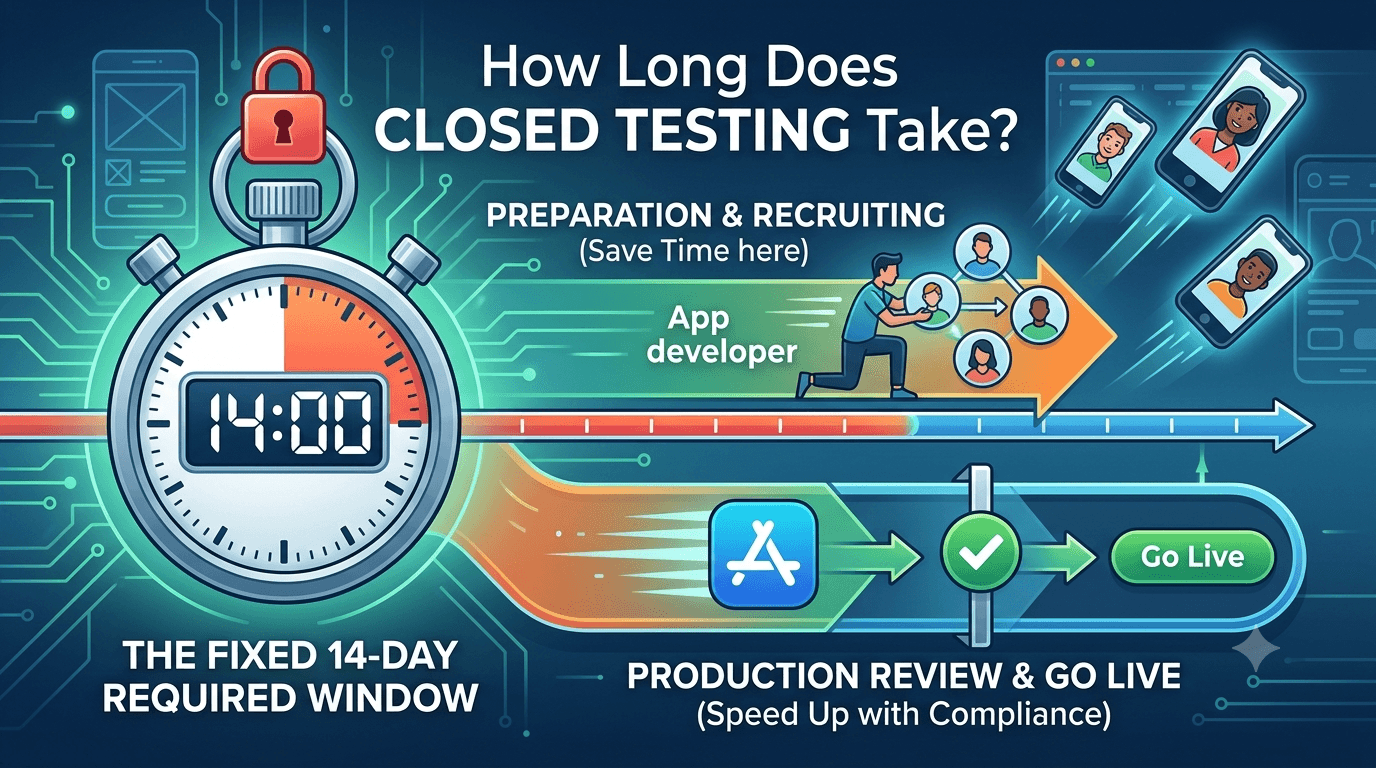
"How long does closed testing take?" is one of the first questions new Android developers ask, usually because they have a launch date in mind and just discovered a mandatory testing period standing in the way. The honest answer has a fixed part and a variable part, and understanding both lets you plan your launch with confidence instead of anxiety.
The fixed part is the 14-day continuous testing window required for production access on personal developer accounts. The variable part is everything around it: how long you take to prepare, start the clock, and get through Google's production review afterward. This article breaks down the full timeline so you know exactly what to expect.
The fixed 14-day requirement
To qualify for production access on a new personal account, you must run a closed test with at least 12 testers opted in for 14 consecutive days. This 14-day period is set by Google and cannot be shortened, sped up, or skipped — no service or trick can compress it, and anyone claiming otherwise is misrepresenting the rule. It is the immovable core of your timeline.
Because it is fixed, the 14 days should be treated as a known constant you plan around rather than a variable you can optimize. The good news is that its predictability makes the whole process plannable: 14 days is always 14 days. Every other part of the timeline is where speed is either gained or lost.
Time before the clock starts
This is where developers lose the most time without realizing it. Before the 14-day window can even begin, you need a stable build uploaded to a closed testing track and a group of testers ready to opt in. Developers who start recruiting testers only after their build is ready often burn a week or more just assembling 12 committed people — and that week adds directly to their timeline.
The fast approach is to have both ready simultaneously: a testable build and a full roster of testers who opt in on day one. This is exactly where a testing service helps, since it removes the recruitment delay entirely. You can submit your app and have real testers begin quickly. For setup, see how to create a closed testing track.
What happens during the 14 days
During the window, your testers keep the app installed and opted in, ideally using it and reporting issues. Your job is to keep the count above 12, fix any serious bugs, and — crucially — prepare everything else for launch in parallel. The 14 days run on their own, so treat them as a background process while you finish your store listing, screenshots, Data Safety declarations, and production build.
| Phase | Typical duration |
|---|---|
| Preparation + recruiting | 0–7 days (0 with a service) |
| Closed testing (fixed) | 14 days |
| Production review | ~1–7 days |
| Total (well-prepared) | ~2–3 weeks |
If your test runs cleanly without dropping below 12 testers, you reach the end of 14 days ready to apply. If testers disengage and your count lapses, you can lose days or have to restart — the single biggest cause of delay.
Time after testing: production review
Once the 14 days are complete, you apply for production access and Google reviews your app. Review time varies but is typically a few days for a compliant app, though it can stretch longer if your app triggers deeper policy checks or requests sensitive permissions. A clean, policy-compliant app with accurate declarations moves fastest. To reduce review risk, read why Google rejects production access and review the official Play developer policies.
Note that production access approval is separate from your app passing review. Completing the test qualifies you to apply; approval still depends on your app meeting Google's policies. Prepare both in parallel and you avoid a late surprise.
What slows the timeline down
Three things cause almost all delays. Starting late — recruiting testers after the build is ready — adds days before the clock even starts. Resets — falling below 12 opted-in testers — can force you to lose progress. And rejections — applying with a non-compliant app or inaccurate declarations — send you back to fix issues and reapply. Eliminate these and your timeline is essentially the fixed 14 days plus a short review.
To avoid resets, recruit a buffer above 12 and use committed testers. To avoid rejections, make sure your app is compliant and your listing complete before you apply. For deadline-driven planning, see testing on a deadline and the fastest way to production access.
Key takeaways
- The 14-day testing window is fixed and cannot be shortened.
- Well-prepared developers reach production in ~2–3 weeks total.
- Most delays come from starting late or letting testers drop below 12.
- Production review adds a few days for a compliant app.
- Prepare everything in parallel so you apply the moment testing ends.
A worked example timeline
To make the timeline concrete, consider a well-prepared indie developer named Sam. Sam finishes a stable build on a Monday. Because Sam lined up testers in advance, the closed test starts that same day with 18 testers opted in — a comfortable buffer above the minimum of 12. The 14-day clock begins immediately at full strength, and Sam spends the next two weeks not idle but finishing the store listing, capturing screenshots, completing the Data Safety form, and preparing the production build in parallel.
Fourteen days later, the window completes cleanly because the buffer absorbed the two testers who drifted away. Sam applies for production access the same day, everything already prepared, and Google's review approves the app a few days later. Total elapsed time from finished build to live app: roughly 18 days. Now contrast that with a developer who starts recruiting only after the build is ready, loses a week finding testers, suffers a reset when the count dips to 11, and applies with an incomplete listing that triggers back-and-forth. That developer can easily take six weeks or more for the exact same app.
Focus on what you can control
Since the 14 days are immovable, your entire influence over the timeline lives in two levers: how early you start the clock, and whether the window runs without resetting. Everything else is noise. Starting early means having both a testable build and a full tester roster ready on the same day, so no time is wasted recruiting after the fact. Running cleanly means recruiting a buffer above 12 and using committed testers who will not vanish, so the count never dips below the minimum.
| Lever | How to maximize it |
|---|---|
| Start the clock early | Have build + testers ready day one |
| Avoid resets | Recruit a buffer; use committed testers |
| Skip preparation delay | Do listing/declarations in parallel |
| Avoid rejection | Ensure compliance before applying |
Master these levers and the "how long does it take" question has a satisfying answer: about as long as the fixed window plus a short review. Everything that stretches the timeline beyond that is avoidable.
Planning around a deadline
If you have a specific launch date — an event, an investor update, a marketing push — plan backward from it. Count back the 14-day window plus a few days for production review and a small buffer for any fixes, and mark that as your hard date to start closed testing. Treat this start date as immovable, because slipping it slips your entire launch. Everything needed to start the clock (a stable build and a ready tester roster) must be complete by then.
The most reliable way to protect a deadline is to remove the least controllable variable: the testers. Self-recruited volunteers are unpredictable, but a service delivers a committed, buffered roster ready to start immediately, converting the riskiest part of the timeline into a fixed input. You can submit your app to start the clock today, and see testing on a deadline for the full playbook.
Myths about the closed testing timeline
Because the 14-day wait frustrates developers, a number of myths circulate about beating it, and believing them costs you time and money. Clearing them up saves you from chasing dead ends.
Myth 1: A service can shorten the 14 days. No legitimate service can. The window is a fixed Google requirement, and any provider claiming to compress it is misrepresenting how the rule works. What a good service actually shortens is the time before the clock starts, by supplying testers immediately.
Myth 2: More testers finish the window faster. Adding testers beyond the minimum improves reliability and device coverage, but the duration is fixed at 14 days regardless of whether you have 12 testers or 50. Recruiting extra is about safety, not speed.
Myth 3: You can pay to skip testing. There is no legitimate way to bypass the requirement on a personal account. Offers of cheap bulk "installs" to shortcut it are fake or install-farm activity that Google detects and discounts, and using them can put your account at risk while achieving nothing.
| Myth | Reality |
|---|---|
| "Shorten the 14 days" | Impossible; it's fixed |
| "More testers = faster" | No; only improves reliability |
| "Pay to skip testing" | No legitimate way; risky |
The honest reality is that real speed comes only from starting the fixed window early, running it without resets, and preparing everything else in parallel. There is no magic shortcut through the 14 days themselves — but there is a great deal you can do to ensure they are the only wait. For the full playbook, see the fastest way to production access.
Understanding every phase of the journey in depth
To truly master your timeline, it helps to walk through each phase in detail and understand not just how long it takes but why, because that understanding is what lets you compress the parts that are compressible. The journey has four distinct phases — preparation, the fixed testing window, the production review, and the go-live moment — and each behaves differently. Preparation is entirely within your control and is where disorganized developers lose the most time; the testing window is fixed and immovable; the review is largely out of your hands but heavily influenced by how compliant your app is; and going live is instantaneous once approved. Treating all four as if they behave the same is a common planning error that leads to wildly inaccurate expectations and missed launch dates.
The preparation phase deserves the most scrutiny because it is where "how long does it take" quietly balloons. A developer who finishes their build and only then starts thinking about testers, store assets, and declarations can easily spend one to two weeks in limbo before the 14-day clock even begins. Every one of those days is avoidable. By contrast, a developer who prepares their testers and store materials in advance can start the fixed window the same day their build is ready, effectively eliminating the preparation phase from their critical path. This is the single biggest difference between a two-week timeline and a six-week one, and it costs nothing but foresight.
The testing window itself is the one phase you cannot compress, so the goal here is not speed but cleanliness. A window that runs without dropping below 12 testers completes in exactly 14 days; a window that stumbles — testers disengaging, the count sagging, a reset — can stretch to double that or worse. Everything you do to make this phase reliable, from recruiting a buffer to using committed testers, protects your timeline far more effectively than any imagined shortcut. Reliability, not haste, is the lever here.
The production review phase is where compliance pays off. A clean, policy-compliant app with accurate declarations typically clears review in a few days, while an app that triggers deeper scrutiny — sensitive permissions, sensitive categories, or mismatched declarations — can wait considerably longer or bounce back for fixes. You influence this phase not during it but before it, by getting compliance right in advance. This is why preparing your declarations and reviewing policies during the fixed window is so valuable: it shortens the phase that comes after. Finally, going live is instantaneous once approved, provided everything else is ready to publish — which, again, rewards parallel preparation.
When you internalize how these four phases behave, the fastest realistic timeline becomes obvious and achievable: eliminate the preparation phase by preparing in advance, keep the fixed window clean with a buffered, committed tester group, and minimize the review phase by being genuinely compliant. Do all three and your total time collapses to roughly the fixed 14 days plus a short review — about two to three weeks. Ignore them and the same app can take well over a month. The timeline, in other words, is mostly determined by your process, not by Google.
If the tester side is the part you are least confident about controlling, that is precisely the variable a service is designed to remove. By supplying a committed, buffered, device-diverse roster ready to opt in immediately, it eliminates the preparation delay on the tester front and dramatically reduces reset risk during the window. You can submit your app to start the fixed clock today, and pair that with your own parallel preparation of listing and compliance for the genuinely fastest path. For a deadline-specific version of this plan, see testing on a deadline.
Frequently asked questions
Can I make the 14 days shorter?
No. The window is fixed by Google. You can only start it sooner and run it cleanly.
How long is Google's production review?
Usually a few days for a compliant app, but it can take longer if deeper policy checks apply.
Does adding more testers speed it up?
No. Extra testers improve reliability and coverage but do not shorten the fixed 14 days.
What is the fastest realistic total time?
About two to three weeks if your build and testers are ready on day one and your app is compliant.
Expanded for topical authority — additional practical sections below. Original guide content above is unchanged.
Quick answer
How Long Does Google Play Closed Testing Take? matters because Google Play production access for many new personal developer accounts depends on a successful closed test: at least 12 real testers opted in for 14 continuous days, plus a policy-compliant, stable app. Use this guide to execute the steps correctly, avoid streak-breaking mistakes, and decide whether DIY recruitment or a managed closed testing service is the better path for your deadline.
Real-world scenarios: who this matters for
The guidance in this article on How Long Does Google Play Closed Testing Take? applies across many Android product types. Use these scenarios to map the advice to your situation.
| Developer type | Typical challenge | Practical focus |
|---|---|---|
| Indie / solo | Limited tester network and time | Start closed testing early; keep a buffer above 12 opted-in testers; parallelize listing + Data safety work |
| Startup | Launch deadline vs 14-day rule | Treat the window as fixed; recruit in parallel with QA; avoid last-minute track setup |
| Agency / white-label | Multiple client apps, each needing its own test | One closed test per app; standardize opt-in onboarding; track eligibility dates per client |
| Flutter / React Native | Cross-platform build + Play Console quirks | Ship a signed AAB to closed testing; verify installs from Play, not sideload; watch vitals on mid-range devices |
| Native Kotlin | Device/API fragmentation | Cover API levels and OEMs in your tester mix; fix crashes before requesting production |
| Game / Unity | Performance + retention during 14 days | Keep testers engaged so count never dips below 12; monitor ANRs and battery |
| E-commerce / fintech | Policy + payment flows | Test checkout, permissions, and declarations carefully before production access |
| Healthcare / kids / education | Sensitive policies (Families, data) | Align listing, privacy, and content rating with real app behavior during the test window |
Visual placeholder: Scenario matrix infographic — Indie / Startup / Agency / Cross-platform paths for How Long Does Google Play Closed Testing Take?.
Comparison: DIY recruitment vs managed closed testing
When your goal is Google Play production access, the path you choose for testers affects time, risk, and feedback quality. Use this comparison while deciding how to apply How Long Does Google Play Closed Testing Take?.
| Approach | Time to 12 opted-in | Cost | Dropout risk | Feedback quality | Best when |
|---|---|---|---|---|---|
| Friends & family | Days–weeks | $0 | High | Mixed | Tiny MVP, flexible timeline |
| Reddit / Discord / Telegram | Unpredictable | $0–low | High | Variable | You can manage onboarding daily |
| Peer community exchange | Variable | $0 | Medium | Developer-biased | You can test others’ apps in return |
| Managed closed testing (e.g. Fast Testers) | ~1 hour after valid link | $15 one-time / app | Low (buffer of 15) | Real Play installs | You need speed + continuity for 14 days |
Decision tip: If a broken streak would delay revenue or a client deadline, prioritize reliability over $0 recruitment. DIY is fine when you already have engaged testers and can monitor Play Console daily.
Visual placeholder: Comparison diagram — DIY vs community vs managed testing for How Long Does Google Play Closed Testing Take?.
Common mistakes (and how to avoid them)
These mistakes repeatedly show up when developers work through How Long Does Google Play Closed Testing Take?:
- Confusing invited vs opted-in testers — Only testers who open the opt-in link and install from Play count toward 12. Check the opted-in number in Play Console, not your email list.
- Recruiting exactly 12 with no buffer — One uninstall can break continuity. Aim for ~15 active opted-in testers.
- Starting the counted clock late — Listing assets, Data safety, and privacy work should run during the 14 days, not after.
- Using sideloaded APKs or fake installs — They do not satisfy Play’s closed testing expectations and can create account risk.
- Ignoring tester feedback until day 14 — Crashes that drive uninstalls threaten your streak and your review outcome.
- Requesting production access before the continuous streak completes — Eligibility checks fail even if calendar time has passed.
Troubleshooting checklist
If something feels “stuck” while applying How Long Does Google Play Closed Testing Take?, walk this list before changing strategy:
| Symptom | Likely cause | Fix |
|---|---|---|
| Console shows < 12 testers | Invites sent but not opted in | Resend opt-in link; confirm install from Play |
| “Not eligible” after 14 calendar days | Count dipped below 12 mid-window | Restore 12+ and complete a full continuous streak |
| Tester cannot join | Wrong account, Group lag, or track not published | Verify Google account, Group membership, track release |
| App fails to install | Device/API mismatch or signing issue | Check AAB, minSDK, Play App Signing |
| Production still rejected after testing | Policy, declarations, or stability — not the clock | Read the exact reason; fix that category completely |
Visual placeholder: Troubleshooting flowchart for How Long Does Google Play Closed Testing Take?.
Action checklist
Use this checklist alongside the rest of this guide on How Long Does Google Play Closed Testing Take?:
- ☐ Closed testing track created with a signed release (AAB)
- ☐ Opt-in link tested on a fresh Google account
- ☐ At least 12 testers opted in (prefer ~15)
- ☐ Daily check that opted-in count stays ≥ 12 for 14 continuous days
- ☐ Core flows exercised (login, main feature, permissions, offline/online)
- ☐ Crashes / ANRs triaged from tester reports and vitals
- ☐ Store listing, screenshots, and feature graphic drafted
- ☐ Privacy policy + Data safety + content rating aligned with real behavior
- ☐ Production access requested only after eligibility is green
- ☐ Staged rollout plan ready for first public release
Additional FAQs developers ask about How Long Does Google Play Closed Testing Take?
Quick answer: what should I do first?
Confirm you are on a closed testing track with real opted-in installs, keep 12+ testers for 14 continuous days, and fix policy/stability issues in parallel. Then use the detailed sections above for How Long Does Google Play Closed Testing Take?.
Does this apply to organization (company) accounts?
The classic 12×14 closed testing gate is primarily associated with new personal developer accounts. Always verify your account type and current Play Console eligibility messaging for your app.
Do friends and family count as testers?
Yes — if they opt in via your closed testing link and install from Google Play. They only help if they stay opted in for the continuous period.
Can I update the app during the 14 days?
You can usually push updates on the closed track, but unstable releases that cause uninstalls can threaten your tester count. Prefer polishing via internal testing first when possible.
What if production access is still rejected?
Read the exact reason. Incomplete testing is only one category — policy, Data safety mismatches, and crashes are common. Fix the cited issue fully before reapplying.
Is paying for testers allowed?
Using real people who install from Play is what matters. Avoid fake install farms. A one-time managed service that supplies real closed testers is a practical option when DIY recruitment is too slow.
How is Fast Testers different from free communities?
Free communities trade time and mutual availability. Fast Testers assigns about 15 real testers after you submit a valid closed testing link (one-time $15 per app) and includes a production access guarantee under its refund terms.
Where should I go next?
Review the related guides below, then either finish DIY recruitment or start closed testing if you need speed and continuity.
Sources, updates, and how to use this guide
This article on How Long Does Google Play Closed Testing Take? is maintained for Android developers preparing Google Play closed testing and production access. Always cross-check eligibility text inside your own Play Console, because Google’s UI labels and account rules can vary by account type and date.
- Primary official references: Google Play closed testing help, Developer Program Policies, and Play Console eligibility messaging for your app.
- Practical experience lens: guidance here reflects common failure modes indie developers and agencies hit when recruiting testers, maintaining the 14-day streak, and recovering from production-access rejections.
- Last reviewed focus: 12×14 closed testing continuity, real vs fake testers, and parallel listing/compliance work during the window.
Related guides and next steps
Continue building topical depth around How Long Does Google Play Closed Testing Take? with these Fast Testers resources:
- Closed Testing Vs Open Testing On Google Play
- Google Play Internal Testing Vs Closed Testing
- How Much Does Google Play Closed Testing Cost
- Common Google Play Closed Testing Mistakes
- Google Play Android Vitals During Closed Testing
- Google Play Closed Testing
- Google Play Closed Testing Dashboard Metrics Explained
- Google Play Closed Testing Email Templates For Testers
- Pricing — $15 closed testing
- How Fast Testers works
- FAQ
- Developer reviews
- Case studies
- Submit your app / start closed testing
Need reliable testers so your 14-day streak does not stall? Educate first with the guides above, then start when you are ready — one-time pricing, real Play installs, dashboard tracking.
Further expansion — case study, decisions, and expert recommendations. Prior sections remain unchanged.
Case study: first Play launch planned around the closed testing window
Problem: A small SaaS team treated Google Play publishing like iOS TestFlight — they expected to upload and go public the same week. They discovered the personal-account closed testing gate mid-sprint.
Solution: They reframed the sprint around How Long Does Google Play Closed Testing Take?: internal testing for crash triage first, then closed testing with a buffer of testers, while design finished screenshots and legal finished privacy/Data safety in parallel.
Result: The 14-day requirement stopped feeling like “dead time.” When eligibility flipped green, listing and declarations were already ready, so production review was the only remaining gate.
Lessons learned:
- Start the closed track as soon as the build is stable enough to keep installed.
- Parallelize compliance work inside the window.
- Protect the streak like a production SLA.
Decision guide: what should you do next?
Use this decision path when applying How Long Does Google Play Closed Testing Take?:
- Is your account a new personal developer account that still needs production access?
If yes, plan for closed testing with 12+ opted-in testers for 14 continuous days. If no, still test — but confirm the exact eligibility text in Play Console. - Do you already have 12+ reliable people who will install from Play and stay for two weeks?
If yes, DIY can work — add a buffer and monitor daily. If no, use community exchange or a managed closed testing service. - Is your build stable enough that testers will not churn?
If no, run internal testing first. Entering the counted window with crash loops is how streaks die. - Are Data safety, privacy policy, permissions, and listing aligned with real behavior?
If no, fix during the window so production review does not bounce you after the clock. - Has production access been rejected?
Classify: eligibility vs policy vs declarations vs stability. Fix that category completely, then re-test / re-request.
Visual placeholder: Decision tree diagram for How Long Does Google Play Closed Testing Take? (DIY vs managed vs fix-and-retry).
Expert recommendations
- Instrument the streak: Check opted-in count daily for the first week; replace dropouts same day.
- Brief testers once: Send a short checklist (install from Play, open app daily, try core flow, report crashes). Silent testers still count if opted in — engaged testers protect quality.
- Never “solve” recruitment with fake installs: It fails the intent of closed testing and can create account risk.
- Ship a boring-stable build to closed testing: Save experimental features for internal tracks.
- Educate first, then accelerate: If your blocker is simply finding real testers fast, a one-time managed option (Fast Testers: 15 testers, $15/app) is often cheaper than slipping a launch.
For hands-on setup after reading about How Long Does Google Play Closed Testing Take?, see how it works and pricing, or submit your closed testing link when you are ready.
Internal navigation hub — added to strengthen topical connections. Original article content above is unchanged.
Topic cluster: Google Play Closed Testing
Pillar guide: Start with Google Play Closed Testing Complete Guide for the full overview, then use the supporting guides below.
- Google Play Closed Testing Complete Guide (pillar)
- Google Play Closed Testing Guide: How to Get 12 Testers for 14 Days
- Google Play Closed Testing Requirements in 2026
- How to Create a Closed Testing Track in Play Console
- Google Play Closed Testing Opt-In Link Setup
- Common Google Play Closed Testing Mistakes to Avoid
- How to Pass Google Play Closed Testing on the First Try
- Updating Your App Mid Closed Testing Period
- Google Play Closed Testing FAQ: 50 Answers
- Avoiding Tester Dropout During 14-Day Testing
Continue learning
- Common Google Play Closed Testing Mistakes to Avoid — The most common Google Play closed testing mistakes — wrong track, too few testers, dropouts, sideloading — an.
- Google Play Closed Testing Requirements in 2026 — A complete, up-to-date breakdown of Google Play closed testing requirements in 2026: the 12-tester rule, 14-da.
- How to Pass Google Play Closed Testing on the First Try — A proven, step-by-step playbook to pass Google Play closed testing on the first try: set up the track correctl.
- Google Play Android Vitals During Closed Testing — Learn about vitals monitoring for Google Play closed testing. Complete guide for Android developers publishing.
- Google Play Closed Testing Complete Guide — A comprehensive walkthrough of the entire closed testing process..
- Google Play Closed Testing Dashboard Metrics Explained — Learn about dashboard analytics for Google Play closed testing. Complete guide for Android developers publishi.
Next steps
- Ready to run closed testing with real Android testers? Submit your app or see pricing ($15 one-time).
- Compare options on our testing service comparison page, or read developer reviews and case studies.
- Still deciding? Review how Fast Testers works and the FAQ.