
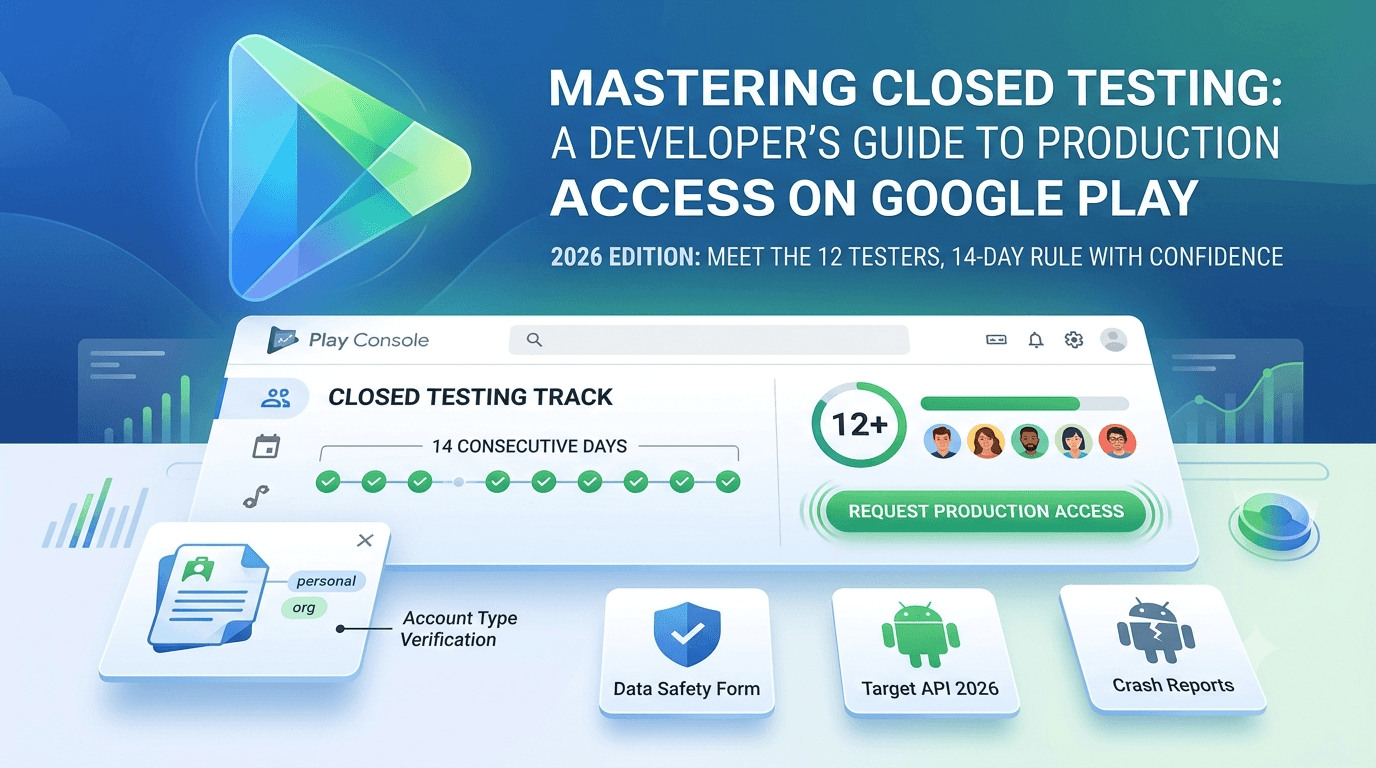
Google Play closed testing requirements continue to shape how new Android developers publish their apps in 2026. If you created a personal Google Play developer account, you must complete a closed test before you can request production access. This guide lays out the current requirements clearly, explains who is affected, and shows you how to comply without wasting weeks.
In this guide
Quick summary of the 2026 requirements
Featured answer: In 2026, new personal Google Play developer accounts must run a closed test with at least 12 testers for 14 consecutive days before applying for production access. Testers must be real people who opt in through Google Play and keep the app installed for the duration. Organization accounts and older accounts may be exempt.
Who must complete closed testing
The requirement primarily targets personal developer accounts created after the policy took effect. Here is a simple breakdown:
| Account type | Closed testing required? |
|---|---|
| New personal account (created recently) | Yes — 12 testers, 14 days |
| Organization account (verified business) | Usually not subject to the 12-tester rule |
| Older personal account (pre-policy) | May be exempt depending on account history |
Not sure which account type is right for you? Compare them in personal account vs organization account.
The full requirement checklist
- Minimum testers: 12 opted-in testers (keep 15+ as a buffer).
- Duration: 14 consecutive days without dropping below the minimum.
- Track: Closed testing — not internal testing.
- Opt-in: Testers must join via your opt-in link or Google Group.
- Install source: The app must be installed from Google Play, not sideloaded.
- Activity: Testers should actually open and use the app during the period.
Important: "14 consecutive days" means the qualifying window must remain unbroken. If your active tester count falls below 12, you can lose progress. Keep extras enrolled.
What counts as a valid tester
Google evaluates whether your testers are genuine. A valid tester is:
- A real person with a genuine Google account.
- Using a real Android device (not an emulator).
- Opted in through your closed testing opt-in link.
- Distinct from you — not another account you control on the same device or network.
Installs from bots, emulators, or install farms are detected and discarded. Learn how detection works in how Google detects fake testers and install farms, and understand the distinction in real testers vs fake testers.
How to meet the requirements step by step
- Set up a closed testing track in Play Console. See how to create a closed testing track.
- Upload your signed app bundle and write clear release notes.
- Create your tester list and opt-in link (a Google Group works well). Guide: opt-in link setup.
- Recruit 12+ real testers. Do it yourself, or assign testers instantly with FastTesters.
- Run the test for 14 consecutive days, monitoring installs in the console.
- Apply for production access once the window completes.
Short on testers? If recruiting 12 reliable testers is the blocker, a professional closed testing service like FastTesters assigns 12+ real, worldwide Android testers within about an hour — fully compatible with Google's policy. See how it works.
Best practices for a clean first pass
- Enroll 15+ testers so dropouts never break the 12 minimum.
- Fix crashes early — check crash reports during closed testing.
- Complete your Data safety form and store listing before applying. See data safety form and closed testing.
- Meet the current target API level: target API level requirements 2026.
- Do not remove testers until production access is granted.
Common mistakes
- Confusing internal testing with closed testing.
- Applying for production before day 14.
- Relying on self-created accounts as testers.
- Ignoring policy issues that block production even after testing completes — see production access rejection reasons.
Why this requirement exists at all
Understanding the reasoning behind the rule makes it far easier to comply with confidence rather than frustration. Google introduced the closed testing requirement to raise the baseline quality of apps on the Play Store and to make automated abuse harder. For years, low-effort, policy-violating, and outright fraudulent apps could be published quickly on freshly created accounts. By forcing new personal accounts to run a genuine 14-day test with real testers, Google adds friction that is trivial for legitimate developers but costly for bad actors operating at scale.
This framing has a practical implication: the system is specifically tuned to reward authenticity. Everything about the requirement — real accounts, real devices, sustained activity over two weeks — is designed to distinguish a real developer with a real app from an automated operation. When you supply genuine testers and a working app, you are exactly what the policy is looking for, and compliance is straightforward. When you try to shortcut it with fake activity, you are precisely what the system was built to catch.
A realistic timeline of the requirement
Planning your launch means understanding how the requirement stretches across a calendar, not just as an abstract "14 days." Here is what a realistic first-launch timeline looks like when nothing goes wrong:
| Phase | Typical duration | What is happening |
|---|---|---|
| Account setup & identity verification | Hours to a few days | Creating the account and passing verification |
| Track setup & tester recruitment | The big variable | Getting 12+ real testers ready |
| Closed testing window | 14 fixed days | Testers keep and use the app |
| Production application & review | Often a few days | Google reviews your request |
The two fixed pieces — verification and the 14-day window — are outside your control. The recruitment phase is entirely within your control, and it is where developers either save or lose weeks. This is why "how do I get testers quickly" is the question that actually determines your launch date.
Should you switch to an organization account?
Because verified organization accounts are often not subject to the 12-tester rule, some developers wonder whether they should simply register as a business to skip closed testing entirely. This is worth considering carefully rather than reflexively. Organization accounts require business verification (such as a D-U-N-S number) and are intended for genuine organizations, so this is not a loophole for individuals. If you are operating as a real business, an organization account may indeed simplify your path and is worth setting up correctly from the start, since changing account type later is limited.
If you are an individual developer, however, the personal account plus closed testing is the normal, expected route — and it is entirely manageable. Do not create a misrepresented business account just to dodge the requirement; the closed test is not difficult once you solve the tester problem. Weigh the options honestly in personal account vs organization account.
Keeping evidence of a compliant test
While Google tracks your testing automatically, it is wise to keep your own record of a clean test in case you ever need to demonstrate compliance or diagnose a rejection. Note when your 14-day window started and ended, roughly how many testers were active throughout, and keep any feedback your testers provided. If a production application is unexpectedly rejected for testing-related reasons, this record helps you quickly determine whether the issue was genuinely your testing signal or something else entirely, such as a policy or data safety problem. Clear self-documentation turns a confusing rejection into a solvable checklist.
Frequently asked questions
Did the requirements change in 2026?
The core rule — 12 testers for 14 consecutive days on a closed track — remains the standard for new personal accounts. Always confirm the latest details in your Play Console, since Google refines policies over time.
Can I skip closed testing?
Not on a new personal account. Closed testing is the gate that unlocks the production application. An organization account may follow a different path.
Do the 14 days need to be back to back?
Yes. The qualifying period is a continuous 14-day window with 12+ active testers throughout.
How many testers should I actually recruit?
At least 12, but plan for 15+ to absorb dropouts. More detail in how many testers do you need.
What happens right after 14 days?
You can request production access; Google reviews and, if compliant, grants it. See what happens after 14 days.
Requirements for special app types
The core 12-tester, 14-day rule applies broadly, but certain categories of apps face additional scrutiny layered on top of it, and knowing this in advance prevents surprises. Apps that handle sensitive data or serve sensitive audiences — finance, health, and children's apps in particular — must satisfy extra policy requirements alongside the standard testing rule. A finance app still needs its 12 testers for 14 days, but it also faces stricter verification and disclosure expectations. A children's app must additionally comply with families policy requirements. Games, subscription apps, and apps requesting sensitive permissions like location or camera each carry their own supplementary obligations.
The practical implication is that closed testing is necessary but not always sufficient for these categories. You should map your app to its category early and confirm what else applies, so you are not blindsided after completing an otherwise clean test. The testing requirement is the universal gate; category-specific policies are the additional gates some apps must pass. Treating them as a combined checklist from the start keeps your launch on schedule.
What changes for updates after launch
A frequent point of confusion is whether the closed testing requirement recurs every time you update your app. For the initial production access on a new personal account, the 12-tester, 14-day test is a one-time gate. Once you have production access, ordinary updates do not each require a fresh 14-day closed test — they go through the normal review process. That said, testing remains valuable for updates as a matter of quality, even when it is not mandatory, because every update reaches your entire installed base and a regression can affect all your users at once.
Many experienced developers therefore keep a lightweight testing habit for significant updates: pushing to a testing track first, letting a handful of testers validate the changes, and then promoting to production. This is optional rather than required, but it protects your ratings and reputation. The key distinction to remember is that the strict requirement is about unlocking initial production access, while post-launch testing is a best practice you adopt for your own benefit.
Regional and device considerations
Because Google Play is global, your closed test benefits from testers who reflect the diversity of your eventual audience. Testers across different countries, network conditions, languages, and device tiers will collectively exercise your app more thoroughly than a homogeneous local group. A budget device on a slow network in one region may reveal performance problems that a flagship phone on fast Wi-Fi never would. If your app targets specific markets, having testers from those regions is especially valuable for catching localization and connectivity issues before launch.
This is one reason worldwide tester coverage is more than a convenience — it materially improves the quality of your test. When you plan your testing, think about who your real users will be and try to have your testers resemble them. A geographically and device-diverse test is not required by the letter of the rule, but it aligns with the spirit of the requirement and produces a more launch-ready app.
Key takeaways
- The core rule: 12 testers, 14 consecutive days, on the closed track, installed from Play.
- Who it hits: new personal accounts; verified organizations are often exempt.
- Only real testers count. Bots, emulators, and self-controlled accounts are discarded.
- Recruitment is the variable. Verification and the 14 days are fixed; getting testers fast is what you control.
- Special categories add rules. Finance, health, and kids apps face extra requirements on top of testing.
Conclusion
The Google Play closed testing requirements in 2026 are straightforward once you know them: 12 real testers, 14 consecutive days, on a closed track, installed from Play. The hard part is logistics — finding and retaining testers. Set up your track correctly, keep a healthy buffer of testers, and fix issues early. If recruiting is your bottleneck, submit your app to a professional service and start your 14-day clock today.
Expanded for topical authority — additional practical sections below. Original guide content above is unchanged.
Quick answer
Google Play Closed Testing Requirements in 2026 matters because Google Play production access for many new personal developer accounts depends on a successful closed test: at least 12 real testers opted in for 14 continuous days, plus a policy-compliant, stable app. Use this guide to execute the steps correctly, avoid streak-breaking mistakes, and decide whether DIY recruitment or a managed closed testing service is the better path for your deadline.
Real-world scenarios: who this matters for
The guidance in this article on Google Play Closed Testing Requirements in 2026 applies across many Android product types. Use these scenarios to map the advice to your situation.
| Developer type | Typical challenge | Practical focus |
|---|---|---|
| Indie / solo | Limited tester network and time | Start closed testing early; keep a buffer above 12 opted-in testers; parallelize listing + Data safety work |
| Startup | Launch deadline vs 14-day rule | Treat the window as fixed; recruit in parallel with QA; avoid last-minute track setup |
| Agency / white-label | Multiple client apps, each needing its own test | One closed test per app; standardize opt-in onboarding; track eligibility dates per client |
| Flutter / React Native | Cross-platform build + Play Console quirks | Ship a signed AAB to closed testing; verify installs from Play, not sideload; watch vitals on mid-range devices |
| Native Kotlin | Device/API fragmentation | Cover API levels and OEMs in your tester mix; fix crashes before requesting production |
| Game / Unity | Performance + retention during 14 days | Keep testers engaged so count never dips below 12; monitor ANRs and battery |
| E-commerce / fintech | Policy + payment flows | Test checkout, permissions, and declarations carefully before production access |
| Healthcare / kids / education | Sensitive policies (Families, data) | Align listing, privacy, and content rating with real app behavior during the test window |
Visual placeholder: Scenario matrix infographic — Indie / Startup / Agency / Cross-platform paths for Google Play Closed Testing Requirements in 2026.
Comparison: DIY recruitment vs managed closed testing
When your goal is Google Play production access, the path you choose for testers affects time, risk, and feedback quality. Use this comparison while deciding how to apply Google Play Closed Testing Requirements in 2026.
| Approach | Time to 12 opted-in | Cost | Dropout risk | Feedback quality | Best when |
|---|---|---|---|---|---|
| Friends & family | Days–weeks | $0 | High | Mixed | Tiny MVP, flexible timeline |
| Reddit / Discord / Telegram | Unpredictable | $0–low | High | Variable | You can manage onboarding daily |
| Peer community exchange | Variable | $0 | Medium | Developer-biased | You can test others’ apps in return |
| Managed closed testing (e.g. Fast Testers) | ~1 hour after valid link | $15 one-time / app | Low (buffer of 15) | Real Play installs | You need speed + continuity for 14 days |
Decision tip: If a broken streak would delay revenue or a client deadline, prioritize reliability over $0 recruitment. DIY is fine when you already have engaged testers and can monitor Play Console daily.
Visual placeholder: Comparison diagram — DIY vs community vs managed testing for Google Play Closed Testing Requirements in 2026.
Common mistakes (and how to avoid them)
These mistakes repeatedly show up when developers work through Google Play Closed Testing Requirements in 2026:
- Confusing invited vs opted-in testers — Only testers who open the opt-in link and install from Play count toward 12. Check the opted-in number in Play Console, not your email list.
- Recruiting exactly 12 with no buffer — One uninstall can break continuity. Aim for ~15 active opted-in testers.
- Starting the counted clock late — Listing assets, Data safety, and privacy work should run during the 14 days, not after.
- Using sideloaded APKs or fake installs — They do not satisfy Play’s closed testing expectations and can create account risk.
- Ignoring tester feedback until day 14 — Crashes that drive uninstalls threaten your streak and your review outcome.
- Requesting production access before the continuous streak completes — Eligibility checks fail even if calendar time has passed.
Troubleshooting checklist
If something feels “stuck” while applying Google Play Closed Testing Requirements in 2026, walk this list before changing strategy:
| Symptom | Likely cause | Fix |
|---|---|---|
| Console shows < 12 testers | Invites sent but not opted in | Resend opt-in link; confirm install from Play |
| “Not eligible” after 14 calendar days | Count dipped below 12 mid-window | Restore 12+ and complete a full continuous streak |
| Tester cannot join | Wrong account, Group lag, or track not published | Verify Google account, Group membership, track release |
| App fails to install | Device/API mismatch or signing issue | Check AAB, minSDK, Play App Signing |
| Production still rejected after testing | Policy, declarations, or stability — not the clock | Read the exact reason; fix that category completely |
Visual placeholder: Troubleshooting flowchart for Google Play Closed Testing Requirements in 2026.
Action checklist
Use this checklist alongside the rest of this guide on Google Play Closed Testing Requirements in 2026:
- ☐ Closed testing track created with a signed release (AAB)
- ☐ Opt-in link tested on a fresh Google account
- ☐ At least 12 testers opted in (prefer ~15)
- ☐ Daily check that opted-in count stays ≥ 12 for 14 continuous days
- ☐ Core flows exercised (login, main feature, permissions, offline/online)
- ☐ Crashes / ANRs triaged from tester reports and vitals
- ☐ Store listing, screenshots, and feature graphic drafted
- ☐ Privacy policy + Data safety + content rating aligned with real behavior
- ☐ Production access requested only after eligibility is green
- ☐ Staged rollout plan ready for first public release
Additional FAQs developers ask about Google Play Closed Testing Requirements in 2026
Quick answer: what should I do first?
Confirm you are on a closed testing track with real opted-in installs, keep 12+ testers for 14 continuous days, and fix policy/stability issues in parallel. Then use the detailed sections above for Google Play Closed Testing Requirements in 2026.
Does this apply to organization (company) accounts?
The classic 12×14 closed testing gate is primarily associated with new personal developer accounts. Always verify your account type and current Play Console eligibility messaging for your app.
Do friends and family count as testers?
Yes — if they opt in via your closed testing link and install from Google Play. They only help if they stay opted in for the continuous period.
Can I update the app during the 14 days?
You can usually push updates on the closed track, but unstable releases that cause uninstalls can threaten your tester count. Prefer polishing via internal testing first when possible.
What if production access is still rejected?
Read the exact reason. Incomplete testing is only one category — policy, Data safety mismatches, and crashes are common. Fix the cited issue fully before reapplying.
Is paying for testers allowed?
Using real people who install from Play is what matters. Avoid fake install farms. A one-time managed service that supplies real closed testers is a practical option when DIY recruitment is too slow.
How is Fast Testers different from free communities?
Free communities trade time and mutual availability. Fast Testers assigns about 15 real testers after you submit a valid closed testing link (one-time $15 per app) and includes a production access guarantee under its refund terms.
Where should I go next?
Review the related guides below, then either finish DIY recruitment or start closed testing if you need speed and continuity.
Sources, updates, and how to use this guide
This article on Google Play Closed Testing Requirements in 2026 is maintained for Android developers preparing Google Play closed testing and production access. Always cross-check eligibility text inside your own Play Console, because Google’s UI labels and account rules can vary by account type and date.
- Primary official references: Google Play closed testing help, Developer Program Policies, and Play Console eligibility messaging for your app.
- Practical experience lens: guidance here reflects common failure modes indie developers and agencies hit when recruiting testers, maintaining the 14-day streak, and recovering from production-access rejections.
- Last reviewed focus: 12×14 closed testing continuity, real vs fake testers, and parallel listing/compliance work during the window.
Related guides and next steps
Continue building topical depth around Google Play Closed Testing Requirements in 2026 with these Fast Testers resources:
- Closed Testing Vs Open Testing On Google Play
- Google Play Internal Testing Vs Closed Testing
- Common Google Play Closed Testing Mistakes
- Google Play Android Vitals During Closed Testing
- Google Play Closed Testing
- Google Play Closed Testing Dashboard Metrics Explained
- Google Play Closed Testing Email Templates For Testers
- Google Play Closed Testing Faq 50 Answers
- Pricing — $15 closed testing
- How Fast Testers works
- FAQ
- Developer reviews
- Case studies
- Submit your app / start closed testing
Need reliable testers so your 14-day streak does not stall? Educate first with the guides above, then start when you are ready — one-time pricing, real Play installs, dashboard tracking.
Further expansion — case study, decisions, and expert recommendations. Prior sections remain unchanged.
Case study: first Play launch planned around the closed testing window
Problem: A small SaaS team treated Google Play publishing like iOS TestFlight — they expected to upload and go public the same week. They discovered the personal-account closed testing gate mid-sprint.
Solution: They reframed the sprint around Google Play Closed Testing Requirements In 2026: internal testing for crash triage first, then closed testing with a buffer of testers, while design finished screenshots and legal finished privacy/Data safety in parallel.
Result: The 14-day requirement stopped feeling like “dead time.” When eligibility flipped green, listing and declarations were already ready, so production review was the only remaining gate.
Lessons learned:
- Start the closed track as soon as the build is stable enough to keep installed.
- Parallelize compliance work inside the window.
- Protect the streak like a production SLA.
Decision guide: what should you do next?
Use this decision path when applying Google Play Closed Testing Requirements In 2026:
- Is your account a new personal developer account that still needs production access?
If yes, plan for closed testing with 12+ opted-in testers for 14 continuous days. If no, still test — but confirm the exact eligibility text in Play Console. - Do you already have 12+ reliable people who will install from Play and stay for two weeks?
If yes, DIY can work — add a buffer and monitor daily. If no, use community exchange or a managed closed testing service. - Is your build stable enough that testers will not churn?
If no, run internal testing first. Entering the counted window with crash loops is how streaks die. - Are Data safety, privacy policy, permissions, and listing aligned with real behavior?
If no, fix during the window so production review does not bounce you after the clock. - Has production access been rejected?
Classify: eligibility vs policy vs declarations vs stability. Fix that category completely, then re-test / re-request.
Visual placeholder: Decision tree diagram for Google Play Closed Testing Requirements In 2026 (DIY vs managed vs fix-and-retry).
Expert recommendations
- Instrument the streak: Check opted-in count daily for the first week; replace dropouts same day.
- Brief testers once: Send a short checklist (install from Play, open app daily, try core flow, report crashes). Silent testers still count if opted in — engaged testers protect quality.
- Never “solve” recruitment with fake installs: It fails the intent of closed testing and can create account risk.
- Ship a boring-stable build to closed testing: Save experimental features for internal tracks.
- Educate first, then accelerate: If your blocker is simply finding real testers fast, a one-time managed option (Fast Testers: 15 testers, $15/app) is often cheaper than slipping a launch.
For hands-on setup after reading about Google Play Closed Testing Requirements In 2026, see how it works and pricing, or submit your closed testing link when you are ready.
Internal navigation hub — added to strengthen topical connections. Original article content above is unchanged.
Topic cluster: Google Play Closed Testing
Pillar guide: Start with Google Play Closed Testing Complete Guide for the full overview, then use the supporting guides below.
- Google Play Closed Testing Complete Guide (pillar)
- Google Play Closed Testing Guide: How to Get 12 Testers for 14 Days
- How to Create a Closed Testing Track in Play Console
- Google Play Closed Testing Opt-In Link Setup
- How Long Does Google Play Closed Testing Take?
- Common Google Play Closed Testing Mistakes to Avoid
- How to Pass Google Play Closed Testing on the First Try
- Updating Your App Mid Closed Testing Period
- Google Play Closed Testing FAQ: 50 Answers
- Avoiding Tester Dropout During 14-Day Testing
Continue learning
- Common Google Play Closed Testing Mistakes to Avoid — The most common Google Play closed testing mistakes — wrong track, too few testers, dropouts, sideloading — an.
- How Long Does Google Play Closed Testing Take? — Learn about testing timelines for Google Play closed testing. Complete guide for Android developers publishing.
- How to Pass Google Play Closed Testing on the First Try — A proven, step-by-step playbook to pass Google Play closed testing on the first try: set up the track correctl.
- Google Play Android Vitals During Closed Testing — Learn about vitals monitoring for Google Play closed testing. Complete guide for Android developers publishing.
- Google Play Closed Testing Complete Guide — A comprehensive walkthrough of the entire closed testing process..
- Google Play Closed Testing Dashboard Metrics Explained — Learn about dashboard analytics for Google Play closed testing. Complete guide for Android developers publishi.
Next steps
- Ready to run closed testing with real Android testers? Submit your app or see pricing ($15 one-time).
- Compare options on our testing service comparison page, or read developer reviews and case studies.
- Still deciding? Review how Fast Testers works and the FAQ.