
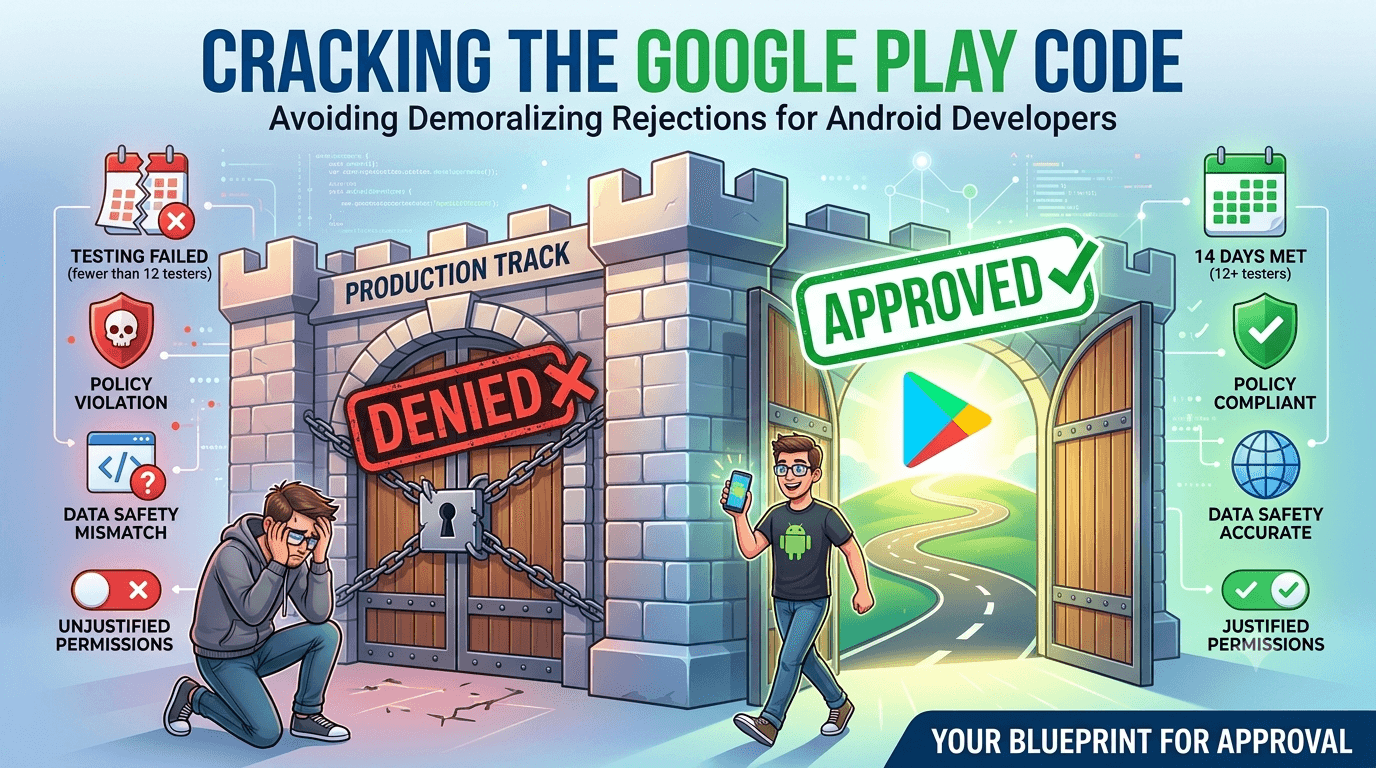
Being denied production access after investing weeks in your app is one of the most demoralizing moments a new Android developer can face, but it is far more common than most people realize, and almost every reason is both understandable and fixable. Google reviews both your closed-testing participation and your app itself before granting access to the production track, and a rejection can stem from either side. Understanding the full list of reasons Google denies production access — and how to preempt each one — is the single best way to make sure your own request sails through on the first attempt rather than bouncing back for corrections.
This guide walks through every major category of production-access rejection, explains why Google cares about each, and gives you concrete steps to avoid it. Read it before you submit your request, ideally during your 14-day testing window, so you have time to address anything that might trip you up. A little preparation here turns a stressful gamble into a routine approval.
The testing requirement was not genuinely met
The most fundamental reason for denial is that the closed-testing requirement was not truly satisfied. On a new personal account you need at least 12 testers opted in and maintained for 14 continuous days, and Google checks this rigorously. Many developers believe they met the bar when in fact their tester count dipped below 12 partway through the window, breaking the "continuous" condition even though 14 calendar days elapsed. Others counted people who opted in and then left, not realizing that only sustained, opted-in participation counts toward the requirement.
The fix is to run a genuinely continuous test with a comfortable buffer above the minimum. Recruit 15 to 20 committed testers rather than exactly 12, so that normal attrition never drops you below the line, and monitor your count throughout so you can top up if it sags. If you struggle to keep enough real testers engaged for the full window, that is precisely the gap a service fills — you can submit your app to get verified, engaged testers, and read Google Play says not enough testers for related troubleshooting.
Policy violations in your app
Even with perfect testing, your app itself must comply with Google Play's policies, and violations are a leading cause of rejection at the production stage. These range from prohibited or restricted content, to misleading functionality, to intellectual-property issues, to improper use of permissions. Google's automated and human reviewers check your app against the developer program policies, and anything that appears to break them can block access regardless of how flawless your test was.
To avoid this, review your app against the official Google Play developer policies before you submit, paying special attention to any area your app touches — user-generated content, financial features, health data, or anything sensitive. Fix issues proactively rather than waiting to be caught. For a structured walkthrough, see the compliance guide and policy violations during closed testing.
Inaccurate Data Safety or declarations
Google requires an accurate Data Safety section describing what data your app collects, how it is used, and whether it is shared, and this declaration must match your app's real behavior. A mismatch — declaring you collect nothing while an analytics SDK quietly transmits data, for example — is treated as a compliance violation and is a frequent, avoidable cause of rejection. The same applies to your content rating and target-audience declarations: inaccuracies here raise flags during review.
Audit every piece of data your app touches, including data collected by third-party SDKs, and make sure your Data Safety form reflects all of it truthfully. Confirm your content rating questionnaire answers are accurate and your target audience is correctly set. See the Data Safety form guide and the official Data Safety documentation to get this right.
Sensitive or unjustified permissions
| Permission issue | How to avoid rejection |
|---|---|
| Requesting more than you need | Remove unnecessary permissions |
| Sensitive permissions unjustified | Explain and justify genuine need |
| Background location | Provide strong justification or remove |
| Undisclosed data access | Declare accurately in Data Safety |
Google scrutinizes permissions closely, especially sensitive ones like background location, SMS, call logs, and access to sensitive user data. Requesting permissions your app does not genuinely need, or requesting sensitive ones without a clear, policy-compliant justification, is a common rejection trigger. The principle is minimalism: request only what your core functionality truly requires, and be ready to justify each sensitive permission.
Before submitting, audit your manifest and remove any permission that is not essential. For permissions that are essential but sensitive, ensure your use case matches Google's allowed reasons and that your app clearly communicates why the permission is needed. See background location and review and camera and microphone testing.
An app that appears incomplete or broken
Google expects apps entering production to be functional, stable, and complete. An app that crashes on launch, contains obvious placeholder content, has broken core features, or looks unfinished can be denied on quality grounds. Reviewers may test your app on real devices, and a poor first impression — a crash, a dead-end screen, a login that fails — can result in rejection even if your policies are fine.
This is exactly where a genuine closed test pays off: real testers on diverse devices surface the crashes and broken flows that would otherwise reach the reviewer. Enter production with a build validated by your testers, free of known crashes on core flows, with all features working and no placeholder content. For a pre-submission quality pass, see the app testing checklist and preparing your app before publishing.
Account or identity issues
Sometimes the rejection is not about the app at all but about your developer account. Incomplete identity verification, discrepancies in your account details, or signals that suggest suspicious or automated activity can all block production access. Google has strengthened identity requirements for developers, and an unverified or inconsistent account can stall your request until resolved.
Make sure your developer account is fully set up and verified, with accurate, consistent information. Complete any identity verification Google requests promptly. Avoid anything that could look like manipulation — most notably fake testers or install-farm activity, which can taint your account. See developer identity verification and how Google detects fake testers.
How to recover from a rejection
If you are rejected, do not panic and do not resubmit blindly. Read Google's stated reason carefully, identify which category above it falls into, and fix the specific underlying issue genuinely rather than superficially. Then resubmit with confidence. Keep your testers opted in during this process so your participation remains verifiable and you are not forced to re-recruit under pressure. Most rejections are entirely fixable, and developers routinely get approved on a subsequent attempt after addressing the cause.
The best recovery, of course, is prevention. Address every category in this guide before your first request — genuine testing, policy compliance, accurate declarations, minimal permissions, a complete app, and a verified account — and rejection becomes unlikely in the first place. For deeper reading, see why Google rejected my production access request and closed testing completed but still rejected.
Key takeaways
- Ensure the testing requirement is genuinely met — 12+ testers, 14 continuous days, with a buffer.
- Comply with Play policies and fix violations before submitting.
- Make Data Safety and declarations accurate, matching real behavior.
- Request only minimal, justified permissions.
- Submit a complete, stable app from a fully verified account.
A complete prevention plan before you submit
The most effective way to deal with production-access rejection is to make it extremely unlikely in the first place, and that requires a deliberate pre-submission plan rather than a hopeful click of the request button. Because rejections come from several independent categories — testing, policy, declarations, permissions, quality, and account — a single overlooked area can undo weeks of work, so a systematic sweep across all of them before submitting is the highest-leverage habit you can adopt. Think of it as a pre-flight checklist that you run during your 14-day testing window, when you have time to fix anything you find, rather than after submission when a rejection costs you days of turnaround.
Start with testing, since it is the prerequisite that unlocks everything else. Verify in the Play Console that you genuinely had at least 12 opted-in testers held continuously for 14 days, with your count never dipping below the minimum. If you ran a bare-minimum group, assume the requirement is fragile and consider whether a buffered, committed group would leave you safer. This is also the moment to confirm that every tester was a real, opted-in account rather than an inflated number, because any reliance on fake activity will surface here as a shortfall or, worse, an account flag.
Next, move to policy compliance, which is where many otherwise-ready apps stumble. Walk through the areas of the developer policies that touch your app specifically — user-generated content, financial or health features, ads, data collection, or anything sensitive — and confirm you comply with each. Do not assume that because your app seems harmless it is automatically fine; reviewers check against concrete rules, and an innocent oversight can read as a violation. Reading the relevant policy sections directly, rather than relying on assumptions, is the surest way to catch problems you did not know you had.
Then audit your declarations and permissions together, because they are closely linked. Confirm your Data Safety section truthfully reflects every kind of data your app and its third-party SDKs collect, use, or share, and that your content rating answers are accurate. Simultaneously, review your manifest and strip out every permission your app does not genuinely need, and for the sensitive ones that remain, confirm your use case matches Google's allowed reasons and is clearly communicated to users. Mismatched declarations and over-broad permissions are among the most common and most avoidable rejection triggers.
Finally, verify quality and account readiness. Make sure your app is stable and complete — no crashes on core flows, no placeholder content, no broken features — by leaning on the real-device feedback your closed testers provided. Confirm your developer account is fully verified with consistent, accurate information, and that nothing about your activity could look like manipulation. With all six categories addressed before you submit, your request has cleared every common obstacle in advance, and approval becomes the routine outcome it should be. If the tester side is your weak point, you can submit your app to secure a genuine, buffered group, and consult preparing your app before publishing for the rest.
Frequently asked questions
Can I reapply after a production-access rejection?
Yes. Address the specific stated reason genuinely, then resubmit. Most rejections are fixable and developers are routinely approved on a later attempt.
How long should I wait before reapplying?
Reapply once you have genuinely resolved the stated issue, not before. Resubmitting without real changes wastes time; a fixed, compliant app is what gets approved.
Will a rejection hurt my account permanently?
A single rejection you address and fix does not doom your account. Repeated policy violations or manipulation signals, however, can cause lasting problems, so resolve issues genuinely.
Do I need to keep testers during the appeal or reapplication?
Yes. Keep your testers opted in so your participation remains verifiable and you are not forced to re-recruit while resolving the issue.
Does completing testing guarantee approval?
No. Testing qualifies you to apply, but Google still reviews your app for policy compliance, declarations, permissions, and quality.
Is a production-access rejection the same as an app being banned?
No. A rejection means your request was not granted yet, usually for a fixable reason. It is not a ban, and you can address the issue and reapply.
Why was I rejected if my test looked complete?
Often the count dipped below 12 during the window, or the app has a policy, declaration, permission, or quality issue separate from testing.
How do I avoid rejection entirely?
Address every category before submitting: genuine testing, compliance, accurate declarations, minimal permissions, a complete app, and a verified account.
Can fake testers cause a rejection?
Yes. Install-farm or fake activity is detected, does not satisfy the requirement, and can taint your account. Use only real testers.
Expanded for topical authority — additional practical sections below. Original guide content above is unchanged.
Quick answer
Google Play Production Access Rejection Reasons matters because Google Play production access for many new personal developer accounts depends on a successful closed test: at least 12 real testers opted in for 14 continuous days, plus a policy-compliant, stable app. Use this guide to execute the steps correctly, avoid streak-breaking mistakes, and decide whether DIY recruitment or a managed closed testing service is the better path for your deadline.
Real-world scenarios: who this matters for
The guidance in this article on Google Play Production Access Rejection Reasons applies across many Android product types. Use these scenarios to map the advice to your situation.
| Developer type | Typical challenge | Practical focus |
|---|---|---|
| Indie / solo | Limited tester network and time | Start closed testing early; keep a buffer above 12 opted-in testers; parallelize listing + Data safety work |
| Startup | Launch deadline vs 14-day rule | Treat the window as fixed; recruit in parallel with QA; avoid last-minute track setup |
| Agency / white-label | Multiple client apps, each needing its own test | One closed test per app; standardize opt-in onboarding; track eligibility dates per client |
| Flutter / React Native | Cross-platform build + Play Console quirks | Ship a signed AAB to closed testing; verify installs from Play, not sideload; watch vitals on mid-range devices |
| Native Kotlin | Device/API fragmentation | Cover API levels and OEMs in your tester mix; fix crashes before requesting production |
| Game / Unity | Performance + retention during 14 days | Keep testers engaged so count never dips below 12; monitor ANRs and battery |
| E-commerce / fintech | Policy + payment flows | Test checkout, permissions, and declarations carefully before production access |
| Healthcare / kids / education | Sensitive policies (Families, data) | Align listing, privacy, and content rating with real app behavior during the test window |
Visual placeholder: Scenario matrix infographic — Indie / Startup / Agency / Cross-platform paths for Google Play Production Access Rejection Reasons.
Comparison: rejection / eligibility categories
Problems related to Google Play Production Access Rejection Reasons usually fall into a few buckets. Classify first, then fix — mixing categories wastes review cycles.
| Category | What Google is signaling | Primary fix | Avoid |
|---|---|---|---|
| Testing eligibility | Closed test incomplete / not continuous | Restore 12+ opted-in for 14 continuous days | Requesting production early |
| Policy / content | App or listing violates Play policy | Change product/listing to comply | Resubmitting unchanged |
| Declarations | Data safety, permissions, or rating mismatch | Align forms with real behavior | Copy-pasting inaccurate answers |
| Stability / quality | Crashes, broken core flows | Fix build; re-test on closed track | Ignoring tester crash reports |
| Metadata / listing | Misleading or stuffed listing | Clean title, description, graphics | Keyword stuffing |
Visual placeholder: Flowchart — diagnose rejection category → fix → retest → re-request.
Common mistakes (and how to avoid them)
These mistakes repeatedly show up when developers work through Google Play Production Access Rejection Reasons:
- Confusing invited vs opted-in testers — Only testers who open the opt-in link and install from Play count toward 12. Check the opted-in number in Play Console, not your email list.
- Recruiting exactly 12 with no buffer — One uninstall can break continuity. Aim for ~15 active opted-in testers.
- Starting the counted clock late — Listing assets, Data safety, and privacy work should run during the 14 days, not after.
- Using sideloaded APKs or fake installs — They do not satisfy Play’s closed testing expectations and can create account risk.
- Ignoring tester feedback until day 14 — Crashes that drive uninstalls threaten your streak and your review outcome.
- Requesting production access before the continuous streak completes — Eligibility checks fail even if calendar time has passed.
Action checklist
Use this checklist alongside the rest of this guide on Google Play Production Access Rejection Reasons:
- ☐ Closed testing track created with a signed release (AAB)
- ☐ Opt-in link tested on a fresh Google account
- ☐ At least 12 testers opted in (prefer ~15)
- ☐ Daily check that opted-in count stays ≥ 12 for 14 continuous days
- ☐ Core flows exercised (login, main feature, permissions, offline/online)
- ☐ Crashes / ANRs triaged from tester reports and vitals
- ☐ Store listing, screenshots, and feature graphic drafted
- ☐ Privacy policy + Data safety + content rating aligned with real behavior
- ☐ Production access requested only after eligibility is green
- ☐ Staged rollout plan ready for first public release
Additional FAQs developers ask about Google Play Production Access Rejection Reasons
Quick answer: what should I do first?
Confirm you are on a closed testing track with real opted-in installs, keep 12+ testers for 14 continuous days, and fix policy/stability issues in parallel. Then use the detailed sections above for Google Play Production Access Rejection Reasons.
Does this apply to organization (company) accounts?
The classic 12×14 closed testing gate is primarily associated with new personal developer accounts. Always verify your account type and current Play Console eligibility messaging for your app.
Do friends and family count as testers?
Yes — if they opt in via your closed testing link and install from Google Play. They only help if they stay opted in for the continuous period.
Can I update the app during the 14 days?
You can usually push updates on the closed track, but unstable releases that cause uninstalls can threaten your tester count. Prefer polishing via internal testing first when possible.
What if production access is still rejected?
Read the exact reason. Incomplete testing is only one category — policy, Data safety mismatches, and crashes are common. Fix the cited issue fully before reapplying.
Is paying for testers allowed?
Using real people who install from Play is what matters. Avoid fake install farms. A one-time managed service that supplies real closed testers is a practical option when DIY recruitment is too slow.
How is Fast Testers different from free communities?
Free communities trade time and mutual availability. Fast Testers assigns about 15 real testers after you submit a valid closed testing link (one-time $15 per app) and includes a production access guarantee under its refund terms.
Where should I go next?
Review the related guides below, then either finish DIY recruitment or start closed testing if you need speed and continuity.
Sources, updates, and how to use this guide
This article on Google Play Production Access Rejection Reasons is maintained for Android developers preparing Google Play closed testing and production access. Always cross-check eligibility text inside your own Play Console, because Google’s UI labels and account rules can vary by account type and date.
- Primary official references: Google Play closed testing help, Developer Program Policies, and Play Console eligibility messaging for your app.
- Practical experience lens: guidance here reflects common failure modes indie developers and agencies hit when recruiting testers, maintaining the 14-day streak, and recovering from production-access rejections.
- Last reviewed focus: 12×14 closed testing continuity, real vs fake testers, and parallel listing/compliance work during the window.
Related guides and next steps
Continue building topical depth around Google Play Production Access Rejection Reasons with these Fast Testers resources:
- Fastest Way To Get Google Play Production Access
- When Can You Request Google Play Production Access
- Case Study Recovering From Google Play Rejection
- Deep Link Testing Before Google Play Production
- Testing Android Games For Google Play Production
- Why Google Rejected My Production Access Request
- Ad Supported Apps And Google Play Ad Policy Testing
- Agency Guide Testing Client Apps On Google Play
- Pricing — $15 closed testing
- How Fast Testers works
- FAQ
- Developer reviews
- Case studies
- Submit your app / start closed testing
Need reliable testers so your 14-day streak does not stall? Educate first with the guides above, then start when you are ready — one-time pricing, real Play installs, dashboard tracking.
Further expansion — case study, decisions, and expert recommendations. Prior sections remain unchanged.
Case study: recovering production access after a rejection
Problem: A solo developer finished what they thought was “14 days of testing,” requested production access, and was told the app was not eligible / rejected. Their invite list had 18 emails, but only 9 had opted in for the full window — and a crash on day 6 caused three uninstalls.
Solution: They paused the production request, fixed the crash on an internal track first, then rebuilt closed testing with ~15 real opted-in testers. During the new 14-day streak they also corrected a Data safety mismatch that would have failed review later. Guidance from articles like this one on Google Play Production Access Rejection Reasons helped them classify the issue as eligibility + stability, not “random Google rejection.”
Result: Continuous 12+ streak completed, production access approved on the next request, staged rollout to 10% with clean vitals.
Lessons learned:
- Count opted-in installs, not invites.
- Fix crash-driven churn before you burn another 14 days.
- Use the window to clear declarations — not only the tester clock.
Decision guide: what should you do next?
Use this decision path when applying Google Play Production Access Rejection Reasons:
- Is your account a new personal developer account that still needs production access?
If yes, plan for closed testing with 12+ opted-in testers for 14 continuous days. If no, still test — but confirm the exact eligibility text in Play Console. - Do you already have 12+ reliable people who will install from Play and stay for two weeks?
If yes, DIY can work — add a buffer and monitor daily. If no, use community exchange or a managed closed testing service. - Is your build stable enough that testers will not churn?
If no, run internal testing first. Entering the counted window with crash loops is how streaks die. - Are Data safety, privacy policy, permissions, and listing aligned with real behavior?
If no, fix during the window so production review does not bounce you after the clock. - Has production access been rejected?
Classify: eligibility vs policy vs declarations vs stability. Fix that category completely, then re-test / re-request.
Visual placeholder: Decision tree diagram for Google Play Production Access Rejection Reasons (DIY vs managed vs fix-and-retry).
Expert recommendations
- Instrument the streak: Check opted-in count daily for the first week; replace dropouts same day.
- Brief testers once: Send a short checklist (install from Play, open app daily, try core flow, report crashes). Silent testers still count if opted in — engaged testers protect quality.
- Never “solve” recruitment with fake installs: It fails the intent of closed testing and can create account risk.
- Ship a boring-stable build to closed testing: Save experimental features for internal tracks.
- Educate first, then accelerate: If your blocker is simply finding real testers fast, a one-time managed option (Fast Testers: 15 testers, $15/app) is often cheaper than slipping a launch.
For hands-on setup after reading about Google Play Production Access Rejection Reasons, see how it works and pricing, or submit your closed testing link when you are ready.
Internal navigation hub — added to strengthen topical connections. Original article content above is unchanged.
Topic cluster: App Rejection & Eligibility
Pillar guide: Start with App Rejected by Google Play? Here's What to Do for the full overview, then use the supporting guides below.
- App Rejected by Google Play? Here's What to Do (pillar)
- Why Google Rejects Android Apps (and How to Avoid It)
- App Not Eligible for Production Access? Here Is Why
- Why Google Rejected My Production Access Request
- Closed Testing Completed but Still Rejected? Do This
- App Rejected for Insufficient Testing: What to Do
- Case Study: Recovering from Google Play Rejection
- Google Play Policy Violations During Closed Testing
- Account Termination Risks and How to Avoid Them
Continue learning
- Case Study: Recovering from Google Play Rejection — Learn about rejection recovery for Google Play closed testing. Complete guide for Android developers publishin.
- Why Google Rejected My Production Access Request — Google rejected your production access request? Here are the real reasons Google denies production access afte.
- App Not Eligible for Production Access? Here Is Why — Seeing "app not eligible for production access" in Play Console? Here are the exact reasons the button is lock.
- App Rejected by Google Play? Here's What to Do — Got your app rejected? This guide walks you through the most common rejection reasons..
- The Fastest Way to Get Google Play Production Access — The fastest way to get Google Play production access: start your 14-day closed test immediately, avoid delays,.
- Google Play Policy Violations During Closed Testing — Can you get policy violations during closed testing? Yes. Learn which Google Play policies apply during testin.
Next steps
- Ready to run closed testing with real Android testers? Submit your app or see pricing ($15 one-time).
- Compare options on our testing service comparison page, or read developer reviews and case studies.
- Still deciding? Review how Fast Testers works and the FAQ.