
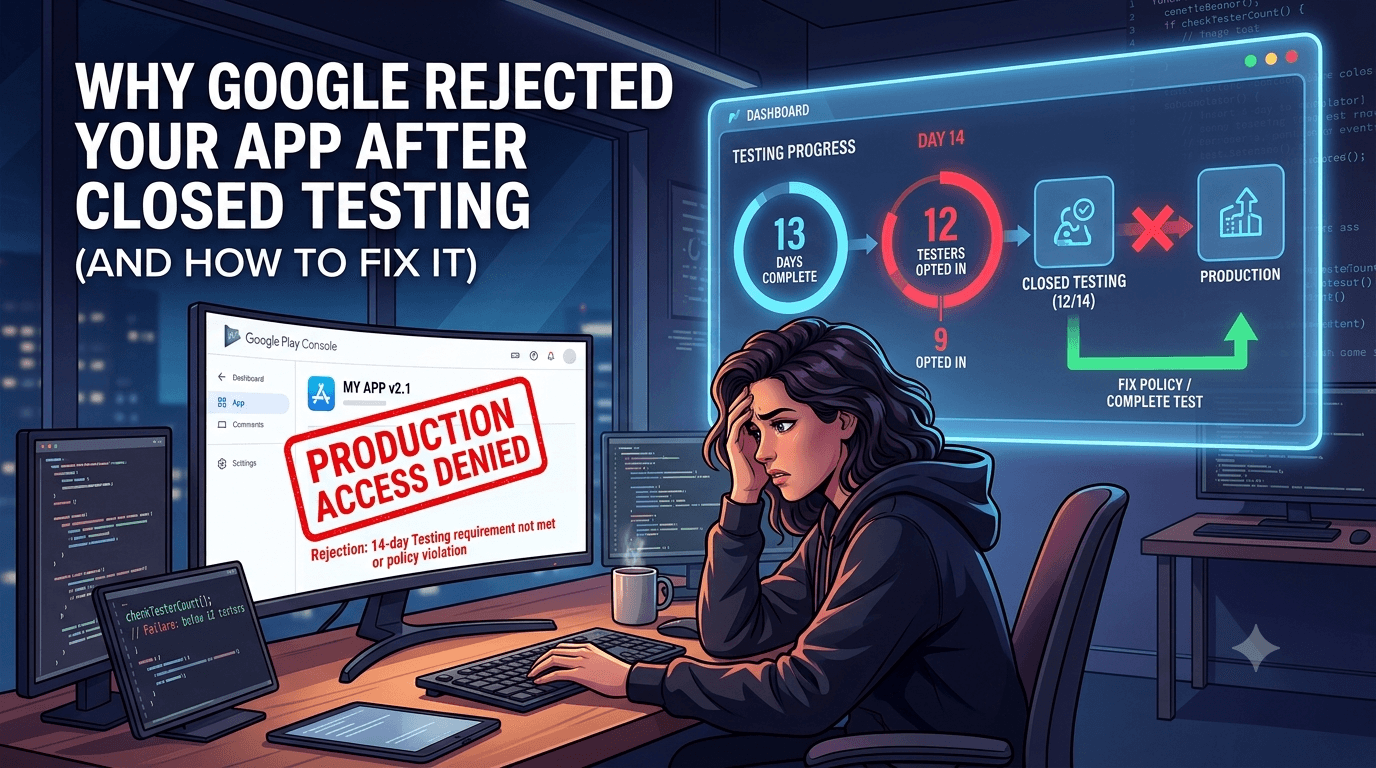
It is one of the most demoralizing moments in publishing: you ran your closed test, you believe you satisfied the 12-tester, 14-day requirement, and yet Google still rejected your production access request or your app. The good news is that this almost never means your app is doomed — it means a specific condition was not actually met the way you thought, or a separate issue is at play. Because a new personal account must complete a closed test with at least 12 testers opted in for 14 continuous days before production, the most common surprise is that the test was not truly complete even though it felt like it was.
This guide unpacks why an app can be rejected after what looked like a finished closed test. The reasons fall into a few buckets: the testing requirement was not genuinely satisfied (usually a continuity or opt-in subtlety), the app has a policy or content problem, or the required declarations are inaccurate or inconsistent. We will diagnose each so you can identify your situation and fix it, because in nearly every case the path forward is clear once you know the real cause.
The test was not actually complete
The single most common reason is that the closed-testing requirement was not truly satisfied, despite appearances. The rule is 12+ testers opted in for 14 continuous days, and both halves are easy to miss: you may have added testers who never opted in, or your opted-in count may have dipped below 12 partway through, breaking the continuous streak. Fourteen calendar days passing is not the same as 14 continuous qualifying days. If you were rejected right after "finishing," check these two things first. See the closed testing guide and app not eligible for production access.
In the Console, review your opted-in tester count over the whole window. If it ever fell under 12, your streak likely reset, and you simply need to maintain 12+ continuously until a full 14-day run completes. This is the most frequent "completed but rejected" scenario, and its fix is straightforward once you see it. See Google's closed testing documentation.
Testers added versus testers opted in
A specific version of the above deserves its own attention: the difference between testers you added and testers who opted in. Adding an email to your closed track does nothing for the count until that person clicks the opt-in link and joins. Developers routinely add 15 emails, assume they are covered, and never notice that only 9 actually opted in. If your rejection is really an eligibility issue, this is a prime suspect. Verify the opted-in number, not your invite list, and top it up well above 12. See creating a closed testing track.
If reliably getting 12+ real testers to opt in and stay is your challenge, a service that supplies verified testers removes the uncertainty — you can submit your app to get started. Reliable opt-in is exactly what prevents this category of rejection. See getting 12 testers.
A genuine policy or content violation
If your testing genuinely was complete, the rejection likely concerns your app's compliance rather than the requirement. Google reviews apps against its policies, and a violation — prohibited content, misleading functionality, intellectual-property issues, permissions you cannot justify, or a policy-restricted feature — will cause rejection regardless of testing. Read the rejection message carefully; it usually cites the specific policy. Fixing it means bringing your app into compliance with that policy, then resubmitting. See common rejection reasons and Google's developer policies.
| Rejection type | What it means | Fix |
|---|---|---|
| Eligibility | Testing requirement not truly met | Complete 12/14 continuously |
| Policy | App violates a Play policy | Fix the cited violation |
| Declaration | Data safety/rating inaccurate | Align declarations with behavior |
Policy rejections are about the app itself, so no amount of extra testing resolves them — the underlying issue must change. See app rejected on Google Play.
Inaccurate or inconsistent declarations
Another cause is a mismatch between what you declared and what your app does. If your Data safety form omits data your app collects, your privacy policy contradicts your form, or your content rating does not match your app's actual content, Google can reject you even with testing complete. The most common culprit is undeclared data collection by third-party SDKs, which developers forget to include. Audit exactly what your app and its SDKs collect, then make your Data safety form and privacy policy match reality and each other. See the Data safety form guide and privacy policy requirements.
These rejections are fixable by correcting the declaration, not the app's function. Get your declarations accurate and consistent, resubmit, and the mismatch that triggered the rejection disappears. Your testing window is the ideal time to do this audit so the problem never arises. See SDK testing.
Diagnosing your specific rejection
The key to fixing a post-testing rejection is reading the actual message Google gives you rather than guessing. The Console typically explains whether the issue is eligibility, policy, or a declaration, and cites specifics. Match the message to the buckets above: if it mentions the testing requirement, it is continuity or opt-in; if it cites a policy, it is content or compliance; if it references your data or rating, it is a declaration mismatch. Precise diagnosis leads directly to the right fix. See app not eligible for production access.
Resist the temptation to resubmit blindly hoping it passes. Identify the exact cited reason, fix that specific thing, and then resubmit. Blind resubmission wastes review cycles and can look careless; targeted fixes get you approved. See the Console beginner guide.
Fixing and resubmitting
Once you know the cause, address it fully before resubmitting. For an eligibility issue, restore 12+ testers and complete a genuine 14-continuous-day streak. For a policy issue, change the app to comply and document the change if helpful. For a declaration issue, correct your Data safety form, privacy policy, or content rating so all agree with your app. Then resubmit through the Console and allow for another review period. A well-targeted fix usually clears the rejection on the next pass. See staged rollouts.
If you are unsure why you were rejected even after reading the message, you can appeal or contact Google Play developer support for clarification. Getting a precise reason is worth the wait, because it prevents repeated rejections from guessing. Fix the real cause once and move on.
Preventing rejection after testing
Most post-testing rejections are preventable. Complete the test genuinely — 12+ opted-in testers, 14 continuous days, verified in the Console, not assumed. Audit your app for policy compliance before submitting, and make your declarations accurate and consistent during the window. Doing this work while the mandatory clock runs means that when you request production, every gate is already cleared. Developers who prepare this way rarely see a rejection after testing. See the first-app checklist.
The theme is that "finishing the test" means meeting every real condition, not just waiting two weeks. Understand each condition precisely and satisfy it, and the frustrating "completed but rejected" outcome becomes something you designed out in advance. See launching fast.
Use internal testing to reduce risk
Validating your build on the internal track before your counted closed test reduces the chance of a post-testing rejection in two ways: a stable build keeps testers opted in (protecting your continuity), and it gives you a chance to catch behavior — like unexpected data collection — that would otherwise surface as a declaration mismatch. Promote the vetted build to your closed track to preserve exactly what you validated. This staging makes both eligibility and compliance more predictable. See internal vs closed testing.
The same disciplined pipeline protects you after launch, when updates must not reintroduce a policy or declaration issue. Building the habit now pays off on every future release. See updating after release.
After approval: stay compliant
Once approved, use a staged rollout and monitor your vitals and reviews so any issue reaches few users. Keep your declarations current as your app changes, because a future update that adds undeclared data collection or violates a policy can trigger the same kind of rejection later. Staying compliant and well-tested on every release keeps you from revisiting the "completed but rejected" experience. See staged rollouts and post-launch monitoring.
Treat approval as the start of ongoing stewardship rather than a finish line. The precision that got you approved — genuine testing, accurate declarations, policy compliance — is what keeps you approved through every update. See updating mid-testing.
Staying methodical when it is frustrating
A rejection after weeks of testing lands hard, and the natural reaction is to feel the platform is against you or to fire off an angry resubmission. Neither helps. The productive response is to treat the message as diagnostic data: it names a specific unmet condition, and your job is to identify and fix exactly that. Almost every post-testing rejection resolves on the next attempt once the real cause is addressed, so the setback is a step, not a dead end. Keeping a methodical mindset turns a demoralizing moment into a solvable ticket. See app rejected on Google Play.
It also helps to remember how common this is. Many developers hit a rejection right after their first test because the continuity or opt-in subtlety caught them, and they all got through by fixing the specific issue. You are following a well-worn path with a known exit. Diagnose precisely, fix fully, resubmit once — and move forward. See common rejection reasons.
Key takeaways
- Rejection after testing usually means a condition was not truly met — most often continuity or opt-in.
- Verify opted-in testers, not emails added, and confirm 14 continuous days with 12+.
- Policy violations cause rejection regardless of testing; fix the cited policy, not the test.
- Inaccurate or inconsistent declarations — Data safety, privacy policy, rating — trigger rejection; align them with your app.
- Read the actual rejection message, fix the specific cause, then resubmit.
Frequently asked questions
I completed 14 days but was still rejected. Why?
Often your opted-in count dipped below 12, breaking the continuous streak, or testers you added never opted in. Verify both in the Console.
Does finishing the test guarantee approval?
No. You must also comply with Play policies and have accurate, consistent declarations. Any of these can cause rejection despite completed testing.
How do I know why I was rejected?
Read the rejection message in the Console; it usually cites whether the issue is eligibility, policy, or a declaration, with specifics.
What if my declarations caused the rejection?
Correct your Data safety form, privacy policy, or content rating so they accurately match your app and each other, then resubmit.
Can I just resubmit and hope it passes?
No. Fix the specific cited cause first. Blind resubmission wastes review cycles and rarely resolves the underlying issue.
Can I appeal a rejection?
Yes. If the reason is unclear, you can appeal or contact developer support for clarification before fixing and resubmitting.
How do I avoid this entirely?
Complete the test genuinely, audit for policy compliance, and make declarations accurate during the window so every gate is cleared before you request production.
How long does re-review take after I resubmit?
Plan for several days. A targeted fix to the specific cited cause usually clears on the next review, but allow for another review period rather than expecting instant approval.
Should I fix everything or just the cited issue?
Fix the cited issue fully, but also verify the other gates — testing, policy, declarations — are genuinely met, so a second issue does not cause a fresh rejection.
Is a rejection after testing common?
Yes. Many developers hit one right after their first test because of the continuity or opt-in subtlety, and nearly all get through by fixing the specific cited cause and resubmitting once.
Can I contact Google if the reason is unclear?
Yes. You can appeal or contact Google Play developer support for clarification, which is worth the wait so you fix the real cause rather than guessing.
Expanded for topical authority — additional practical sections below. Original guide content above is unchanged.
Quick answer
Closed Testing Completed but Still Rejected? Do This matters because Google Play production access for many new personal developer accounts depends on a successful closed test: at least 12 real testers opted in for 14 continuous days, plus a policy-compliant, stable app. Use this guide to execute the steps correctly, avoid streak-breaking mistakes, and decide whether DIY recruitment or a managed closed testing service is the better path for your deadline.
Real-world scenarios: who this matters for
The guidance in this article on Closed Testing Completed but Still Rejected? Do This applies across many Android product types. Use these scenarios to map the advice to your situation.
| Developer type | Typical challenge | Practical focus |
|---|---|---|
| Indie / solo | Limited tester network and time | Start closed testing early; keep a buffer above 12 opted-in testers; parallelize listing + Data safety work |
| Startup | Launch deadline vs 14-day rule | Treat the window as fixed; recruit in parallel with QA; avoid last-minute track setup |
| Agency / white-label | Multiple client apps, each needing its own test | One closed test per app; standardize opt-in onboarding; track eligibility dates per client |
| Flutter / React Native | Cross-platform build + Play Console quirks | Ship a signed AAB to closed testing; verify installs from Play, not sideload; watch vitals on mid-range devices |
| Native Kotlin | Device/API fragmentation | Cover API levels and OEMs in your tester mix; fix crashes before requesting production |
| Game / Unity | Performance + retention during 14 days | Keep testers engaged so count never dips below 12; monitor ANRs and battery |
| E-commerce / fintech | Policy + payment flows | Test checkout, permissions, and declarations carefully before production access |
| Healthcare / kids / education | Sensitive policies (Families, data) | Align listing, privacy, and content rating with real app behavior during the test window |
Visual placeholder: Scenario matrix infographic — Indie / Startup / Agency / Cross-platform paths for Closed Testing Completed but Still Rejected? Do This.
Comparison: rejection / eligibility categories
Problems related to Closed Testing Completed but Still Rejected? Do This usually fall into a few buckets. Classify first, then fix — mixing categories wastes review cycles.
| Category | What Google is signaling | Primary fix | Avoid |
|---|---|---|---|
| Testing eligibility | Closed test incomplete / not continuous | Restore 12+ opted-in for 14 continuous days | Requesting production early |
| Policy / content | App or listing violates Play policy | Change product/listing to comply | Resubmitting unchanged |
| Declarations | Data safety, permissions, or rating mismatch | Align forms with real behavior | Copy-pasting inaccurate answers |
| Stability / quality | Crashes, broken core flows | Fix build; re-test on closed track | Ignoring tester crash reports |
| Metadata / listing | Misleading or stuffed listing | Clean title, description, graphics | Keyword stuffing |
Visual placeholder: Flowchart — diagnose rejection category → fix → retest → re-request.
Common mistakes (and how to avoid them)
These mistakes repeatedly show up when developers work through Closed Testing Completed but Still Rejected? Do This:
- Confusing invited vs opted-in testers — Only testers who open the opt-in link and install from Play count toward 12. Check the opted-in number in Play Console, not your email list.
- Recruiting exactly 12 with no buffer — One uninstall can break continuity. Aim for ~15 active opted-in testers.
- Starting the counted clock late — Listing assets, Data safety, and privacy work should run during the 14 days, not after.
- Using sideloaded APKs or fake installs — They do not satisfy Play’s closed testing expectations and can create account risk.
- Ignoring tester feedback until day 14 — Crashes that drive uninstalls threaten your streak and your review outcome.
- Requesting production access before the continuous streak completes — Eligibility checks fail even if calendar time has passed.
Troubleshooting checklist
If something feels “stuck” while applying Closed Testing Completed but Still Rejected? Do This, walk this list before changing strategy:
| Symptom | Likely cause | Fix |
|---|---|---|
| Console shows < 12 testers | Invites sent but not opted in | Resend opt-in link; confirm install from Play |
| “Not eligible” after 14 calendar days | Count dipped below 12 mid-window | Restore 12+ and complete a full continuous streak |
| Tester cannot join | Wrong account, Group lag, or track not published | Verify Google account, Group membership, track release |
| App fails to install | Device/API mismatch or signing issue | Check AAB, minSDK, Play App Signing |
| Production still rejected after testing | Policy, declarations, or stability — not the clock | Read the exact reason; fix that category completely |
Visual placeholder: Troubleshooting flowchart for Closed Testing Completed but Still Rejected? Do This.
Action checklist
Use this checklist alongside the rest of this guide on Closed Testing Completed but Still Rejected? Do This:
- ☐ Closed testing track created with a signed release (AAB)
- ☐ Opt-in link tested on a fresh Google account
- ☐ At least 12 testers opted in (prefer ~15)
- ☐ Daily check that opted-in count stays ≥ 12 for 14 continuous days
- ☐ Core flows exercised (login, main feature, permissions, offline/online)
- ☐ Crashes / ANRs triaged from tester reports and vitals
- ☐ Store listing, screenshots, and feature graphic drafted
- ☐ Privacy policy + Data safety + content rating aligned with real behavior
- ☐ Production access requested only after eligibility is green
- ☐ Staged rollout plan ready for first public release
Additional FAQs developers ask about Closed Testing Completed but Still Rejected? Do This
Quick answer: what should I do first?
Confirm you are on a closed testing track with real opted-in installs, keep 12+ testers for 14 continuous days, and fix policy/stability issues in parallel. Then use the detailed sections above for Closed Testing Completed but Still Rejected? Do This.
Does this apply to organization (company) accounts?
The classic 12×14 closed testing gate is primarily associated with new personal developer accounts. Always verify your account type and current Play Console eligibility messaging for your app.
Do friends and family count as testers?
Yes — if they opt in via your closed testing link and install from Google Play. They only help if they stay opted in for the continuous period.
Can I update the app during the 14 days?
You can usually push updates on the closed track, but unstable releases that cause uninstalls can threaten your tester count. Prefer polishing via internal testing first when possible.
What if production access is still rejected?
Read the exact reason. Incomplete testing is only one category — policy, Data safety mismatches, and crashes are common. Fix the cited issue fully before reapplying.
Is paying for testers allowed?
Using real people who install from Play is what matters. Avoid fake install farms. A one-time managed service that supplies real closed testers is a practical option when DIY recruitment is too slow.
How is Fast Testers different from free communities?
Free communities trade time and mutual availability. Fast Testers assigns about 15 real testers after you submit a valid closed testing link (one-time $15 per app) and includes a production access guarantee under its refund terms.
Where should I go next?
Review the related guides below, then either finish DIY recruitment or start closed testing if you need speed and continuity.
Sources, updates, and how to use this guide
This article on Closed Testing Completed but Still Rejected? Do This is maintained for Android developers preparing Google Play closed testing and production access. Always cross-check eligibility text inside your own Play Console, because Google’s UI labels and account rules can vary by account type and date.
- Primary official references: Google Play closed testing help, Developer Program Policies, and Play Console eligibility messaging for your app.
- Practical experience lens: guidance here reflects common failure modes indie developers and agencies hit when recruiting testers, maintaining the 14-day streak, and recovering from production-access rejections.
- Last reviewed focus: 12×14 closed testing continuity, real vs fake testers, and parallel listing/compliance work during the window.
Related guides and next steps
Continue building topical depth around Closed Testing Completed but Still Rejected? Do This with these Fast Testers resources:
- Analytics Sdk Testing During Closed Testing
- Closed Testing Vs Open Testing On Google Play
- Google Play Internal Testing Vs Closed Testing
- App Bundle Vs Apk For Closed Testing Releases
- App Rejected For Insufficient Testing What To Do
- Ar Vr Android Apps And Closed Testing Requirements
- Closed Testing Track Not Showing
- Closed Testing Vs Apk Sharing
- Pricing — $15 closed testing
- How Fast Testers works
- FAQ
- Developer reviews
- Case studies
- Submit your app / start closed testing
Need reliable testers so your 14-day streak does not stall? Educate first with the guides above, then start when you are ready — one-time pricing, real Play installs, dashboard tracking.
Further expansion — case study, decisions, and expert recommendations. Prior sections remain unchanged.
Case study: recovering production access after a rejection
Problem: A solo developer finished what they thought was “14 days of testing,” requested production access, and was told the app was not eligible / rejected. Their invite list had 18 emails, but only 9 had opted in for the full window — and a crash on day 6 caused three uninstalls.
Solution: They paused the production request, fixed the crash on an internal track first, then rebuilt closed testing with ~15 real opted-in testers. During the new 14-day streak they also corrected a Data safety mismatch that would have failed review later. Guidance from articles like this one on Closed Testing Completed But Still Rejected? Do This helped them classify the issue as eligibility + stability, not “random Google rejection.”
Result: Continuous 12+ streak completed, production access approved on the next request, staged rollout to 10% with clean vitals.
Lessons learned:
- Count opted-in installs, not invites.
- Fix crash-driven churn before you burn another 14 days.
- Use the window to clear declarations — not only the tester clock.
Decision guide: what should you do next?
Use this decision path when applying Closed Testing Completed But Still Rejected? Do This:
- Is your account a new personal developer account that still needs production access?
If yes, plan for closed testing with 12+ opted-in testers for 14 continuous days. If no, still test — but confirm the exact eligibility text in Play Console. - Do you already have 12+ reliable people who will install from Play and stay for two weeks?
If yes, DIY can work — add a buffer and monitor daily. If no, use community exchange or a managed closed testing service. - Is your build stable enough that testers will not churn?
If no, run internal testing first. Entering the counted window with crash loops is how streaks die. - Are Data safety, privacy policy, permissions, and listing aligned with real behavior?
If no, fix during the window so production review does not bounce you after the clock. - Has production access been rejected?
Classify: eligibility vs policy vs declarations vs stability. Fix that category completely, then re-test / re-request.
Visual placeholder: Decision tree diagram for Closed Testing Completed But Still Rejected? Do This (DIY vs managed vs fix-and-retry).
Expert recommendations
- Instrument the streak: Check opted-in count daily for the first week; replace dropouts same day.
- Brief testers once: Send a short checklist (install from Play, open app daily, try core flow, report crashes). Silent testers still count if opted in — engaged testers protect quality.
- Never “solve” recruitment with fake installs: It fails the intent of closed testing and can create account risk.
- Ship a boring-stable build to closed testing: Save experimental features for internal tracks.
- Educate first, then accelerate: If your blocker is simply finding real testers fast, a one-time managed option (Fast Testers: 15 testers, $15/app) is often cheaper than slipping a launch.
For hands-on setup after reading about Closed Testing Completed But Still Rejected? Do This, see how it works and pricing, or submit your closed testing link when you are ready.
Internal navigation hub — added to strengthen topical connections. Original article content above is unchanged.
Topic cluster: App Rejection & Eligibility
Pillar guide: Start with App Rejected by Google Play? Here's What to Do for the full overview, then use the supporting guides below.
- App Rejected by Google Play? Here's What to Do (pillar)
- Why Google Rejects Android Apps (and How to Avoid It)
- Google Play Production Access Rejection Reasons
- App Not Eligible for Production Access? Here Is Why
- Why Google Rejected My Production Access Request
- App Rejected for Insufficient Testing: What to Do
- Case Study: Recovering from Google Play Rejection
- Google Play Policy Violations During Closed Testing
- Account Termination Risks and How to Avoid Them
Continue learning
- App Rejected for Insufficient Testing: What to Do — Learn about insufficient testing rejections for Google Play closed testing. Complete guide for Android develop.
- Crash Reports During Closed Testing: Fix Before Production — Learn about ANR and crash handling for Google Play closed testing. Complete guide for Android developers publi.
- Google Play Policy Violations During Closed Testing — Can you get policy violations during closed testing? Yes. Learn which Google Play policies apply during testin.
- App Rejected by Google Play? Here's What to Do — Got your app rejected? This guide walks you through the most common rejection reasons..
- Why Google Rejected My Production Access Request — Google rejected your production access request? Here are the real reasons Google denies production access afte.
- Analytics SDK Testing During Closed Testing — Learn about analytics integration QA for Google Play closed testing. Complete guide for Android developers pub.
Next steps
- Ready to run closed testing with real Android testers? Submit your app or see pricing ($15 one-time).
- Compare options on our testing service comparison page, or read developer reviews and case studies.
- Still deciding? Review how Fast Testers works and the FAQ.