
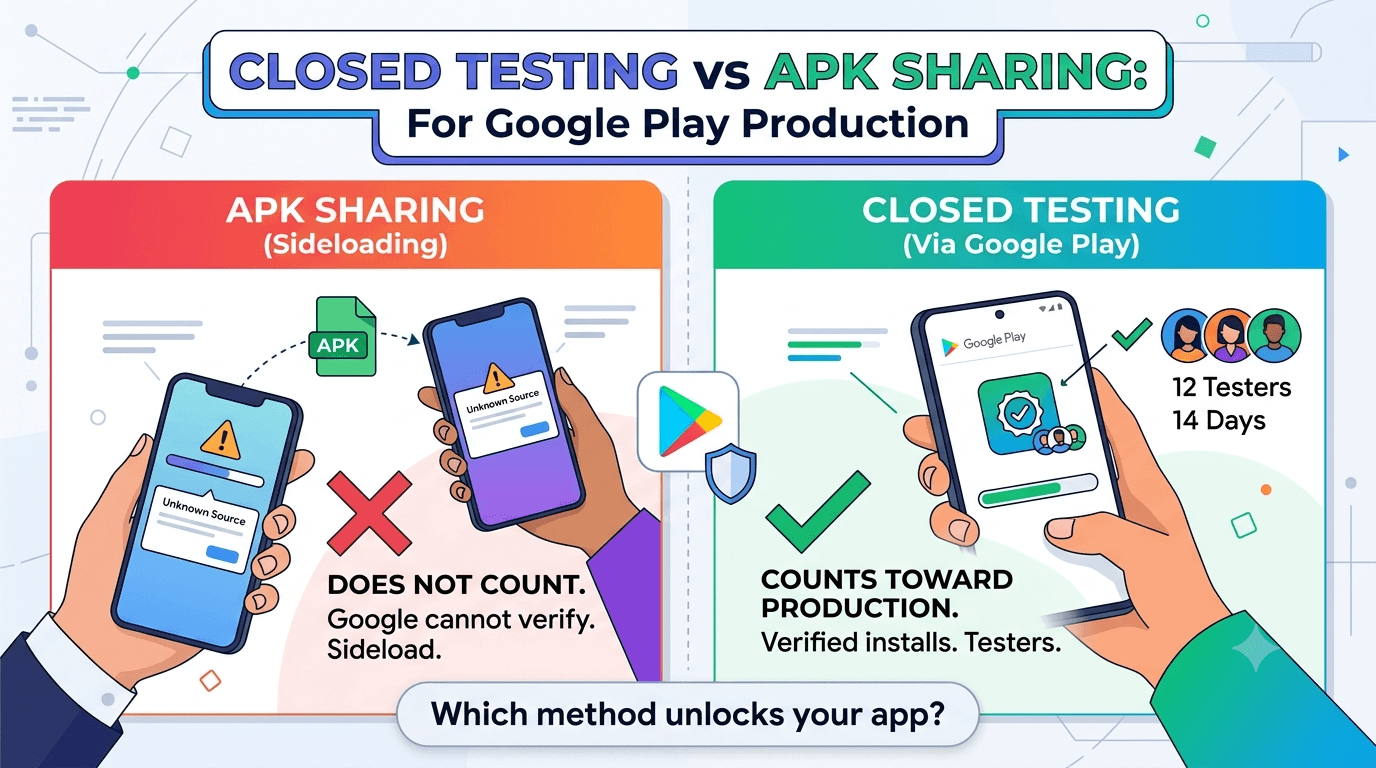
When you need testers, sharing an APK file feels like the simplest path — just send the file and let people install it. But for Google Play's production requirement, APK sharing does not count. This guide explains the difference between closed testing vs APK sharing and why the install method matters so much.
Contents
Quick answer
Featured answer: APK sharing means distributing your app file directly for sideloading, which does not count toward Google Play production access. Closed testing distributes your app through Google Play to opted-in testers, and only these Play installs satisfy the 12-tester, 14-day requirement.
What APK sharing is
APK sharing means sending the installable file (via chat, email, or a link) so users sideload it, bypassing the Play Store. It is useful for quick internal demos, but it produces no signal that Google can verify for production access.
What closed testing is
Closed testing distributes your app through the Play Store to invited testers who opt in and install from Google Play. This is the only method that counts toward production access. Set it up with this guide and share the opt-in link.
Why the difference matters
- Verification: Google can only verify installs that go through Play.
- Requirement: The 12-tester, 14-day rule counts Play installs only.
- Integrity: Sideloaded installs cannot demonstrate genuine tester engagement.
Warning: Asking testers to sideload an APK to "save time" wastes the effort — those installs never count. Always route testers through the Play opt-in flow. See install correctly.
Comparison table
| Factor | APK sharing | Closed testing |
|---|---|---|
| Install source | Sideload | Google Play |
| Counts toward production | No | Yes |
| Google can verify | No | Yes |
| Good for | Quick demos | The 12-tester requirement |
Tip: Skip the APK shortcut and run a proper closed test. Submit your app to get real testers who install from Play and count toward your requirement.
When APK sharing still makes sense
APK sharing is not useless — it is just the wrong tool for the production requirement. There are legitimate cases where sending a build directly is the fastest option:
- Quick internal demos: Showing a stakeholder or teammate a work-in-progress build.
- Rapid debugging: Handing a specific build to a developer to reproduce an issue.
- Pre-Play QA: Early smoke tests before you set up any Play track.
The key is to keep these uses separate from your compliance work. None of them contribute to the 12-tester, 14-day rule, so treat them as private QA only. When it is time to satisfy Google's requirement, switch entirely to the closed track and route every tester through the Play opt-in link. Mixing the two is where developers get into trouble — they assume their sideloaded testers "count," discover they do not, and lose time. Keep a clear line: APK sharing for internal convenience, closed testing for production access.
What each approach actually is
To compare these fairly, it helps to define them precisely. APK sharing means distributing your app's installable file directly — via email, a download link, a file-sharing service, or a messaging app — so people can sideload it onto their devices outside the Play Store. It is quick, requires no Play Console setup, and gives you complete control over who receives the file. Closed testing, by contrast, distributes your app through Google Play itself: testers opt in via a link and install the app from the Play Store, exactly as they would any published app.
This distinction — sideloaded file versus Play Store install — is the crux of everything that follows. It determines not only whether your testing counts toward production access, but also the security, update, and feedback characteristics of each approach. Many developers reach for APK sharing because it is familiar and frictionless, only to discover that for the purpose of unlocking production, it does not help at all.
Why APK sharing does not count
The most important fact is blunt: APK sharing does not count toward the closed testing requirement. For a new personal account, production access requires 12 testers who install through Google Play on a closed track and use the app for 14 consecutive days. Sideloaded APK installs happen entirely outside this system — Google has no record of them as closed-testing installs — so no matter how many people you send your APK to, it does nothing to satisfy the requirement.
This catches developers off guard because APK sharing feels like testing: real people are installing and using the app. But the requirement is specifically about installs through Play's official flow, which is how Google verifies genuine, trackable testing. If your goal is production access, APK sharing is a dead end for that purpose, and time spent on it is time not spent on the closed test that actually counts. Understanding this early prevents a frustrating detour.
Why the install source matters so much
Google's insistence on Play Store installs is not arbitrary. Installing through Play ties each install to a genuine Google account, runs it through Play's integrity and anti-abuse systems, and creates a verifiable record that real people tested your app. This is the entire point of the requirement — to confirm authentic, real-world usage before an app reaches the public. Sideloaded installs bypass all of this, offering no such verification, which is precisely why they cannot count.
The same principle explains why fake installs and emulators fail: they lack the authentic signals that Play-based installs carry. It also explains why, even within closed testing, testers must install from Play rather than being handed an APK — the install source is what makes the test meaningful. When you internalize that Google is verifying genuine engagement through its own channel, the rules stop feeling like obstacles and start making sense. See real testers vs fake testers.
Security, versions, and updates
Beyond the counting issue, closed testing has practical advantages over APK sharing. Distributing raw APK files carries security and version-control problems: recipients must enable installation from unknown sources (a risky habit), files can be tampered with in transit, and you have no easy way to push updates — everyone is stuck on whatever file you sent until you manually distribute a new one. Testers can also end up on different versions, muddying your feedback.
Closed testing solves these problems. Updates roll out through Play automatically, so testers always have the current build; installs are verified and secure; and everyone is testing the same version. This makes closed testing not just the compliant choice but the more manageable one, especially over a two-week window where you may need to push a fix. APK sharing's apparent simplicity hides real friction that closed testing avoids. See app bundle vs APK.
When APK sharing still has a place
None of this means APK sharing is useless — it simply serves a different purpose. For very early, informal checks — handing a build to a teammate sitting next to you, or a quick sanity test before you set up any tracks — direct sharing can be convenient. It is fine as a rough, throwaway step in early development, before your app is ready for the structured testing that actually counts. The key is to recognize its limits: it is a quick internal convenience, not a path to production access.
The productive workflow uses each tool for its strength. Use quick internal sharing or the internal testing track for rapid early iteration, then move to closed testing for the qualifying 14-day window that unlocks production. Treating APK sharing as a temporary early step rather than a substitute for closed testing keeps you from wasting effort on a method that cannot achieve your actual goal. If you need real testers for the closed test that counts, a professional service can supply them within about an hour.
Migrating from APK sharing to closed testing
If you have been sharing APKs and now need to satisfy the production requirement, the transition to closed testing is straightforward once you understand the steps. First, take the build you have been distributing — assuming it is stable — and prepare it as a signed Android App Bundle for upload, since Play distributes bundles rather than raw APKs. Then set up a closed testing track in your Play Console, upload the release, and generate your opt-in link. From here, your testers will install through Play rather than sideloading, which is the change that makes their testing actually count.
The bigger shift is often in your testers themselves. People who happily installed a sideloaded APK may need to re-join properly through the opt-in link and install from the Play Store using a consistent Google account. This is a good moment to reconfirm you have 12+ genuine testers ready for the 14-day window, since APK recipients do not automatically carry over. If assembling those testers is a challenge, a professional service can supply real ones within about an hour so your qualifying window starts immediately rather than stalling.
Think of this migration as graduating from informal, throwaway distribution to the structured testing that unlocks production. Everything you learned about your app from APK sharing still has value, but the closed test is what Google recognizes. Making the switch cleanly — signed bundle, closed track, opt-in installs, 12+ real testers for 14 days — converts your informal testing into genuine progress toward launch. See how to create a closed testing track.
Why APK sharing is so tempting — and why to resist
It is worth acknowledging why APK sharing appeals to so many developers, because understanding the temptation helps you resist it for the wrong purpose. APK sharing is instant and familiar: you have a file, you send it, and someone installs it — no Play Console setup, no opt-in links, no waiting for rollout. For a developer eager to get their app into someone's hands quickly, that immediacy is genuinely attractive. It feels like real testing because real people are really using the app.
The trap is mistaking that convenience for progress toward production. Because sideloaded installs do not count toward the closed testing requirement, every hour spent recruiting APK testers is an hour not spent on the closed test that actually unlocks production. Developers who lean on APK sharing as their testing strategy can find themselves weeks in with plenty of "testers" but zero qualifying progress. The convenience is real, but for the specific goal of production access, it is a detour.
The disciplined approach is to use APK sharing only for its legitimate niche — quick, informal early checks — and to move to closed testing the moment you are serious about launching. If your instinct to share an APK comes from wanting testers fast, redirect that urgency toward a legitimate fast path: a professional service can put real testers on your closed track within about an hour, satisfying the same desire for speed while actually counting toward production. Resist the convenience trap, and channel it into the method that reaches your real goal.
Key takeaways
- APK sharing does not count toward the closed testing requirement.
- Only Play Store installs on a closed track satisfy production access.
- Install source matters because Play verifies genuine, trackable usage.
- Closed testing is safer and easier to update than distributing raw APKs.
- Use APK sharing only for quick early checks, then switch to closed testing.
Frequently asked questions
Does sharing an APK count for production access?
No. Only Play Store installs through closed testing count.
Is APK sharing ever useful?
Yes — for quick internal demos, but not for the testing requirement.
Can testers sideload and still count?
No. They must install from Google Play via the opt-in link.
Why does Google require Play installs?
So it can verify real, genuine testing before production.
What track should I use instead?
The closed testing track — see internal vs closed.
How do I get testers to install from Play?
Share the opt-in link and clear steps, or use a service that handles it.
Key takeaways
- APK sharing means sideloading a build outside the Play Store.
- Sideloaded installs do not count toward production access.
- Closed testing distributes through Play, and only those installs count.
- Google can only verify installs that go through Google Play.
- Use APK sharing for internal demos; use closed testing for the requirement.
Conclusion
APK sharing is fine for demos but worthless for the production requirement. Closed testing through Google Play is the only method that counts. Route every tester through the opt-in flow — or let a service handle it. Submit your app to test the way Google requires.
Expanded for topical authority — additional practical sections below. Original guide content above is unchanged.
Real-world scenarios: who this matters for
The guidance in this article on Closed Testing vs APK Sharing: What Counts? applies across many Android product types. Use these scenarios to map the advice to your situation.
| Developer type | Typical challenge | Practical focus |
|---|---|---|
| Indie / solo | Limited tester network and time | Start closed testing early; keep a buffer above 12 opted-in testers; parallelize listing + Data safety work |
| Startup | Launch deadline vs 14-day rule | Treat the window as fixed; recruit in parallel with QA; avoid last-minute track setup |
| Agency / white-label | Multiple client apps, each needing its own test | One closed test per app; standardize opt-in onboarding; track eligibility dates per client |
| Flutter / React Native | Cross-platform build + Play Console quirks | Ship a signed AAB to closed testing; verify installs from Play, not sideload; watch vitals on mid-range devices |
| Native Kotlin | Device/API fragmentation | Cover API levels and OEMs in your tester mix; fix crashes before requesting production |
| Game / Unity | Performance + retention during 14 days | Keep testers engaged so count never dips below 12; monitor ANRs and battery |
| E-commerce / fintech | Policy + payment flows | Test checkout, permissions, and declarations carefully before production access |
| Healthcare / kids / education | Sensitive policies (Families, data) | Align listing, privacy, and content rating with real app behavior during the test window |
Visual placeholder: Scenario matrix infographic — Indie / Startup / Agency / Cross-platform paths for Closed Testing vs APK Sharing: What Counts?.
Comparison: DIY recruitment vs managed closed testing
When your goal is Google Play production access, the path you choose for testers affects time, risk, and feedback quality. Use this comparison while deciding how to apply Closed Testing vs APK Sharing: What Counts?.
| Approach | Time to 12 opted-in | Cost | Dropout risk | Feedback quality | Best when |
|---|---|---|---|---|---|
| Friends & family | Days–weeks | $0 | High | Mixed | Tiny MVP, flexible timeline |
| Reddit / Discord / Telegram | Unpredictable | $0–low | High | Variable | You can manage onboarding daily |
| Peer community exchange | Variable | $0 | Medium | Developer-biased | You can test others’ apps in return |
| Managed closed testing (e.g. Fast Testers) | ~1 hour after valid link | $15 one-time / app | Low (buffer of 15) | Real Play installs | You need speed + continuity for 14 days |
Decision tip: If a broken streak would delay revenue or a client deadline, prioritize reliability over $0 recruitment. DIY is fine when you already have engaged testers and can monitor Play Console daily.
Visual placeholder: Comparison diagram — DIY vs community vs managed testing for Closed Testing vs APK Sharing: What Counts?.
Common mistakes (and how to avoid them)
These mistakes repeatedly show up when developers work through Closed Testing vs APK Sharing: What Counts?:
- Confusing invited vs opted-in testers — Only testers who open the opt-in link and install from Play count toward 12. Check the opted-in number in Play Console, not your email list.
- Recruiting exactly 12 with no buffer — One uninstall can break continuity. Aim for ~15 active opted-in testers.
- Starting the counted clock late — Listing assets, Data safety, and privacy work should run during the 14 days, not after.
- Using sideloaded APKs or fake installs — They do not satisfy Play’s closed testing expectations and can create account risk.
- Ignoring tester feedback until day 14 — Crashes that drive uninstalls threaten your streak and your review outcome.
- Requesting production access before the continuous streak completes — Eligibility checks fail even if calendar time has passed.
Troubleshooting checklist
If something feels “stuck” while applying Closed Testing vs APK Sharing: What Counts?, walk this list before changing strategy:
| Symptom | Likely cause | Fix |
|---|---|---|
| Console shows < 12 testers | Invites sent but not opted in | Resend opt-in link; confirm install from Play |
| “Not eligible” after 14 calendar days | Count dipped below 12 mid-window | Restore 12+ and complete a full continuous streak |
| Tester cannot join | Wrong account, Group lag, or track not published | Verify Google account, Group membership, track release |
| App fails to install | Device/API mismatch or signing issue | Check AAB, minSDK, Play App Signing |
| Production still rejected after testing | Policy, declarations, or stability — not the clock | Read the exact reason; fix that category completely |
Visual placeholder: Troubleshooting flowchart for Closed Testing vs APK Sharing: What Counts?.
Action checklist
Use this checklist alongside the rest of this guide on Closed Testing vs APK Sharing: What Counts?:
- ☐ Closed testing track created with a signed release (AAB)
- ☐ Opt-in link tested on a fresh Google account
- ☐ At least 12 testers opted in (prefer ~15)
- ☐ Daily check that opted-in count stays ≥ 12 for 14 continuous days
- ☐ Core flows exercised (login, main feature, permissions, offline/online)
- ☐ Crashes / ANRs triaged from tester reports and vitals
- ☐ Store listing, screenshots, and feature graphic drafted
- ☐ Privacy policy + Data safety + content rating aligned with real behavior
- ☐ Production access requested only after eligibility is green
- ☐ Staged rollout plan ready for first public release
Additional FAQs developers ask about Closed Testing vs APK Sharing: What Counts?
Quick answer: what should I do first?
Confirm you are on a closed testing track with real opted-in installs, keep 12+ testers for 14 continuous days, and fix policy/stability issues in parallel. Then use the detailed sections above for Closed Testing vs APK Sharing: What Counts?.
Does this apply to organization (company) accounts?
The classic 12×14 closed testing gate is primarily associated with new personal developer accounts. Always verify your account type and current Play Console eligibility messaging for your app.
Do friends and family count as testers?
Yes — if they opt in via your closed testing link and install from Google Play. They only help if they stay opted in for the continuous period.
Can I update the app during the 14 days?
You can usually push updates on the closed track, but unstable releases that cause uninstalls can threaten your tester count. Prefer polishing via internal testing first when possible.
What if production access is still rejected?
Read the exact reason. Incomplete testing is only one category — policy, Data safety mismatches, and crashes are common. Fix the cited issue fully before reapplying.
Is paying for testers allowed?
Using real people who install from Play is what matters. Avoid fake install farms. A one-time managed service that supplies real closed testers is a practical option when DIY recruitment is too slow.
How is Fast Testers different from free communities?
Free communities trade time and mutual availability. Fast Testers assigns about 15 real testers after you submit a valid closed testing link (one-time $15 per app) and includes a production access guarantee under its refund terms.
Where should I go next?
Review the related guides below, then either finish DIY recruitment or start closed testing if you need speed and continuity.
Sources, updates, and how to use this guide
This article on Closed Testing vs APK Sharing: What Counts? is maintained for Android developers preparing Google Play closed testing and production access. Always cross-check eligibility text inside your own Play Console, because Google’s UI labels and account rules can vary by account type and date.
- Primary official references: Google Play closed testing help, Developer Program Policies, and Play Console eligibility messaging for your app.
- Practical experience lens: guidance here reflects common failure modes indie developers and agencies hit when recruiting testers, maintaining the 14-day streak, and recovering from production-access rejections.
- Last reviewed focus: 12×14 closed testing continuity, real vs fake testers, and parallel listing/compliance work during the window.
Related guides and next steps
Continue building topical depth around Closed Testing vs APK Sharing: What Counts? with these Fast Testers resources:
- Analytics Sdk Testing During Closed Testing
- Closed Testing Vs Open Testing On Google Play
- Google Play Internal Testing Vs Closed Testing
- App Bundle Vs Apk For Closed Testing Releases
- Ar Vr Android Apps And Closed Testing Requirements
- Closed Testing Completed But Still Rejected
- Closed Testing Track Not Showing
- Closed Testing Vs Firebase App Distribution
- Pricing — $15 closed testing
- How Fast Testers works
- FAQ
- Developer reviews
- Case studies
- Submit your app / start closed testing
Need reliable testers so your 14-day streak does not stall? Educate first with the guides above, then start when you are ready — one-time pricing, real Play installs, dashboard tracking.
Related: Also see Export Compliance and Encryption Declarations for more detail on this topic.
Internal navigation hub — added to strengthen topical connections. Original article content above is unchanged.
Continue learning
- Closed Testing Track Not Showing in Play Console? — Closed testing track not showing in Google Play Console? Learn why the track or tab is missing and how to crea.
- Closed Testing vs Firebase App Distribution — Closed testing vs Firebase App Distribution: what each is for, why Firebase does not satisfy Google Play produ.
- Closed Testing vs TestFlight: Android vs iOS Beta — Closed testing vs TestFlight: how Android and iOS beta testing differ, what each requires, and what Android de.
- Common Google Play Closed Testing Mistakes to Avoid — The most common Google Play closed testing mistakes — wrong track, too few testers, dropouts, sideloading — an.
- Google Play Android Vitals During Closed Testing — Learn about vitals monitoring for Google Play closed testing. Complete guide for Android developers publishing.
- Google Play Closed Testing Complete Guide — A comprehensive walkthrough of the entire closed testing process..
Next steps
- Ready to run closed testing with real Android testers? Submit your app or see pricing ($15 one-time).
- Compare options on our testing service comparison page, or read developer reviews and case studies.
- Still deciding? Review how Fast Testers works and the FAQ.