
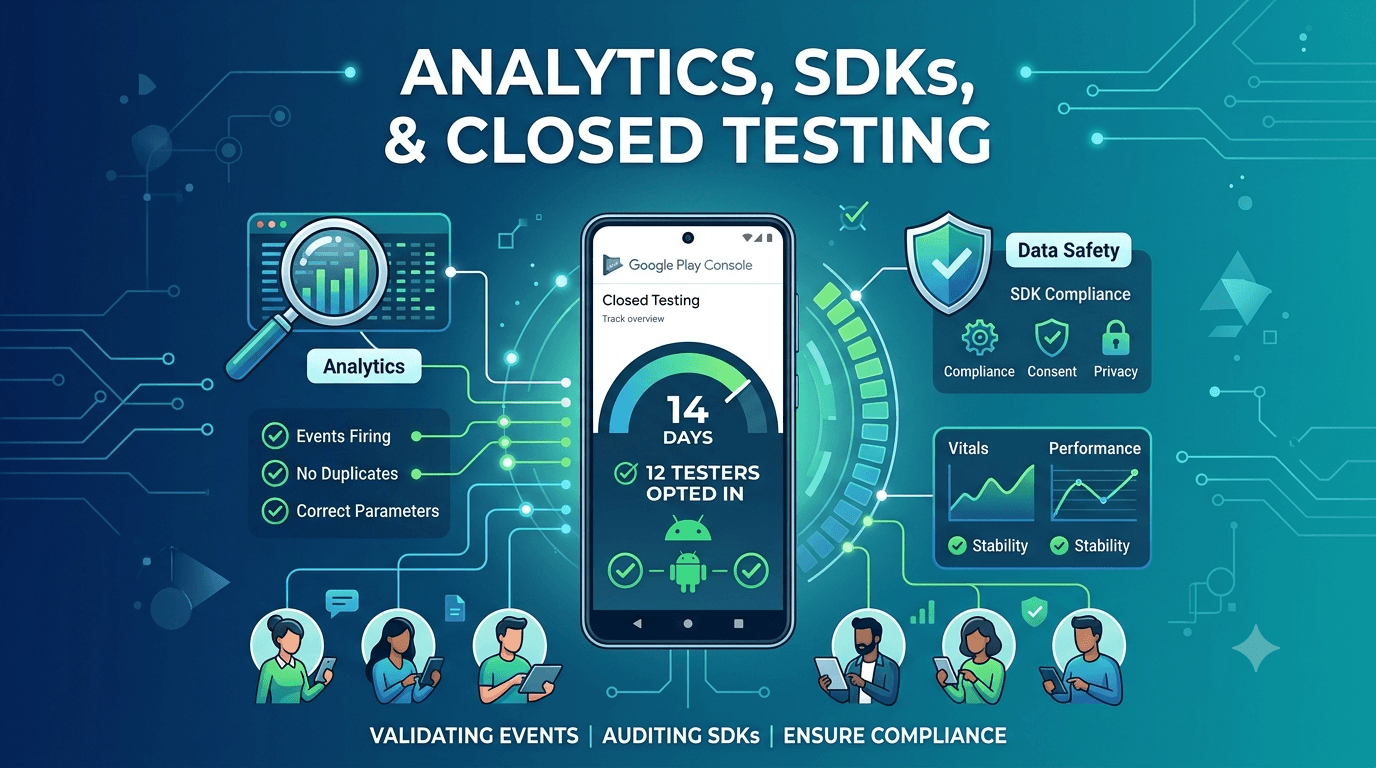
Analytics and third-party SDKs are essential for understanding how users behave, but they also collect data, add code you did not write, and must be reflected accurately in your Data safety declarations. Getting analytics right during your closed-testing period means both verifying that your events fire correctly and confirming that every SDK complies with policy and privacy requirements. Like any app published from a new personal account, yours must complete a closed test with at least 12 testers opted in for 14 continuous days before production access. This guide covers analytics and SDK testing to run during your window.
The closed-testing process is the same as for any app, but analytics validation and SDK compliance are areas that are easy to neglect and costly to get wrong. Using your window to verify both turns the mandatory wait into cleaner data and safer compliance from day one.
The requirement and analytics
The closed-testing requirement is tied to your developer account type, so any app on a new personal account must complete a closed test with 12+ testers for 14 continuous days before production access. See the closed testing guide. The window is an ideal opportunity to validate your analytics events with real usage and to audit your SDKs before launch.
Standard advice applies: recruit committed, device-diverse testers, keep your count above 12, and prepare your listing in parallel. Real tester activity also generates the first real analytics data you can use to confirm your instrumentation is correct.
Validating analytics events
Analytics are only useful if the data is accurate, and instrumentation bugs are common: events that never fire, fire twice, carry wrong parameters, or attribute actions to the wrong screen. Use your closed test — with real testers performing real actions — to verify that your key events fire correctly and with the right data. Most analytics platforms offer a debug or real-time view where you can watch events arrive as testers use the app, which is the ideal way to confirm your instrumentation before you rely on the data post-launch.
| Analytics test focus | Why it matters |
|---|---|
| Events fire correctly | Missing events mean blind spots |
| No duplicates | Double-counting corrupts metrics |
| Correct parameters | Wrong data misleads decisions |
| Funnels & screens | Attribution must be accurate |
| Consent gating | Analytics respect user consent |
Real tester activity is the perfect way to validate instrumentation. See closed testing metrics explained.
SDK compliance and data safety
Every third-party SDK in your app — analytics, ads, crash reporting, attribution — collects or processes data, and you are responsible for declaring that accurately in your Data safety form. Google requires your Data safety declarations to reflect all data collection, including by SDKs, so you must know what each SDK does. Audit your dependencies, understand what data each collects and shares, and ensure your declarations and privacy policy are complete and accurate. Undeclared SDK data collection is a common enforcement trigger. See Google's data safety guidance and the data safety form guide.
Use your window to complete this audit thoroughly: list every SDK, confirm what it collects, verify it is configured for compliance (for example, respecting consent and, for kids apps, using only certified SDKs), and align your declarations with reality. If your app serves children, every SDK must meet Families requirements, which many analytics and ads SDKs do not by default. Getting SDK compliance right is as important as any functional test, since it directly affects your account's standing. See privacy policy requirements.
Consent and privacy
Depending on your users' regions and your data practices, you may need to obtain user consent before collecting analytics data, and your SDKs must honor that consent. Test that any consent mechanism works — that declining consent actually stops the relevant data collection, and that granting it enables analytics as expected. Consent that is displayed but not actually enforced is both a compliance risk and a betrayal of user trust, so verify the wiring end to end during your window.
Test consent behavior across the scenarios your users will encounter, and confirm that data flows match what you declared and what the user chose. For apps serving European users or children, consent and data-minimization requirements are stricter, so pay particular attention. Real testing of your consent and data flows during the closed-testing window ensures that your privacy posture is not just declared but actually implemented, protecting both your users and your account. See GDPR compliance.
Performance and stability impact
SDKs add code, and poorly behaved SDKs can slow your app, increase its size, drain battery, or even cause crashes. Use your closed test to watch for SDK-related performance and stability problems: check that adding your SDKs has not bloated startup time, that none is causing ANRs or crashes (visible in Android vitals), and that background SDK activity is reasonable. An analytics or attribution SDK that misbehaves can degrade the whole app, so validate that your SDKs are good citizens across devices.
Android vitals will surface crashes and ANRs from your testers, some of which may trace to a specific SDK. Investigate any such issues during your window, and consider whether each SDK earns its place given its performance cost. Real-device testing across your tester group reveals SDK-induced problems that a clean development environment hides, letting you enter production with a lean, stable app rather than one weighed down by third-party code. See Android vitals during closed testing.
Setting up your closed-testing track
Once your signed release build is ready, create a closed-testing track in the Play Console and upload it, add testers by email or Google Group, and share the opt-in link each tester must use before installing. Correct configuration matters because the 14-day clock counts only opted-in testers, and a misconfigured track is a common reason developers realize late that their timer never started. Set up your analytics debug view so you can watch events as testers use the app, and verify on a real device before inviting your full group. See how to create a closed testing track.
Give testers clear onboarding instructions and let them use the app naturally so your analytics capture realistic behavior. Every failed opt-in is a tester who does not count toward your 12, so smooth guidance maximizes active testers from day one and gives you real usage data to validate your instrumentation.
Recruiting and managing the window
You need 12+ committed, device-diverse testers for 14 continuous days. Recruit a buffer above 12, keep testers engaged with clear tasks and quick responses, and let their natural usage exercise your analytics. Monitor your active count in the Play Console and recruit replacements early if it slips. Their activity doubles as both requirement fulfillment and instrumentation validation.
If assembling a reliable, device-diverse group is your bottleneck, a service that supplies verified real testers solves it quickly. You can submit your app to get started, and read where to find real testers and how to keep testers engaged.
Why real usage matters here
Analytics instrumentation can only be truly validated with real, varied usage, because bugs like double-firing events, wrong attribution, or missing parameters often appear only under real navigation patterns and on specific devices. Similarly, SDK performance and consent behavior depend on real conditions. A developer clicking through a happy path once will not exercise the analytics the way a group of real testers over two weeks does, which is exactly why the closed-testing window is such a good fit for this validation.
This is why the window, built on real opt-in testers, is genuinely valuable for analytics and SDK work. Real testers generate the authentic usage data that reveals instrumentation bugs, and their varied devices surface SDK performance and stability issues. The window is your structured chance to confirm your data is trustworthy and your SDKs are compliant and well-behaved before launch, and diversity in your tester group makes that confirmation meaningful. See performance testing.
Making the 14-day window count
Because the requirement forces you to test anyway, use the window to get your analytics and SDKs right. Watch events arrive in real time as testers use the app, audit every SDK for compliance, verify consent, and check for SDK-induced performance issues. A well-run window turns a mandatory delay into trustworthy data and a compliant, lean app from the moment you launch.
Enter production knowing your key events fire correctly, your Data safety declarations match reality, your consent works, and no SDK is dragging down your app, and you launch on a solid analytical and compliance footing. The 14 days are an investment in decision-making data and account safety. See the testing checklist.
Turning tester activity into confidence
Unlike features testers consciously exercise, analytics validation mostly relies on you observing the data their natural usage generates. Still, ask testers to report anything odd — unexpected prompts, consent dialogs that reappear, or performance hiccups — and correlate that with your analytics and vitals. Combining their qualitative reports with the quantitative event data gives you a complete picture of both instrumentation correctness and SDK behavior.
When you fix an instrumentation or SDK issue, redeploy and confirm the corrected behavior in your analytics debug view with fresh tester activity. This closes the loop and validates your fix under real usage. An app that enters production having verified its analytics and audited its SDKs launches with data it can trust and compliance it can defend. See fixing crashes before production.
A realistic timeline and next steps
Plan backward from the 14-day minimum: a few days to finalize your build, set up analytics debugging, and recruit testers, the continuous 14-day window during which you validate events and audit SDKs, then production review, for roughly three to four weeks end to end. Front-load recruitment and your SDK audit so nothing blocks you when the window closes. When it completes, request production access with your listing and declarations prepared in parallel. See what happens after 14 days and internal vs closed testing.
After launch: trusting your data
Your closed test is the start of quality assurance, not the end. Once you launch and real users arrive, your validated instrumentation should give you data you can trust for decisions, but keep an eye out for anomalies — sudden drops or spikes in events often signal an instrumentation regression rather than a real behavior change. Whenever you ship an update that touches tracked flows, re-verify the affected events, and periodically re-audit your SDKs as you add or update dependencies, since each change can alter what data you collect and what you must declare. Treating data quality and SDK compliance as ongoing keeps both your metrics and your account healthy. See post-launch monitoring.
Key takeaways
- The 12-tester, 14-day requirement applies regardless of analytics.
- Validate events with real tester usage — check firing, duplicates, and parameters.
- Audit every SDK and align your Data safety declarations with reality.
- Verify consent is actually enforced, not just displayed.
- Watch for SDK-induced performance and stability issues in vitals.
Frequently asked questions
Do apps with analytics need closed testing?
Yes. On a new personal account, the 12-tester, 14-day requirement applies regardless of features.
How do I validate analytics during closed testing?
Use your platform's debug or real-time view to watch events arrive as real testers use the app, checking firing, duplicates, and parameters.
Do I need to declare SDK data collection?
Yes. Your Data safety form must reflect all data collection, including by third-party SDKs. Audit each SDK and align your declarations.
What about analytics in kids apps?
Every SDK must meet Families requirements, and many analytics SDKs do not by default. Use only compliant SDKs and minimize data.
Can an SDK hurt my app's performance?
Yes. Poorly behaved SDKs can slow startup, bloat size, drain battery, or cause crashes. Watch vitals and validate SDK behavior across devices.
How do I keep analytics accurate after launch?
Re-verify affected events whenever you ship changes to tracked flows, watch for anomalous spikes or drops that signal regressions, and re-audit SDKs as dependencies change.
Expanded for topical authority — additional practical sections below. Original guide content above is unchanged.
Quick answer
Analytics SDK Testing During Closed Testing matters because Google Play production access for many new personal developer accounts depends on a successful closed test: at least 12 real testers opted in for 14 continuous days, plus a policy-compliant, stable app. Use this guide to execute the steps correctly, avoid streak-breaking mistakes, and decide whether DIY recruitment or a managed closed testing service is the better path for your deadline.
Real-world scenarios: who this matters for
The guidance in this article on Analytics SDK Testing During Closed Testing applies across many Android product types. Use these scenarios to map the advice to your situation.
| Developer type | Typical challenge | Practical focus |
|---|---|---|
| Indie / solo | Limited tester network and time | Start closed testing early; keep a buffer above 12 opted-in testers; parallelize listing + Data safety work |
| Startup | Launch deadline vs 14-day rule | Treat the window as fixed; recruit in parallel with QA; avoid last-minute track setup |
| Agency / white-label | Multiple client apps, each needing its own test | One closed test per app; standardize opt-in onboarding; track eligibility dates per client |
| Flutter / React Native | Cross-platform build + Play Console quirks | Ship a signed AAB to closed testing; verify installs from Play, not sideload; watch vitals on mid-range devices |
| Native Kotlin | Device/API fragmentation | Cover API levels and OEMs in your tester mix; fix crashes before requesting production |
| Game / Unity | Performance + retention during 14 days | Keep testers engaged so count never dips below 12; monitor ANRs and battery |
| E-commerce / fintech | Policy + payment flows | Test checkout, permissions, and declarations carefully before production access |
| Healthcare / kids / education | Sensitive policies (Families, data) | Align listing, privacy, and content rating with real app behavior during the test window |
Visual placeholder: Scenario matrix infographic — Indie / Startup / Agency / Cross-platform paths for Analytics SDK Testing During Closed Testing.
Closed testing vs other Play tracks (quick reference)
Context for Analytics SDK Testing During Closed Testing: choose the right track so you do not waste the 14-day window on the wrong workflow.
| Track | Purpose | Counts toward 12×14? | Typical use |
|---|---|---|---|
| Internal testing | Fast private builds | No | Shake out bugs before the counted window |
| Closed testing | Private / invite testers | Yes (for new personal accounts) | Meet production-access requirement + QA |
| Open testing | Public beta | Not a substitute for the closed requirement | Broader feedback after closed eligibility |
| Production | Public release | N/A | After access approved + review |
Visual placeholder: Timeline — Internal → Closed (14 days) → Production request → Staged rollout.
Common mistakes (and how to avoid them)
These mistakes repeatedly show up when developers work through Analytics SDK Testing During Closed Testing:
- Confusing invited vs opted-in testers — Only testers who open the opt-in link and install from Play count toward 12. Check the opted-in number in Play Console, not your email list.
- Recruiting exactly 12 with no buffer — One uninstall can break continuity. Aim for ~15 active opted-in testers.
- Starting the counted clock late — Listing assets, Data safety, and privacy work should run during the 14 days, not after.
- Using sideloaded APKs or fake installs — They do not satisfy Play’s closed testing expectations and can create account risk.
- Ignoring tester feedback until day 14 — Crashes that drive uninstalls threaten your streak and your review outcome.
- Requesting production access before the continuous streak completes — Eligibility checks fail even if calendar time has passed.
Troubleshooting checklist
If something feels “stuck” while applying Analytics SDK Testing During Closed Testing, walk this list before changing strategy:
| Symptom | Likely cause | Fix |
|---|---|---|
| Console shows < 12 testers | Invites sent but not opted in | Resend opt-in link; confirm install from Play |
| “Not eligible” after 14 calendar days | Count dipped below 12 mid-window | Restore 12+ and complete a full continuous streak |
| Tester cannot join | Wrong account, Group lag, or track not published | Verify Google account, Group membership, track release |
| App fails to install | Device/API mismatch or signing issue | Check AAB, minSDK, Play App Signing |
| Production still rejected after testing | Policy, declarations, or stability — not the clock | Read the exact reason; fix that category completely |
Visual placeholder: Troubleshooting flowchart for Analytics SDK Testing During Closed Testing.
Action checklist
Use this checklist alongside the rest of this guide on Analytics SDK Testing During Closed Testing:
- ☐ Closed testing track created with a signed release (AAB)
- ☐ Opt-in link tested on a fresh Google account
- ☐ At least 12 testers opted in (prefer ~15)
- ☐ Daily check that opted-in count stays ≥ 12 for 14 continuous days
- ☐ Core flows exercised (login, main feature, permissions, offline/online)
- ☐ Crashes / ANRs triaged from tester reports and vitals
- ☐ Store listing, screenshots, and feature graphic drafted
- ☐ Privacy policy + Data safety + content rating aligned with real behavior
- ☐ Production access requested only after eligibility is green
- ☐ Staged rollout plan ready for first public release
Additional FAQs developers ask about Analytics SDK Testing During Closed Testing
Quick answer: what should I do first?
Confirm you are on a closed testing track with real opted-in installs, keep 12+ testers for 14 continuous days, and fix policy/stability issues in parallel. Then use the detailed sections above for Analytics SDK Testing During Closed Testing.
Does this apply to organization (company) accounts?
The classic 12×14 closed testing gate is primarily associated with new personal developer accounts. Always verify your account type and current Play Console eligibility messaging for your app.
Do friends and family count as testers?
Yes — if they opt in via your closed testing link and install from Google Play. They only help if they stay opted in for the continuous period.
Can I update the app during the 14 days?
You can usually push updates on the closed track, but unstable releases that cause uninstalls can threaten your tester count. Prefer polishing via internal testing first when possible.
What if production access is still rejected?
Read the exact reason. Incomplete testing is only one category — policy, Data safety mismatches, and crashes are common. Fix the cited issue fully before reapplying.
Is paying for testers allowed?
Using real people who install from Play is what matters. Avoid fake install farms. A one-time managed service that supplies real closed testers is a practical option when DIY recruitment is too slow.
How is Fast Testers different from free communities?
Free communities trade time and mutual availability. Fast Testers assigns about 15 real testers after you submit a valid closed testing link (one-time $15 per app) and includes a production access guarantee under its refund terms.
Where should I go next?
Review the related guides below, then either finish DIY recruitment or start closed testing if you need speed and continuity.
Sources, updates, and how to use this guide
This article on Analytics SDK Testing During Closed Testing is maintained for Android developers preparing Google Play closed testing and production access. Always cross-check eligibility text inside your own Play Console, because Google’s UI labels and account rules can vary by account type and date.
- Primary official references: Google Play closed testing help, Developer Program Policies, and Play Console eligibility messaging for your app.
- Practical experience lens: guidance here reflects common failure modes indie developers and agencies hit when recruiting testers, maintaining the 14-day streak, and recovering from production-access rejections.
- Last reviewed focus: 12×14 closed testing continuity, real vs fake testers, and parallel listing/compliance work during the window.
Related guides and next steps
Continue building topical depth around Analytics SDK Testing During Closed Testing with these Fast Testers resources:
- Closed Testing Vs Open Testing On Google Play
- Crash Reports During Closed Testing Fix Before Production
- Google Play Android Vitals During Closed Testing
- Google Play Internal Testing Vs Closed Testing
- Google Play Policy Violations During Closed Testing
- App Bundle Vs Apk For Closed Testing Releases
- Ar Vr Android Apps And Closed Testing Requirements
- Avoiding Tester Dropout During 14 Day Testing
- Pricing — $15 closed testing
- How Fast Testers works
- FAQ
- Developer reviews
- Case studies
- Submit your app / start closed testing
Need reliable testers so your 14-day streak does not stall? Educate first with the guides above, then start when you are ready — one-time pricing, real Play installs, dashboard tracking.
Further expansion — case study, decisions, and expert recommendations. Prior sections remain unchanged.
Case study: first Play launch planned around the closed testing window
Problem: A small SaaS team treated Google Play publishing like iOS TestFlight — they expected to upload and go public the same week. They discovered the personal-account closed testing gate mid-sprint.
Solution: They reframed the sprint around Analytics SDK Testing During Closed Testing: internal testing for crash triage first, then closed testing with a buffer of testers, while design finished screenshots and legal finished privacy/Data safety in parallel.
Result: The 14-day requirement stopped feeling like “dead time.” When eligibility flipped green, listing and declarations were already ready, so production review was the only remaining gate.
Lessons learned:
- Start the closed track as soon as the build is stable enough to keep installed.
- Parallelize compliance work inside the window.
- Protect the streak like a production SLA.
Decision guide: what should you do next?
Use this decision path when applying Analytics SDK Testing During Closed Testing:
- Is your account a new personal developer account that still needs production access?
If yes, plan for closed testing with 12+ opted-in testers for 14 continuous days. If no, still test — but confirm the exact eligibility text in Play Console. - Do you already have 12+ reliable people who will install from Play and stay for two weeks?
If yes, DIY can work — add a buffer and monitor daily. If no, use community exchange or a managed closed testing service. - Is your build stable enough that testers will not churn?
If no, run internal testing first. Entering the counted window with crash loops is how streaks die. - Are Data safety, privacy policy, permissions, and listing aligned with real behavior?
If no, fix during the window so production review does not bounce you after the clock. - Has production access been rejected?
Classify: eligibility vs policy vs declarations vs stability. Fix that category completely, then re-test / re-request.
Visual placeholder: Decision tree diagram for Analytics SDK Testing During Closed Testing (DIY vs managed vs fix-and-retry).
Expert recommendations
- Instrument the streak: Check opted-in count daily for the first week; replace dropouts same day.
- Brief testers once: Send a short checklist (install from Play, open app daily, try core flow, report crashes). Silent testers still count if opted in — engaged testers protect quality.
- Never “solve” recruitment with fake installs: It fails the intent of closed testing and can create account risk.
- Ship a boring-stable build to closed testing: Save experimental features for internal tracks.
- Educate first, then accelerate: If your blocker is simply finding real testers fast, a one-time managed option (Fast Testers: 15 testers, $15/app) is often cheaper than slipping a launch.
For hands-on setup after reading about Analytics SDK Testing During Closed Testing, see how it works and pricing, or submit your closed testing link when you are ready.
Internal navigation hub — added to strengthen topical connections. Original article content above is unchanged.
Continue learning
- App Bundle vs APK for Closed Testing Releases — Learn about AAB release format for Google Play closed testing. Complete guide for Android developers publishin.
- Push Notification Testing with Closed Testers — Learn about FCM testing for Google Play closed testing. Complete guide for Android developers publishing on th.
- Dark Mode and Theme Testing on Android — Learn about theme testing for Google Play closed testing. Complete guide for Android developers publishing on .
- Deep Link Testing Before Google Play Production — Learn about deep link QA for Google Play closed testing. Complete guide for Android developers publishing on t.
- Instant Apps and Google Play Testing Considerations — Learn about instant app testing for Google Play closed testing. Complete guide for Android developers publishi.
- Notification Permission Changes and App Testing — Learn about notification permission testing for Google Play closed testing. Complete guide for Android develop.
Next steps
- Ready to run closed testing with real Android testers? Submit your app or see pricing ($15 one-time).
- Compare options on our testing service comparison page, or read developer reviews and case studies.
- Still deciding? Review how Fast Testers works and the FAQ.