
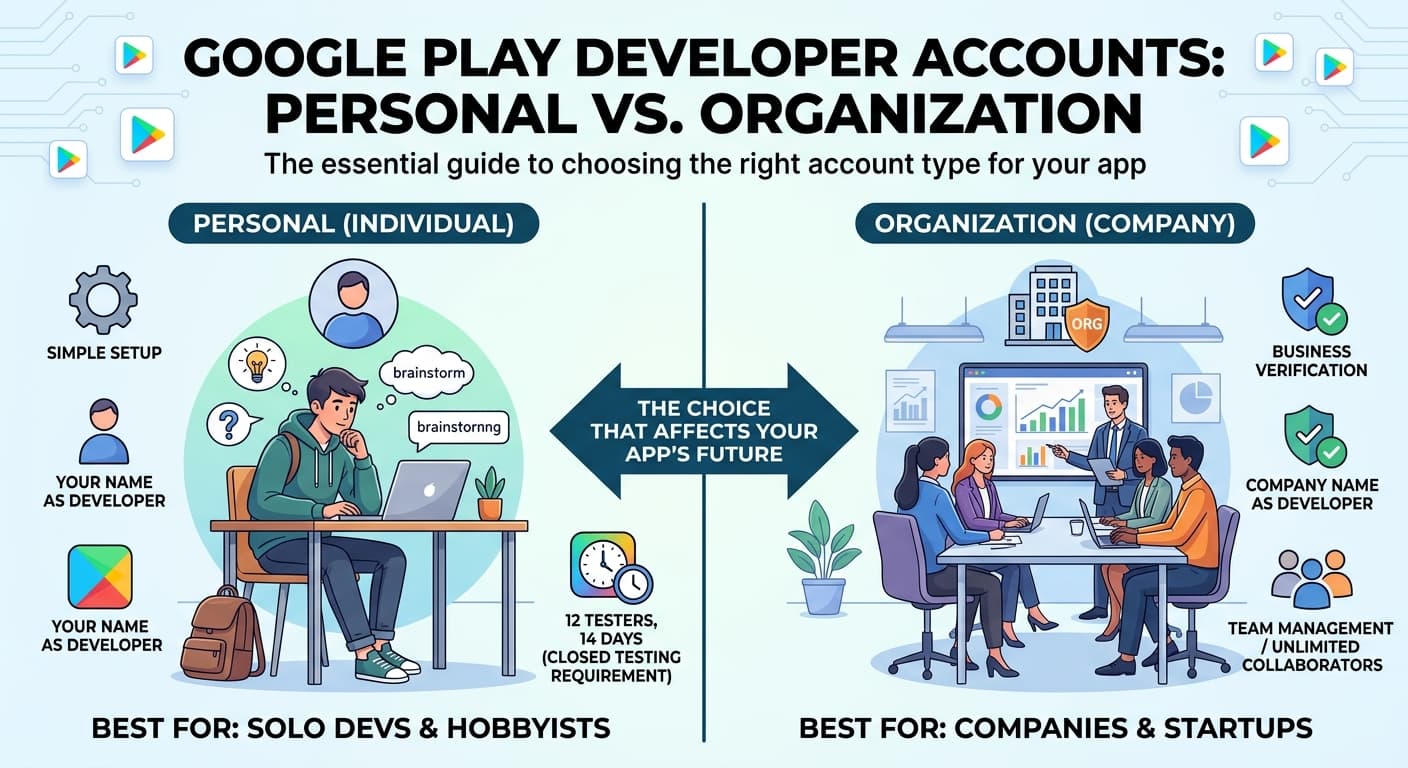
One of the first and most consequential decisions when publishing on Google Play is whether to register a personal (individual) developer account or an organization (company) account. This choice affects your verification requirements, whether the closed-testing 12-tester rule applies to you, how your developer name appears, and more. Choosing the wrong type can mean unnecessary hurdles or a name you cannot easily change, so it is worth understanding the differences before you register. This guide compares personal and organization accounts across every dimension that matters.
The headline difference most developers care about is that the closed-testing production-access requirement primarily targets new personal accounts, while organization accounts follow a different path. But there is more to the decision than that single rule, and picking correctly depends on who you are and what you are building.
What a personal account is
A personal or individual developer account is registered to you as an individual, using your own identity. It is the natural choice for solo developers, hobbyists, and indie makers publishing under their own name. Registration is straightforward and requires verifying your personal identity. Your developer name typically reflects you as an individual, and you are personally responsible for the account and its apps.
The key consideration for new personal accounts is the closed-testing requirement: to gain production access you must run a closed test with at least 12 testers for 14 continuous days. This is the rule that sends most indie developers looking for testers. For the full requirement, see the closed testing guide.
What an organization account is
An organization (company) account is registered to a legal business entity rather than an individual. It requires a D-U-N-S number (a business identifier) and verification of the organization's legitimacy, which is a more involved process than personal verification. Organization accounts are appropriate for companies, startups with a legal entity, and teams publishing under a business name.
Organization accounts appear under the business name and are owned by the entity, which matters for branding, continuity, and team management. The verification is more demanding, but organization accounts are generally not subject to the same new-personal-account closed-testing prerequisite in the same way, following the standard publishing path instead. That said, testing your app well before launch remains a best practice regardless of account type.
Side-by-side comparison
| Aspect | Personal account | Organization account |
|---|---|---|
| Registered to | An individual | A legal business entity |
| Verification | Personal identity | Business (D-U-N-S) + identity |
| Developer name | Usually individual | Business name |
| 12-tester requirement | Applies to new accounts | Different path |
| Best for | Solo devs, hobbyists, indies | Companies, startups, teams |
| Setup complexity | Lower | Higher |
This comparison highlights the trade-off: personal accounts are simpler to set up but carry the closed-testing prerequisite for new accounts, while organization accounts require more verification but suit businesses and follow a different path. Match the account type to your actual situation rather than trying to game the requirement.
Which should you choose?
If you are a solo developer or hobbyist publishing under your own name, a personal account is the natural, simpler choice — just plan for the closed-testing requirement. If you are a registered business, a startup with a legal entity, or a team that wants to publish under a company name with business ownership and continuity, an organization account is appropriate despite the heavier verification. Do not register as an organization solely to avoid the testing requirement if you are not genuinely a business; misrepresenting your entity can cause problems.
Remember that whichever you choose, testing your app before launch is valuable. The closed-testing requirement formalizes what good developers do anyway. If you are a personal account facing the requirement and struggling to find testers, you can submit your app to get verified real testers.
Can you switch account types?
Changing account type after registration is not always simple, and some attributes (like your developer name) can be difficult to change later, so it is best to choose correctly from the start. If your circumstances change — for example, a solo project becomes a registered company — investigate the current transfer and conversion options in the Play Console rather than assuming it is trivial. For related mechanics, see transferring apps between accounts.
Because switching can be awkward, think ahead about your trajectory. If you expect to operate as a business soon, registering as an organization from the outset may save friction later, even though the initial verification is heavier.
Getting through verification
Both account types require verification, and completing it accurately and promptly avoids delays. Personal accounts verify your individual identity; organization accounts additionally verify the business, typically via a D-U-N-S number, which can take time to obtain if you do not already have one. Provide consistent, accurate information and respond quickly to any verification requests. See developer identity verification and the official Play Console overview.
Verification issues are a common cause of delays and even production-access problems, so treat this step seriously regardless of account type. A fully verified account with consistent details is the foundation for a smooth path to launch.
Key takeaways
- Personal accounts suit individuals; organization accounts suit businesses.
- The 12-tester closed-testing prerequisite targets new personal accounts.
- Organization accounts need a D-U-N-S number and heavier verification.
- Choose based on who you genuinely are, not to game the requirement.
- Switching later can be awkward — choose correctly from the start.
Thinking about the long-term implications
The personal-versus-organization decision is easy to treat as a one-time registration formality, but it has long-term implications that ripple through the entire life of your developer presence, so it deserves more thought than most first-time publishers give it. The account type shapes how your apps are branded, who legally owns them, how easily you can bring on collaborators, and how gracefully your presence can grow or transfer as your circumstances change. Choosing with the future in mind, not just today's convenience, saves you from friction that is difficult to undo later.
Consider branding and identity first. A personal account typically presents under your individual identity, which is perfect for a solo maker building a personal reputation but can feel less professional for a product meant to look like it comes from a company. An organization account presents under a business name, which lends credibility to a commercial product and keeps your personal identity separate from the app. If you expect your app to be perceived as a business offering rather than a personal project, the organization route aligns better with that perception from day one.
Ownership and continuity are the next long-term factors. Apps under a personal account are tied to you as an individual, which can complicate matters if you later form a company, bring on partners, or want the app owned by a business entity for legal or tax reasons. Apps under an organization account are owned by the entity itself, which makes continuity, team involvement, and eventual transfer far cleaner. Because moving apps and changing account attributes after the fact can be awkward, anticipating your trajectory now prevents painful migrations later — see transferring apps between accounts.
Team management also differs meaningfully. If you are a solo developer with no plans to collaborate, a personal account is perfectly adequate and simpler to run. But if you expect to work with others — designers, additional developers, or business partners who need Console access — an organization account is built for that kind of shared, role-based management. Setting up the right structure from the beginning is far easier than retrofitting collaboration onto an account that was never designed for it, so factor in not just who is building the app today but who might be involved tomorrow.
Weighing all of this, the guiding principle is to choose the account type that matches not only who you are today but who you realistically expect to be during your app's lifetime. A genuine hobby project under your own name is a natural fit for a personal account, testing requirement and all. A product you intend to grow into a business, involve others in, or present under a company brand is better served by an organization account despite its heavier verification. And whichever you choose, remember that thorough pre-launch testing remains valuable regardless — if you are a personal account facing the closed-testing requirement, you can submit your app to meet it with real testers.
Navigating verification for each account type
Verification is the step where the practical difference between account types becomes most tangible, and understanding what each requires helps you avoid the delays that catch unprepared developers. Both personal and organization accounts must be verified before you can fully operate, but the nature and difficulty of that verification differ substantially, and planning for the specific requirements of your chosen type keeps your path to launch smooth rather than stalled on paperwork.
For a personal account, verification centers on confirming your individual identity. You provide personal identifying information and, depending on Google's current requirements, may need to supply identity documentation. This is generally the lighter of the two processes, but it is not trivial — inconsistent or inaccurate information can cause delays or complications, and unresolved identity verification can even interfere with production access down the line. The practical advice is to provide accurate, consistent details that match your identity documents and to respond promptly to any verification request rather than letting it sit.
For an organization account, verification is more involved because Google is confirming the legitimacy of a business entity, not just a person. This typically requires a D-U-N-S number, a unique identifier issued to businesses, which you may need to obtain if you do not already have one — and acquiring a D-U-N-S number can itself take time, so it is wise to start early if you are going the organization route. Google also verifies details about the organization and the individuals associated with it, making the overall process heavier and slower than personal verification, though it is entirely manageable with preparation.
Because verification issues are a common source of delay for both types, and can even contribute to production-access problems, treating this step seriously from the outset pays off. Gather the necessary information and documents before you begin, ensure everything is consistent across your account, and factor the verification timeline into your launch planning — especially for organization accounts, where obtaining a D-U-N-S number adds lead time. A fully verified account with clean, consistent details is the foundation on which a smooth launch is built, regardless of which type you chose.
Whichever account type you select, verification is a one-time hurdle that, once cleared, rarely troubles you again. Getting it right up front — accurate information, prompt responses, and for organizations an early start on the D-U-N-S number — means you never have to worry about it interfering with a time-sensitive launch later. For more on this, see developer identity verification, and if you are a personal account facing the testing requirement after verification, you can submit your app to meet it efficiently.
Frequently asked questions
Does the 12-tester rule apply to organization accounts?
It primarily targets new personal accounts. Organization accounts follow a different path, though testing remains a best practice.
Can I move apps from a personal to an organization account later?
Transfers are possible but can be awkward, which is why choosing the right type upfront is best. See our guide on transferring apps between accounts.
Do I need a business to use an organization account?
Yes. Organization accounts require a legal entity and a D-U-N-S number, and verify the business itself.
How long does a D-U-N-S number take to get?
It varies and can take time, so start early if you plan to register an organization account, to avoid delaying your launch on paperwork.
Can I change my developer name later?
Some attributes are hard to change after registration, so choose your account type and name carefully upfront.
Should I register as an organization to skip testing?
No. Only register as an organization if you are genuinely a business. Misrepresenting your entity can cause problems.
Which account is simpler to set up?
Personal accounts are simpler, requiring only individual identity verification, but new ones carry the testing requirement.
Expanded for topical authority — additional practical sections below. Original guide content above is unchanged.
Quick answer
Google Play Personal Account vs Organization Account matters because Google Play production access for many new personal developer accounts depends on a successful closed test: at least 12 real testers opted in for 14 continuous days, plus a policy-compliant, stable app. Use this guide to execute the steps correctly, avoid streak-breaking mistakes, and decide whether DIY recruitment or a managed closed testing service is the better path for your deadline.
Real-world scenarios: who this matters for
The guidance in this article on Google Play Personal Account vs Organization Account applies across many Android product types. Use these scenarios to map the advice to your situation.
| Developer type | Typical challenge | Practical focus |
|---|---|---|
| Indie / solo | Limited tester network and time | Start closed testing early; keep a buffer above 12 opted-in testers; parallelize listing + Data safety work |
| Startup | Launch deadline vs 14-day rule | Treat the window as fixed; recruit in parallel with QA; avoid last-minute track setup |
| Agency / white-label | Multiple client apps, each needing its own test | One closed test per app; standardize opt-in onboarding; track eligibility dates per client |
| Flutter / React Native | Cross-platform build + Play Console quirks | Ship a signed AAB to closed testing; verify installs from Play, not sideload; watch vitals on mid-range devices |
| Native Kotlin | Device/API fragmentation | Cover API levels and OEMs in your tester mix; fix crashes before requesting production |
| Game / Unity | Performance + retention during 14 days | Keep testers engaged so count never dips below 12; monitor ANRs and battery |
| E-commerce / fintech | Policy + payment flows | Test checkout, permissions, and declarations carefully before production access |
| Healthcare / kids / education | Sensitive policies (Families, data) | Align listing, privacy, and content rating with real app behavior during the test window |
Visual placeholder: Scenario matrix infographic — Indie / Startup / Agency / Cross-platform paths for Google Play Personal Account vs Organization Account.
Closed testing vs other Play tracks (quick reference)
Context for Google Play Personal Account vs Organization Account: choose the right track so you do not waste the 14-day window on the wrong workflow.
| Track | Purpose | Counts toward 12×14? | Typical use |
|---|---|---|---|
| Internal testing | Fast private builds | No | Shake out bugs before the counted window |
| Closed testing | Private / invite testers | Yes (for new personal accounts) | Meet production-access requirement + QA |
| Open testing | Public beta | Not a substitute for the closed requirement | Broader feedback after closed eligibility |
| Production | Public release | N/A | After access approved + review |
Visual placeholder: Timeline — Internal → Closed (14 days) → Production request → Staged rollout.
Common mistakes (and how to avoid them)
These mistakes repeatedly show up when developers work through Google Play Personal Account vs Organization Account:
- Confusing invited vs opted-in testers — Only testers who open the opt-in link and install from Play count toward 12. Check the opted-in number in Play Console, not your email list.
- Recruiting exactly 12 with no buffer — One uninstall can break continuity. Aim for ~15 active opted-in testers.
- Starting the counted clock late — Listing assets, Data safety, and privacy work should run during the 14 days, not after.
- Using sideloaded APKs or fake installs — They do not satisfy Play’s closed testing expectations and can create account risk.
- Ignoring tester feedback until day 14 — Crashes that drive uninstalls threaten your streak and your review outcome.
- Requesting production access before the continuous streak completes — Eligibility checks fail even if calendar time has passed.
Troubleshooting checklist
If something feels “stuck” while applying Google Play Personal Account vs Organization Account, walk this list before changing strategy:
| Symptom | Likely cause | Fix |
|---|---|---|
| Console shows < 12 testers | Invites sent but not opted in | Resend opt-in link; confirm install from Play |
| “Not eligible” after 14 calendar days | Count dipped below 12 mid-window | Restore 12+ and complete a full continuous streak |
| Tester cannot join | Wrong account, Group lag, or track not published | Verify Google account, Group membership, track release |
| App fails to install | Device/API mismatch or signing issue | Check AAB, minSDK, Play App Signing |
| Production still rejected after testing | Policy, declarations, or stability — not the clock | Read the exact reason; fix that category completely |
Visual placeholder: Troubleshooting flowchart for Google Play Personal Account vs Organization Account.
Action checklist
Use this checklist alongside the rest of this guide on Google Play Personal Account vs Organization Account:
- ☐ Closed testing track created with a signed release (AAB)
- ☐ Opt-in link tested on a fresh Google account
- ☐ At least 12 testers opted in (prefer ~15)
- ☐ Daily check that opted-in count stays ≥ 12 for 14 continuous days
- ☐ Core flows exercised (login, main feature, permissions, offline/online)
- ☐ Crashes / ANRs triaged from tester reports and vitals
- ☐ Store listing, screenshots, and feature graphic drafted
- ☐ Privacy policy + Data safety + content rating aligned with real behavior
- ☐ Production access requested only after eligibility is green
- ☐ Staged rollout plan ready for first public release
Additional FAQs developers ask about Google Play Personal Account vs Organization Account
Quick answer: what should I do first?
Confirm you are on a closed testing track with real opted-in installs, keep 12+ testers for 14 continuous days, and fix policy/stability issues in parallel. Then use the detailed sections above for Google Play Personal Account vs Organization Account.
Does this apply to organization (company) accounts?
The classic 12×14 closed testing gate is primarily associated with new personal developer accounts. Always verify your account type and current Play Console eligibility messaging for your app.
Do friends and family count as testers?
Yes — if they opt in via your closed testing link and install from Google Play. They only help if they stay opted in for the continuous period.
Can I update the app during the 14 days?
You can usually push updates on the closed track, but unstable releases that cause uninstalls can threaten your tester count. Prefer polishing via internal testing first when possible.
What if production access is still rejected?
Read the exact reason. Incomplete testing is only one category — policy, Data safety mismatches, and crashes are common. Fix the cited issue fully before reapplying.
Is paying for testers allowed?
Using real people who install from Play is what matters. Avoid fake install farms. A one-time managed service that supplies real closed testers is a practical option when DIY recruitment is too slow.
How is Fast Testers different from free communities?
Free communities trade time and mutual availability. Fast Testers assigns about 15 real testers after you submit a valid closed testing link (one-time $15 per app) and includes a production access guarantee under its refund terms.
Where should I go next?
Review the related guides below, then either finish DIY recruitment or start closed testing if you need speed and continuity.
Sources, updates, and how to use this guide
This article on Google Play Personal Account vs Organization Account is maintained for Android developers preparing Google Play closed testing and production access. Always cross-check eligibility text inside your own Play Console, because Google’s UI labels and account rules can vary by account type and date.
- Primary official references: Google Play closed testing help, Developer Program Policies, and Play Console eligibility messaging for your app.
- Practical experience lens: guidance here reflects common failure modes indie developers and agencies hit when recruiting testers, maintaining the 14-day streak, and recovering from production-access rejections.
- Last reviewed focus: 12×14 closed testing continuity, real vs fake testers, and parallel listing/compliance work during the window.
Related guides and next steps
Continue building topical depth around Google Play Personal Account vs Organization Account with these Fast Testers resources:
- Google Play Developer Account Guide
- Ad Supported Apps And Google Play Ad Policy Testing
- Agency Guide Testing Client Apps On Google Play
- Android Tv Apps And Google Play Testing Tracks
- App Rejected Google Play
- App Title And Description Seo For Google Play
- Buy Google Play Testers Is It Safe
- Case Study Recovering From Google Play Rejection
- Pricing — $15 closed testing
- How Fast Testers works
- FAQ
- Developer reviews
- Case studies
- Submit your app / start closed testing
Need reliable testers so your 14-day streak does not stall? Educate first with the guides above, then start when you are ready — one-time pricing, real Play installs, dashboard tracking.
Further expansion — case study, decisions, and expert recommendations. Prior sections remain unchanged.
Case study: first Play launch planned around the closed testing window
Problem: A small SaaS team treated Google Play publishing like iOS TestFlight — they expected to upload and go public the same week. They discovered the personal-account closed testing gate mid-sprint.
Solution: They reframed the sprint around Google Play Personal Account Vs Organization Account: internal testing for crash triage first, then closed testing with a buffer of testers, while design finished screenshots and legal finished privacy/Data safety in parallel.
Result: The 14-day requirement stopped feeling like “dead time.” When eligibility flipped green, listing and declarations were already ready, so production review was the only remaining gate.
Lessons learned:
- Start the closed track as soon as the build is stable enough to keep installed.
- Parallelize compliance work inside the window.
- Protect the streak like a production SLA.
Decision guide: what should you do next?
Use this decision path when applying Google Play Personal Account Vs Organization Account:
- Is your account a new personal developer account that still needs production access?
If yes, plan for closed testing with 12+ opted-in testers for 14 continuous days. If no, still test — but confirm the exact eligibility text in Play Console. - Do you already have 12+ reliable people who will install from Play and stay for two weeks?
If yes, DIY can work — add a buffer and monitor daily. If no, use community exchange or a managed closed testing service. - Is your build stable enough that testers will not churn?
If no, run internal testing first. Entering the counted window with crash loops is how streaks die. - Are Data safety, privacy policy, permissions, and listing aligned with real behavior?
If no, fix during the window so production review does not bounce you after the clock. - Has production access been rejected?
Classify: eligibility vs policy vs declarations vs stability. Fix that category completely, then re-test / re-request.
Visual placeholder: Decision tree diagram for Google Play Personal Account Vs Organization Account (DIY vs managed vs fix-and-retry).
Expert recommendations
- Instrument the streak: Check opted-in count daily for the first week; replace dropouts same day.
- Brief testers once: Send a short checklist (install from Play, open app daily, try core flow, report crashes). Silent testers still count if opted in — engaged testers protect quality.
- Never “solve” recruitment with fake installs: It fails the intent of closed testing and can create account risk.
- Ship a boring-stable build to closed testing: Save experimental features for internal tracks.
- Educate first, then accelerate: If your blocker is simply finding real testers fast, a one-time managed option (Fast Testers: 15 testers, $15/app) is often cheaper than slipping a launch.
For hands-on setup after reading about Google Play Personal Account Vs Organization Account, see how it works and pricing, or submit your closed testing link when you are ready.
Internal navigation hub — added to strengthen topical connections. Original article content above is unchanged.
Continue learning
- Google Play Developer Account Guide — A complete Google Play developer account guide: registration, identity verification, personal vs organization .
- COPPA and Kids Apps on Google Play Store — Learn about COPPA compliance for Google Play closed testing. Complete guide for Android developers publishing .
- GDPR Compliance for Android Apps on Google Play — Learn about GDPR requirements for Google Play closed testing. Complete guide for Android developers publishing.
- Google Play – 12 Testers for 14 Days — Everything you need to know about Google Play's closed testing requirement..
- Google Play Closed Testing Guide: How to Get 12 Testers for 14 Days — Stuck on the Google Play Console closed testing track? Learn how to successfully recruit 12 active testers, ma.
- Google Play Compliance Guide for Developers — A Google Play compliance guide covering data safety, privacy, permissions, content policy, target API level, a.
Next steps
- Ready to run closed testing with real Android testers? Submit your app or see pricing ($15 one-time).
- Compare options on our testing service comparison page, or read developer reviews and case studies.
- Still deciding? Review how Fast Testers works and the FAQ.