
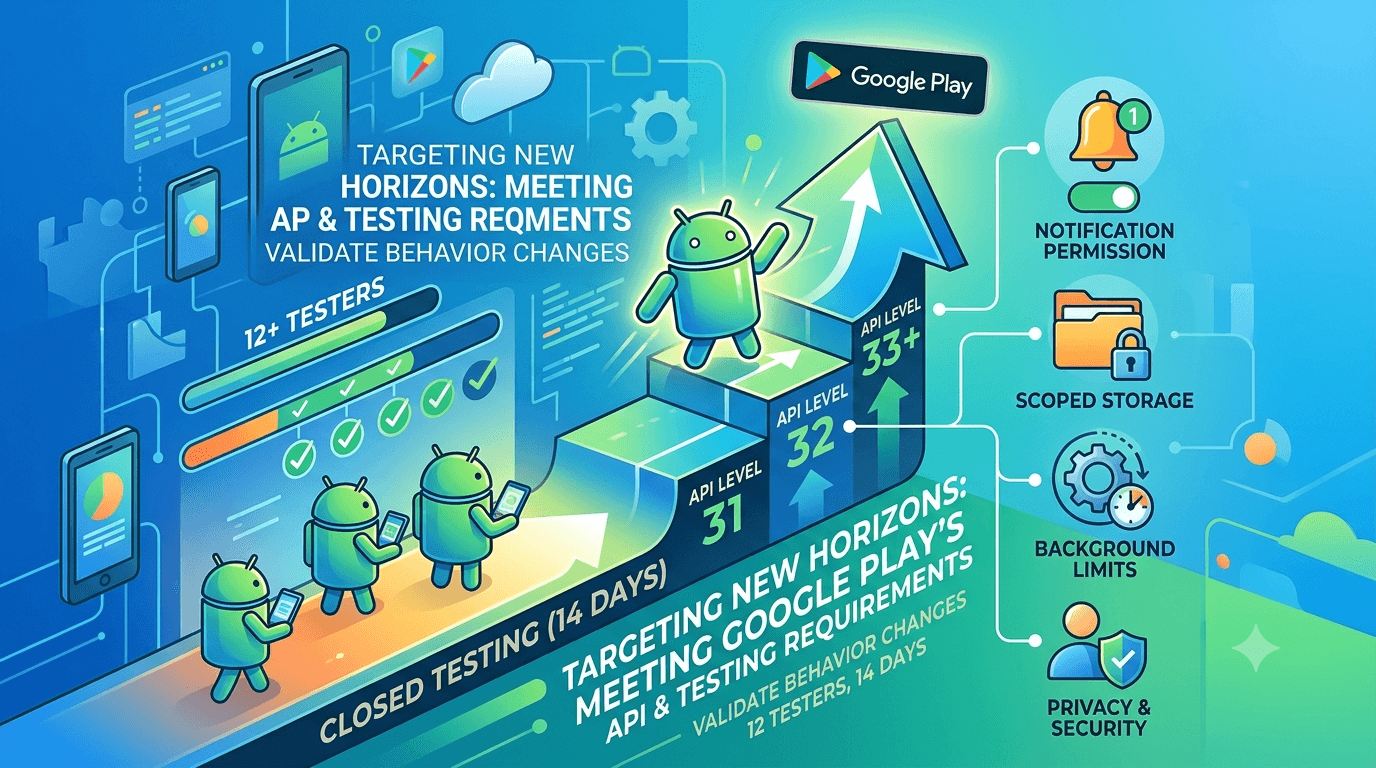
Google Play enforces a minimum target API level for apps, and if your app targets an API level below the current requirement, you cannot publish new apps or updates until you raise it. This catches many developers off guard, because targeting a recent API level is not just a checkbox — it means adopting the behavior changes, permission models, and restrictions of that Android version, which can require real work and testing. Because any app from a new personal account must also complete a closed test with at least 12 testers opted in for 14 continuous days before production access, this guide explains target API level requirements and how to validate compliance during your window.
The closed-testing process is the same regardless of API level, but meeting the target requirement introduces behavior changes you must test on real devices. Using your window to validate those changes turns the mandatory wait into confidence that your app behaves correctly under the modern Android rules Google enforces.
Two requirements, one launch
To publish, your app must both meet Google Play's target API level requirement and, for a new personal account, complete the 12-tester, 14-day closed test. See the closed testing guide. These are independent gates: one about which Android behaviors your app adopts, the other about real-world validation. Both must be satisfied, so address them together. Review Google's target API level policy for the current required level, which rises over time.
Standard advice applies: recruit committed, device-diverse testers, keep your count above 12, and prepare your listing in parallel. Use the window to specifically test the behavior changes that come with your target API level.
Target vs minimum API level
It is important not to confuse target and minimum SDK. Your minimum SDK is the oldest Android version your app supports and can run on; your target SDK declares the Android version your app is built and tested against, and it determines which runtime behaviors and restrictions apply. Google's requirement is about the target level: it must be recent (typically within a year of the latest Android release). Raising your target does not drop older users — you can keep a low minimum SDK while targeting a high level — but it does mean your app opts into the newer version's behavior changes on devices running it.
This distinction matters because raising your target is not about excluding old devices; it is about adopting new rules. When you bump your target API level, review the behavior changes Google documents for each version between your old and new target, since each can affect permissions, background execution, storage access, notifications, and more. Understanding this is the first step to a smooth compliance upgrade. See device and version testing.
Behavior changes to test
Each recent Android version has introduced behavior changes that a higher target enforces, and these are exactly what you must test. Notable areas include the runtime notification permission (Android 13+), scoped storage restricting broad file access, tighter background execution and location limits, stricter intent and package-visibility rules, foreground service type requirements, and various privacy and security tightenings. If your app relied on older, looser behavior, raising your target can break it in ways that only appear at runtime on a device running that Android version.
| Behavior area | What to verify |
|---|---|
| Notification permission | Requested correctly on Android 13+ |
| Scoped storage | File access works without broad permissions |
| Background limits | Background work still functions |
| Foreground services | Correct service types declared |
| Permissions & privacy | Prompts and restrictions handled |
Test these on devices running your target Android version, where the changes take effect. See notification permission testing.
Testing target-level compliance
The critical insight is that target API behavior changes take effect on devices running that Android version, so you must test on such devices, not just an old one where the changes do not apply. A bug from scoped storage or the notification permission may be invisible on an Android 11 device but break on Android 13+, so your testing must include current Android versions. This is where a device- and version-diverse closed test is invaluable: your testers on newer Android versions will exercise exactly the behaviors your higher target enforces, surfacing compliance issues before launch.
Systematically walk through the features that touch the changed behaviors — notifications, file access, background work, permissions — on devices running your target-level Android, confirming each works under the new rules. Fix anything that broke, and re-test. Because these issues are version-specific and often silent on older devices, real testers across current Android versions are the reliable way to validate compliance. See Android version behavior changes.
Setting up your closed-testing track
Once your signed release build, targeting the required API level, is ready, create a closed-testing track in the Play Console and upload it, add testers by email or Google Group, and share the opt-in link each tester must use before installing. Correct configuration matters because the 14-day clock counts only opted-in testers, and a misconfigured track is a common reason developers realize late that their timer never started. If your build does not meet the target requirement, the Console will flag it, so confirm compliance before you rely on the window. See how to create a closed testing track.
Give testers clear onboarding instructions and, ideally, ensure some run current Android versions so they exercise your target-level behavior changes. Every failed opt-in is a tester who does not count toward your 12, so smooth guidance maximizes active testers from day one and gives you the version coverage compliance testing needs.
Recruiting version-diverse testers
For target API testing, Android-version diversity is as important as device diversity, since the behavior changes only bite on newer versions. Recruit 12+ committed, device-diverse testers for 14 continuous days, aiming to include testers on the latest Android versions, keep a buffer above 12, and keep them engaged. Monitor your active count in the Play Console and recruit replacements early if it slips.
If assembling a version- and device-diverse group is your bottleneck, a service that supplies verified real testers across current Android versions solves it quickly. You can submit your app to get started, and read where to find real testers and how to keep testers engaged.
Making the 14-day window count
Because the requirement forces you to test anyway, use the window to validate that your app behaves correctly under the modern rules your target API level enforces. Have version-diverse testers exercise notifications, storage, background work, and permissions on current Android versions, and fix anything the new behaviors break. A well-run window turns a mandatory delay into confidence that you meet Google's target requirement in practice, not just on paper.
Enter production having confirmed your app runs correctly under your target level's behavior changes across current Android versions, and you avoid both the publishing block and the runtime bugs that catch unprepared developers. The 14 days are an investment in staying current with Android's evolving platform. See the testing checklist.
Turning tester feedback into fixes
Give testers a frictionless way to report problems and ask specific questions: did notifications work on your Android version, could you access or save files, did background features function, did any permission prompt behave oddly? Concrete questions, especially from testers on current Android versions, produce the actionable reports that reveal target-level compliance issues.
Then close the loop: when you ship a build addressing reported issues, tell testers what changed and ask them to reconfirm on their Android version. This validates fixes across versions and keeps testers engaged. An app that enters production having validated its behavior under the required target level launches compliant and correct on modern Android. See fixing crashes before production.
Use internal testing to check compliance early
The internal testing track is faster than the closed track, so use it to confirm your build meets the target requirement and behaves correctly on current Android versions before your counted 14-day window begins. Upload there, run the pre-launch report (which exercises current devices), and fix obvious behavior-change breakages first. Catching a scoped-storage or notification-permission bug privately, rather than during your closed test, prevents wasting days of your continuous window on a build that misbehaves on modern Android. See pre-launch report vs closed testing.
A practical rhythm is to validate each build's target-level behavior on the internal track and current-version devices, then promote it to the closed track where version-diverse testers confirm compliance broadly. See internal vs closed testing.
After launch: the target rises again
Your closed test validates today's target requirement, but the bar rises annually, so staying compliant is ongoing. Each year, Google raises the required target level, and you must update your app to keep publishing updates, which means adopting and testing the next round of behavior changes. Build the habit of tracking Android releases and Google's target requirements, and plan a compliance-and-testing cycle each year. An app that keeps pace stays publishable and modern; one that lets its target level lapse eventually cannot ship updates at all. See policy changes to watch and post-launch monitoring.
How to raise your target level safely
Raising your target API level is a code-and-test exercise, not just a manifest edit. Update your targetSdkVersion to the required level, then work through Google's documented behavior changes for every version between your old and new target, addressing each that applies to your app. Some changes require code updates — migrating to scoped storage, requesting the notification permission, declaring foreground service types — while others are handled automatically. Do this deliberately rather than bumping the number and hoping, because an unaddressed behavior change becomes a runtime failure on modern devices.
Once your code accounts for the changes, build and run on emulators and devices spanning the affected Android versions, exercising the features that touch each changed behavior. Treat the upgrade as its own testing effort feeding into your closed test: by the time your build reaches the closed track, it should already handle the new rules, and your version-diverse testers then confirm it across real hardware. This staged approach turns a potentially disruptive requirement into a controlled upgrade. See behavior changes by version.
Key takeaways
- Google Play requires a recent target API level — below it, you cannot publish.
- The 12-tester, 14-day requirement applies alongside the target requirement.
- Target differs from minimum SDK — raising your target does not drop old users.
- Test behavior changes — notifications, storage, background, permissions — on current Android versions.
- The target requirement rises yearly — plan an annual compliance cycle.
Frequently asked questions
What is the target API level requirement?
Google Play requires apps to target a recent API level (typically within a year of the latest Android release) to publish new apps or updates.
What is the difference between target and minimum SDK?
Minimum SDK is the oldest Android version you support; target SDK is the version you build and test against, determining which behaviors apply. The requirement is about the target.
Will raising my target drop older users?
No. You can keep a low minimum SDK while targeting a high level, so older devices still install your app.
Why does my app break when I raise the target?
Because a higher target enforces newer behavior changes — scoped storage, notification permission, background limits — that only take effect on devices running those versions.
Which devices should I test target compliance on?
Devices running current Android versions, where the target-level behavior changes take effect, not just older devices where they do not apply.
Does the target requirement change over time?
Yes. It rises annually, so you must periodically raise your target and test the new behavior changes to keep publishing updates.
Should I check compliance on internal testing first?
Yes. Confirm your build meets the target and behaves correctly on current versions via the faster internal track before your counted window begins.
How do I raise my target API level?
Update targetSdkVersion, then address every documented behavior change between your old and new target that applies to your app, and test on the affected Android versions.
Is bumping the target number enough?
No. The number opts you into new behaviors that can break your app at runtime, so you must handle each relevant behavior change and test it.
Can I get an extension on the target requirement?
Google sometimes offers limited extensions in specific circumstances, but you should plan to meet the requirement on time rather than rely on one.
Expanded for topical authority — additional practical sections below. Original guide content above is unchanged.
Quick answer
Target API Level Requirements for Google Play 2026 matters because Google Play production access for many new personal developer accounts depends on a successful closed test: at least 12 real testers opted in for 14 continuous days, plus a policy-compliant, stable app. Use this guide to execute the steps correctly, avoid streak-breaking mistakes, and decide whether DIY recruitment or a managed closed testing service is the better path for your deadline.
Real-world scenarios: who this matters for
The guidance in this article on Target API Level Requirements for Google Play 2026 applies across many Android product types. Use these scenarios to map the advice to your situation.
| Developer type | Typical challenge | Practical focus |
|---|---|---|
| Indie / solo | Limited tester network and time | Start closed testing early; keep a buffer above 12 opted-in testers; parallelize listing + Data safety work |
| Startup | Launch deadline vs 14-day rule | Treat the window as fixed; recruit in parallel with QA; avoid last-minute track setup |
| Agency / white-label | Multiple client apps, each needing its own test | One closed test per app; standardize opt-in onboarding; track eligibility dates per client |
| Flutter / React Native | Cross-platform build + Play Console quirks | Ship a signed AAB to closed testing; verify installs from Play, not sideload; watch vitals on mid-range devices |
| Native Kotlin | Device/API fragmentation | Cover API levels and OEMs in your tester mix; fix crashes before requesting production |
| Game / Unity | Performance + retention during 14 days | Keep testers engaged so count never dips below 12; monitor ANRs and battery |
| E-commerce / fintech | Policy + payment flows | Test checkout, permissions, and declarations carefully before production access |
| Healthcare / kids / education | Sensitive policies (Families, data) | Align listing, privacy, and content rating with real app behavior during the test window |
Visual placeholder: Scenario matrix infographic — Indie / Startup / Agency / Cross-platform paths for Target API Level Requirements for Google Play 2026.
Comparison: DIY recruitment vs managed closed testing
When your goal is Google Play production access, the path you choose for testers affects time, risk, and feedback quality. Use this comparison while deciding how to apply Target API Level Requirements for Google Play 2026.
| Approach | Time to 12 opted-in | Cost | Dropout risk | Feedback quality | Best when |
|---|---|---|---|---|---|
| Friends & family | Days–weeks | $0 | High | Mixed | Tiny MVP, flexible timeline |
| Reddit / Discord / Telegram | Unpredictable | $0–low | High | Variable | You can manage onboarding daily |
| Peer community exchange | Variable | $0 | Medium | Developer-biased | You can test others’ apps in return |
| Managed closed testing (e.g. Fast Testers) | ~1 hour after valid link | $15 one-time / app | Low (buffer of 15) | Real Play installs | You need speed + continuity for 14 days |
Decision tip: If a broken streak would delay revenue or a client deadline, prioritize reliability over $0 recruitment. DIY is fine when you already have engaged testers and can monitor Play Console daily.
Visual placeholder: Comparison diagram — DIY vs community vs managed testing for Target API Level Requirements for Google Play 2026.
Common mistakes (and how to avoid them)
These mistakes repeatedly show up when developers work through Target API Level Requirements for Google Play 2026:
- Confusing invited vs opted-in testers — Only testers who open the opt-in link and install from Play count toward 12. Check the opted-in number in Play Console, not your email list.
- Recruiting exactly 12 with no buffer — One uninstall can break continuity. Aim for ~15 active opted-in testers.
- Starting the counted clock late — Listing assets, Data safety, and privacy work should run during the 14 days, not after.
- Using sideloaded APKs or fake installs — They do not satisfy Play’s closed testing expectations and can create account risk.
- Ignoring tester feedback until day 14 — Crashes that drive uninstalls threaten your streak and your review outcome.
- Requesting production access before the continuous streak completes — Eligibility checks fail even if calendar time has passed.
Troubleshooting checklist
If something feels “stuck” while applying Target API Level Requirements for Google Play 2026, walk this list before changing strategy:
| Symptom | Likely cause | Fix |
|---|---|---|
| Console shows < 12 testers | Invites sent but not opted in | Resend opt-in link; confirm install from Play |
| “Not eligible” after 14 calendar days | Count dipped below 12 mid-window | Restore 12+ and complete a full continuous streak |
| Tester cannot join | Wrong account, Group lag, or track not published | Verify Google account, Group membership, track release |
| App fails to install | Device/API mismatch or signing issue | Check AAB, minSDK, Play App Signing |
| Production still rejected after testing | Policy, declarations, or stability — not the clock | Read the exact reason; fix that category completely |
Visual placeholder: Troubleshooting flowchart for Target API Level Requirements for Google Play 2026.
Action checklist
Use this checklist alongside the rest of this guide on Target API Level Requirements for Google Play 2026:
- ☐ Closed testing track created with a signed release (AAB)
- ☐ Opt-in link tested on a fresh Google account
- ☐ At least 12 testers opted in (prefer ~15)
- ☐ Daily check that opted-in count stays ≥ 12 for 14 continuous days
- ☐ Core flows exercised (login, main feature, permissions, offline/online)
- ☐ Crashes / ANRs triaged from tester reports and vitals
- ☐ Store listing, screenshots, and feature graphic drafted
- ☐ Privacy policy + Data safety + content rating aligned with real behavior
- ☐ Production access requested only after eligibility is green
- ☐ Staged rollout plan ready for first public release
Additional FAQs developers ask about Target API Level Requirements for Google Play 2026
Quick answer: what should I do first?
Confirm you are on a closed testing track with real opted-in installs, keep 12+ testers for 14 continuous days, and fix policy/stability issues in parallel. Then use the detailed sections above for Target API Level Requirements for Google Play 2026.
Does this apply to organization (company) accounts?
The classic 12×14 closed testing gate is primarily associated with new personal developer accounts. Always verify your account type and current Play Console eligibility messaging for your app.
Do friends and family count as testers?
Yes — if they opt in via your closed testing link and install from Google Play. They only help if they stay opted in for the continuous period.
Can I update the app during the 14 days?
You can usually push updates on the closed track, but unstable releases that cause uninstalls can threaten your tester count. Prefer polishing via internal testing first when possible.
What if production access is still rejected?
Read the exact reason. Incomplete testing is only one category — policy, Data safety mismatches, and crashes are common. Fix the cited issue fully before reapplying.
Is paying for testers allowed?
Using real people who install from Play is what matters. Avoid fake install farms. A one-time managed service that supplies real closed testers is a practical option when DIY recruitment is too slow.
How is Fast Testers different from free communities?
Free communities trade time and mutual availability. Fast Testers assigns about 15 real testers after you submit a valid closed testing link (one-time $15 per app) and includes a production access guarantee under its refund terms.
Where should I go next?
Review the related guides below, then either finish DIY recruitment or start closed testing if you need speed and continuity.
Sources, updates, and how to use this guide
This article on Target API Level Requirements for Google Play 2026 is maintained for Android developers preparing Google Play closed testing and production access. Always cross-check eligibility text inside your own Play Console, because Google’s UI labels and account rules can vary by account type and date.
- Primary official references: Google Play closed testing help, Developer Program Policies, and Play Console eligibility messaging for your app.
- Practical experience lens: guidance here reflects common failure modes indie developers and agencies hit when recruiting testers, maintaining the 14-day streak, and recovering from production-access rejections.
- Last reviewed focus: 12×14 closed testing continuity, real vs fake testers, and parallel listing/compliance work during the window.
Related guides and next steps
Continue building topical depth around Target API Level Requirements for Google Play 2026 with these Fast Testers resources:
- Google Play Closed Testing Requirements 2026
- Google Play Developer Identity Verification 2026
- Google Play Testing Requirements By Country
- Privacy Policy Requirements For Google Play Apps
- Ad Supported Apps And Google Play Ad Policy Testing
- Agency Guide Testing Client Apps On Google Play
- Android Tv Apps And Google Play Testing Tracks
- App Rejected Google Play
- Pricing — $15 closed testing
- How Fast Testers works
- FAQ
- Developer reviews
- Case studies
- Submit your app / start closed testing
Need reliable testers so your 14-day streak does not stall? Educate first with the guides above, then start when you are ready — one-time pricing, real Play installs, dashboard tracking.
Internal navigation hub — added to strengthen topical connections. Original article content above is unchanged.
Continue learning
- Google Play Closed Testing Requirements in 2026 — A complete, up-to-date breakdown of Google Play closed testing requirements in 2026: the 12-tester rule, 14-da.
- Common Google Play Closed Testing Mistakes to Avoid — The most common Google Play closed testing mistakes — wrong track, too few testers, dropouts, sideloading — an.
- Complete Glossary of Google Play Testing Terms — Learn about testing terminology for Google Play closed testing. Complete guide for Android developers publishi.
- The Fastest Way to Get Google Play Production Access — The fastest way to get Google Play production access: start your 14-day closed test immediately, avoid delays,.
- Google Play Android Vitals During Closed Testing — Learn about vitals monitoring for Google Play closed testing. Complete guide for Android developers publishing.
- Google Play Closed Testing Complete Guide — A comprehensive walkthrough of the entire closed testing process..
Next steps
- Ready to run closed testing with real Android testers? Submit your app or see pricing ($15 one-time).
- Compare options on our testing service comparison page, or read developer reviews and case studies.
- Still deciding? Review how Fast Testers works and the FAQ.