
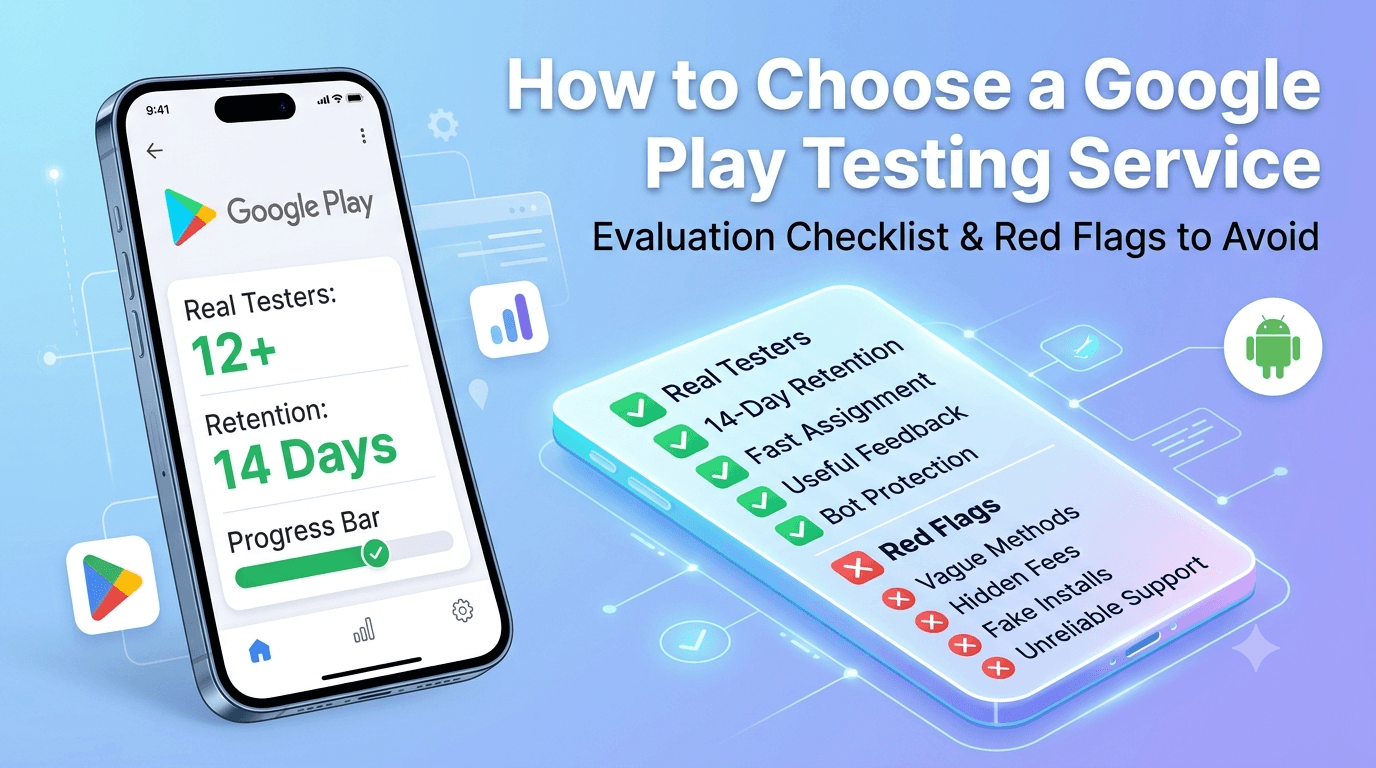
Not all testing services are equal, and the wrong one can waste your money on installs that do not count — or worse, put your account at risk. Knowing how to choose a Google Play testing service comes down to a handful of criteria that separate legitimate, effective providers from ineffective or risky ones. This guide gives you a practical checklist and the red flags to avoid.
Contents
Quick answer
Featured answer: Choose a Google Play testing service based on whether it uses real, opted-in testers, guarantees retention for the full 14 days, assigns testers quickly, provides feedback, is transparent about its methods, and charges a fair one-time fee. Avoid any service that offers fake installs or vague, bot-driven "installs."
The criteria that matter
The best services share a few characteristics. First and most important, they use real testers on real devices who opt in through the official Play flow — this is what makes the testing count and keeps you compliant. Second, they guarantee retention, maintaining at least 12 active testers for the entire window so a dropout does not sink your test. Third, they are fast, assigning testers quickly so your clock starts right away. Fourth, they provide feedback, not just silent installs, helping you improve the app before review. Finally, they are transparent about how they work and charge a fair, clear price.
Evaluation checklist
| Criterion | What good looks like |
|---|---|
| Tester authenticity | Real people, real devices, Play opt-in |
| Retention | 12+ active for the full 14 days |
| Speed | Testers assigned within ~1 hour |
| Feedback | Structured reports, not silent installs |
| Transparency | Clear method and pricing |
| Support | Responsive help if issues arise |
Red flags to avoid
- "Thousands of installs" for a few dollars — a hallmark of bots and farms.
- No mention of opt-in through Play — installs that do not count.
- Vague or hidden methods — legitimate services explain how they work.
- No retention guarantee — you bear the dropout risk.
- Prices that seem too good to be true — they usually are.
Warning: Fake-install services do not just waste money — they can trigger enforcement against your account. See how Google detects fakes.
Questions to ask
Before committing, ask: Are your testers real people who opt in through Google Play? Do you guarantee 12+ active testers for the full 14 days? How quickly are testers assigned? Do you provide feedback? What happens if a tester drops out? Clear, confident answers signal a trustworthy provider; evasiveness is a warning sign. For the safety angle, see is buying testers safe?
Tip: FastTesters uses real testers, manages retention, assigns fast, and provides feedback. Submit your app or review pricing to compare.
Key takeaways
- Prioritize real, opted-in testers above everything else.
- Insist on a retention guarantee for the full 14 days.
- Value speed, feedback, and transparency.
- Avoid "cheap installs" and vague methods.
- Ask direct questions and expect confident answers.
How to verify a service before you pay
You do not have to take a provider's word for it. A few minutes of due diligence protects you from wasting money and risking your account. Look for concrete, specific claims rather than vague promises — a trustworthy service explains that its testers are real people who opt in through Google Play, and it can describe how retention is maintained across the 14 days. Check that pricing is stated clearly rather than hidden behind escalating upsells, and that there is a real way to reach support if something goes wrong mid-test.
Be especially skeptical of anything that emphasizes raw install numbers over genuine testing. The requirement is not about volume; it is about real testers engaging for two weeks. A service boasting about tens of thousands of installs is describing exactly the pattern Google's systems are built to detect. The services worth paying for are the ones that talk about real people, retention, and feedback — the substance of what Google actually requires.
Why choosing the right service matters
Not all closed testing services are equal, and the difference between a good one and a bad one is the difference between a smooth launch and a wasted two weeks. Because Google's requirement hinges on real, opted-in testers staying active for 14 continuous days, a service that supplies unreliable or fake testers does not just underperform — it causes you to fail the requirement outright, forcing you to start over. Choosing carefully is therefore not about finding the cheapest option; it is about protecting your launch timeline and your money.
The stakes are higher than they first appear because the cost of a bad choice is not just the fee you paid, but the delay it causes. A failed test can push your launch back weeks, undoing marketing plans and momentum. That asymmetry — where a slightly better service costs a little more but a bad one costs you your timeline — is why it pays to evaluate providers on substance rather than headline price.
The criteria that actually matter
| Criterion | What to verify |
|---|---|
| Real, opted-in testers | Genuine Google accounts, not bots or incentivized fakes |
| Sufficient testers + buffer | Comfortably above the 12-tester minimum |
| Engagement guarantee | Testers stay active the full 14 days |
| Device diversity | Varied manufacturers, versions, screen sizes |
| Speed to start | Testers begin quickly to start the fixed clock |
| Transparent pricing | Clear total with no hidden add-ons |
| Responsive support | Help available if something goes wrong |
Rank these by consequence. Real, opted-in testers sit at the top because nothing else matters if the installs do not count. Right behind it are a tester buffer and an engagement guarantee, since dropouts are the most common way tests fail. Device diversity, speed, transparent pricing, and support round out the list — each meaningfully affects your experience and outcome, but they are secondary to getting genuine, reliably engaged testers.
Red flags to walk away from
Certain signals should end your consideration of a service immediately. The clearest is any provider that cannot or will not explain how their testers are real, opted-in humans — vagueness here usually hides bots or incentivized fake accounts that Google detects and discounts. Prices that are dramatically lower than everyone else's are another warning sign, because genuine, engaged human testers have a real cost; a price that seems impossible usually is. Be wary too of anyone promising to "guarantee approval," since production approval depends on your app meeting Google's policies, not just on completing the test.
Other red flags include no buffer above the minimum (leaving you exposed to dropouts), no support channel if something goes wrong mid-test, and opaque pricing that grows with add-ons. A trustworthy service is transparent about exactly what you get, how its testers are genuine, and what the total will cost. If you cannot get straight answers to those questions, keep looking.
Questions to ask before you buy
Before committing, put a few direct questions to any service: Are your testers real people with genuine Google accounts who opt in properly? How many testers will I get, and is there a buffer above 12? How do you keep testers engaged for the full 14 days? What device variety can I expect? How quickly can testing start? What is the total price, all-in? And what support do you offer if the count dips or something goes wrong? Clear, confident answers indicate a service that understands the requirement and stands behind its work.
A provider that answers these readily is one you can trust with your launch. When you have found one, the process is simple: you submit your app, real testers begin opting in, and you monitor progress toward production access while focusing on the rest of your launch. For a broader view of whether paying is worthwhile at all, see is buying testers worth it.
Key takeaways
- A bad service costs you your timeline, not just the fee.
- Real, opted-in testers are the top criterion; nothing else matters without them.
- Prioritize a tester buffer and engagement guarantee to avoid dropout failures.
- Walk away from bot-like offers, impossible prices, and "guaranteed approval."
- Ask direct questions about testers, buffer, engagement, devices, speed, and price.
Understanding pricing models
Testing services price their offerings in different ways, and understanding the models helps you compare fairly and avoid surprises. Some charge a single flat fee for meeting the full requirement — a set price to get you the required testers for the 14-day window. Others price per tester or offer tiers based on how many testers or how much device diversity you want. Neither model is inherently better, but you should know which you are buying so you can compare total cost rather than a misleading headline number.
What matters most is transparency: the price you are quoted should be the price you pay, with no essential features held back as paid add-ons. Be cautious of services that advertise a low entry price but then charge extra for the things that actually make a test succeed, like enough testers to clear the minimum with a buffer, or device diversity. A trustworthy service tells you the all-in cost for a complete, requirement-satisfying test up front, so you can budget with confidence and compare apples to apples.
Judging reputation and track record
| Signal | What it tells you |
|---|---|
| Clear explanation of tester sourcing | Testers are genuine, not bots |
| Consistent positive feedback | The service reliably delivers |
| Responsive communication | You will get help if needed |
| Honest claims (no "guaranteed approval") | Understands what it can control |
A service's reputation is one of the most reliable predictors of your outcome, so weigh it heavily. Look for providers that explain clearly and specifically how their testers are real, opted-in people, since this is where the value lives. Consistent feedback from other developers, responsive communication, and honest claims — especially the absence of impossible promises like guaranteed production approval — all signal a service that understands the requirement and delivers on it. A provider that is cagey about how it works or makes claims that sound too good to be true should give you pause.
Matching the service to your needs
The "best" service is the one that best fits your specific situation, so factor in your own priorities alongside the universal criteria. If you are on a tight deadline, speed to start weighs heavily, because every day saved before the fixed 14-day clock begins is a day off your launch. If quality coverage matters to you, prioritize strong device diversity. If budget is your main concern, focus on transparent, all-in pricing — while still refusing to compromise on testers being real, since a cheap failed test is the most expensive outcome of all.
Once you have weighed the criteria against your needs and found a service that is transparent, reputable, and honest about what it delivers, acting is simple: you submit your app, real testers begin opting in, and you focus on the rest of your launch while the requirement is handled. Choosing well up front is what makes the rest of the process smooth, on-time, and stress-free. To sanity-check whether paying makes sense for you at all, see is buying testers worth it.
Frequently asked questions
What is the most important criterion?
Real, opted-in testers — without that, nothing else matters because the installs will not count.
How do I spot a fake-install service?
Watch for huge install counts at tiny prices and no mention of Play opt-in.
Does retention really matter?
Yes. Dropping below 12 mid-window is the most common cause of a failed test.
Should I expect feedback?
Good services provide it; silent installs are less useful.
Is the cheapest option best?
Rarely. Suspiciously low prices usually mean fake installs.
What questions should I ask?
About tester authenticity, retention, speed, feedback, and dropout handling.
Conclusion
Choosing a testing service is about one thing above all: real testers who make your testing count. Add retention, speed, feedback, and transparency, and avoid the fake-install traps, and you will pick a provider that protects both your launch and your account. Ready to try a service that checks every box? Submit your app today.
Expanded for topical authority — additional practical sections below. Original guide content above is unchanged.
Real-world scenarios: who this matters for
The guidance in this article on How to Choose a Google Play Testing Service applies across many Android product types. Use these scenarios to map the advice to your situation.
| Developer type | Typical challenge | Practical focus |
|---|---|---|
| Indie / solo | Limited tester network and time | Start closed testing early; keep a buffer above 12 opted-in testers; parallelize listing + Data safety work |
| Startup | Launch deadline vs 14-day rule | Treat the window as fixed; recruit in parallel with QA; avoid last-minute track setup |
| Agency / white-label | Multiple client apps, each needing its own test | One closed test per app; standardize opt-in onboarding; track eligibility dates per client |
| Flutter / React Native | Cross-platform build + Play Console quirks | Ship a signed AAB to closed testing; verify installs from Play, not sideload; watch vitals on mid-range devices |
| Native Kotlin | Device/API fragmentation | Cover API levels and OEMs in your tester mix; fix crashes before requesting production |
| Game / Unity | Performance + retention during 14 days | Keep testers engaged so count never dips below 12; monitor ANRs and battery |
| E-commerce / fintech | Policy + payment flows | Test checkout, permissions, and declarations carefully before production access |
| Healthcare / kids / education | Sensitive policies (Families, data) | Align listing, privacy, and content rating with real app behavior during the test window |
Visual placeholder: Scenario matrix infographic — Indie / Startup / Agency / Cross-platform paths for How to Choose a Google Play Testing Service.
Comparison: DIY recruitment vs managed closed testing
When your goal is Google Play production access, the path you choose for testers affects time, risk, and feedback quality. Use this comparison while deciding how to apply How to Choose a Google Play Testing Service.
| Approach | Time to 12 opted-in | Cost | Dropout risk | Feedback quality | Best when |
|---|---|---|---|---|---|
| Friends & family | Days–weeks | $0 | High | Mixed | Tiny MVP, flexible timeline |
| Reddit / Discord / Telegram | Unpredictable | $0–low | High | Variable | You can manage onboarding daily |
| Peer community exchange | Variable | $0 | Medium | Developer-biased | You can test others’ apps in return |
| Managed closed testing (e.g. Fast Testers) | ~1 hour after valid link | $15 one-time / app | Low (buffer of 15) | Real Play installs | You need speed + continuity for 14 days |
Decision tip: If a broken streak would delay revenue or a client deadline, prioritize reliability over $0 recruitment. DIY is fine when you already have engaged testers and can monitor Play Console daily.
Visual placeholder: Comparison diagram — DIY vs community vs managed testing for How to Choose a Google Play Testing Service.
Common mistakes (and how to avoid them)
These mistakes repeatedly show up when developers work through How to Choose a Google Play Testing Service:
- Confusing invited vs opted-in testers — Only testers who open the opt-in link and install from Play count toward 12. Check the opted-in number in Play Console, not your email list.
- Recruiting exactly 12 with no buffer — One uninstall can break continuity. Aim for ~15 active opted-in testers.
- Starting the counted clock late — Listing assets, Data safety, and privacy work should run during the 14 days, not after.
- Using sideloaded APKs or fake installs — They do not satisfy Play’s closed testing expectations and can create account risk.
- Ignoring tester feedback until day 14 — Crashes that drive uninstalls threaten your streak and your review outcome.
- Requesting production access before the continuous streak completes — Eligibility checks fail even if calendar time has passed.
Troubleshooting checklist
If something feels “stuck” while applying How to Choose a Google Play Testing Service, walk this list before changing strategy:
| Symptom | Likely cause | Fix |
|---|---|---|
| Console shows < 12 testers | Invites sent but not opted in | Resend opt-in link; confirm install from Play |
| “Not eligible” after 14 calendar days | Count dipped below 12 mid-window | Restore 12+ and complete a full continuous streak |
| Tester cannot join | Wrong account, Group lag, or track not published | Verify Google account, Group membership, track release |
| App fails to install | Device/API mismatch or signing issue | Check AAB, minSDK, Play App Signing |
| Production still rejected after testing | Policy, declarations, or stability — not the clock | Read the exact reason; fix that category completely |
Visual placeholder: Troubleshooting flowchart for How to Choose a Google Play Testing Service.
Action checklist
Use this checklist alongside the rest of this guide on How to Choose a Google Play Testing Service:
- ☐ Closed testing track created with a signed release (AAB)
- ☐ Opt-in link tested on a fresh Google account
- ☐ At least 12 testers opted in (prefer ~15)
- ☐ Daily check that opted-in count stays ≥ 12 for 14 continuous days
- ☐ Core flows exercised (login, main feature, permissions, offline/online)
- ☐ Crashes / ANRs triaged from tester reports and vitals
- ☐ Store listing, screenshots, and feature graphic drafted
- ☐ Privacy policy + Data safety + content rating aligned with real behavior
- ☐ Production access requested only after eligibility is green
- ☐ Staged rollout plan ready for first public release
Additional FAQs developers ask about How to Choose a Google Play Testing Service
Quick answer: what should I do first?
Confirm you are on a closed testing track with real opted-in installs, keep 12+ testers for 14 continuous days, and fix policy/stability issues in parallel. Then use the detailed sections above for How to Choose a Google Play Testing Service.
Does this apply to organization (company) accounts?
The classic 12×14 closed testing gate is primarily associated with new personal developer accounts. Always verify your account type and current Play Console eligibility messaging for your app.
Do friends and family count as testers?
Yes — if they opt in via your closed testing link and install from Google Play. They only help if they stay opted in for the continuous period.
Can I update the app during the 14 days?
You can usually push updates on the closed track, but unstable releases that cause uninstalls can threaten your tester count. Prefer polishing via internal testing first when possible.
What if production access is still rejected?
Read the exact reason. Incomplete testing is only one category — policy, Data safety mismatches, and crashes are common. Fix the cited issue fully before reapplying.
Is paying for testers allowed?
Using real people who install from Play is what matters. Avoid fake install farms. A one-time managed service that supplies real closed testers is a practical option when DIY recruitment is too slow.
How is Fast Testers different from free communities?
Free communities trade time and mutual availability. Fast Testers assigns about 15 real testers after you submit a valid closed testing link (one-time $15 per app) and includes a production access guarantee under its refund terms.
Where should I go next?
Review the related guides below, then either finish DIY recruitment or start closed testing if you need speed and continuity.
Sources, updates, and how to use this guide
This article on How to Choose a Google Play Testing Service is maintained for Android developers preparing Google Play closed testing and production access. Always cross-check eligibility text inside your own Play Console, because Google’s UI labels and account rules can vary by account type and date.
- Primary official references: Google Play closed testing help, Developer Program Policies, and Play Console eligibility messaging for your app.
- Practical experience lens: guidance here reflects common failure modes indie developers and agencies hit when recruiting testers, maintaining the 14-day streak, and recovering from production-access rejections.
- Last reviewed focus: 12×14 closed testing continuity, real vs fake testers, and parallel listing/compliance work during the window.
Related guides and next steps
Continue building topical depth around How to Choose a Google Play Testing Service with these Fast Testers resources:
- Closed Testing Vs Open Testing On Google Play
- Google Play Closed Testing Service
- Google Play Internal Testing Vs Closed Testing
- Google Play Testing Service Vs Diy
- Ad Supported Apps And Google Play Ad Policy Testing
- Agency Guide Testing Client Apps On Google Play
- Android Tv Apps And Google Play Testing Tracks
- Common Google Play Closed Testing Mistakes
- Pricing — $15 closed testing
- How Fast Testers works
- FAQ
- Developer reviews
- Case studies
- Submit your app / start closed testing
Need reliable testers so your 14-day streak does not stall? Educate first with the guides above, then start when you are ready — one-time pricing, real Play installs, dashboard tracking.
Further expansion — case study, decisions, and expert recommendations. Prior sections remain unchanged.
Case study: indie app that needed 12 testers in under a day
Problem: A Flutter indie developer had a client demo in three weeks. Friends-and-family recruitment stalled at 6 opted-in testers after five days of chasing messages.
Solution: They kept DIY outreach running, but also submitted a valid closed testing opt-in link to a managed service to reach ~15 real Play installs quickly. They used this guide on How To Choose A Google Play Testing Service to brief testers on what to exercise (onboarding, permissions, offline mode) and monitored Play Console daily so the continuous streak would not break.
Result: Opted-in count stabilized above 12 within hours of assignment; 14 continuous days completed; production access requested on schedule.
Lessons learned:
- Recruit a buffer early — waiting until day 10 is the expensive mistake.
- Real Play installs beat large invite lists.
- Managed testing is a timeline tool, not a substitute for fixing product quality.
Decision guide: what should you do next?
Use this decision path when applying How To Choose A Google Play Testing Service:
- Is your account a new personal developer account that still needs production access?
If yes, plan for closed testing with 12+ opted-in testers for 14 continuous days. If no, still test — but confirm the exact eligibility text in Play Console. - Do you already have 12+ reliable people who will install from Play and stay for two weeks?
If yes, DIY can work — add a buffer and monitor daily. If no, use community exchange or a managed closed testing service. - Is your build stable enough that testers will not churn?
If no, run internal testing first. Entering the counted window with crash loops is how streaks die. - Are Data safety, privacy policy, permissions, and listing aligned with real behavior?
If no, fix during the window so production review does not bounce you after the clock. - Has production access been rejected?
Classify: eligibility vs policy vs declarations vs stability. Fix that category completely, then re-test / re-request.
Visual placeholder: Decision tree diagram for How To Choose A Google Play Testing Service (DIY vs managed vs fix-and-retry).
Expert recommendations
- Instrument the streak: Check opted-in count daily for the first week; replace dropouts same day.
- Brief testers once: Send a short checklist (install from Play, open app daily, try core flow, report crashes). Silent testers still count if opted in — engaged testers protect quality.
- Never “solve” recruitment with fake installs: It fails the intent of closed testing and can create account risk.
- Ship a boring-stable build to closed testing: Save experimental features for internal tracks.
- Educate first, then accelerate: If your blocker is simply finding real testers fast, a one-time managed option (Fast Testers: 15 testers, $15/app) is often cheaper than slipping a launch.
For hands-on setup after reading about How To Choose A Google Play Testing Service, see how it works and pricing, or submit your closed testing link when you are ready.
Internal navigation hub — added to strengthen topical connections. Original article content above is unchanged.
Topic cluster: Testing Services & Comparisons
Pillar guide: Start with Google Play Closed Testing Service: What It Is and How It Works for the full overview, then use the supporting guides below.
- Google Play Closed Testing Service: What It Is and How It Works (pillar)
- Google Play Testing Service vs DIY: Which Should You Choose?
- How Much Does Google Play Closed Testing Cost?
- Is Buying Google Play Testers Worth It?
- FastTesters vs Reddit Testers: Which Is Better?
- FastTesters vs Telegram Communities for Testing
- FastTesters vs Facebook Groups for App Testing
- Why Professional Testers Improve Production Approval Chances
Continue learning
- Closed Testing vs Open Testing on Google Play — Learn about testing track differences for Google Play closed testing. Complete guide for Android developers pu.
- Google Play Closed Testing Service: What It Is and How It Works — What a Google Play closed testing service does, how it works, what to expect, and how it helps you get 12 real.
- Google Play Testing Service vs DIY: Which Should You Choose? — Google Play testing service vs DIY: compare time, cost, reliability, and outcomes of recruiting your own teste.
- Agency Guide: Testing Client Apps on Google Play — Learn about agency multi-app testing for Google Play closed testing. Complete guide for Android developers pub.
- Fitness Apps and Google Play Beta Testing Rules — Learn about health app testing for Google Play closed testing. Complete guide for Android developers publishin.
- Google Play Testing for Startups on a Deadline — Google Play testing for startups on a deadline: how to meet the 12-tester, 14-day requirement without derailin.
Next steps
- Ready to run closed testing with real Android testers? Submit your app or see pricing ($15 one-time).
- Compare options on our testing service comparison page, or read developer reviews and case studies.
- Still deciding? Review how Fast Testers works and the FAQ.