
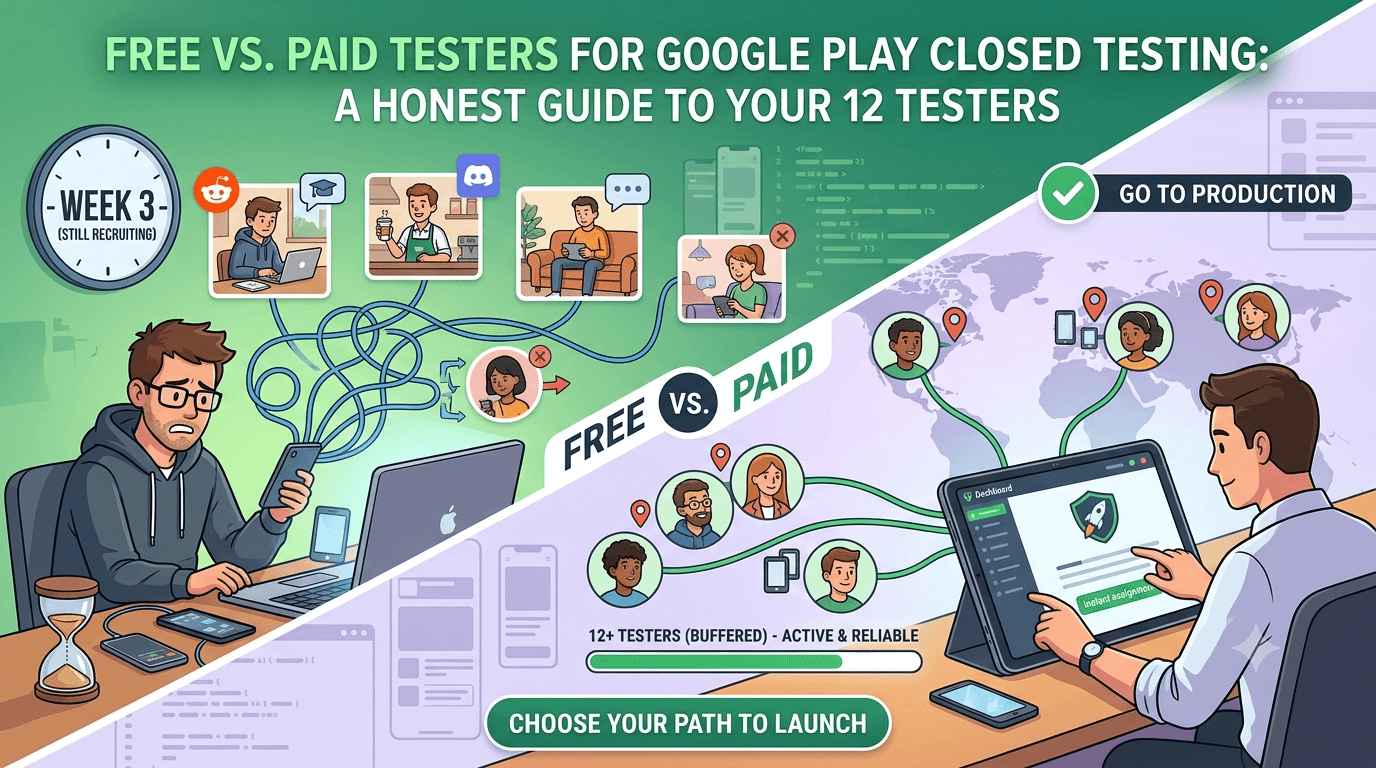
When you need 12 testers for Google Play Closed Testing, you face a simple fork in the road: recruit free testers yourself, or use paid testers from a service. Both can satisfy Google's requirement, but they differ sharply in speed, reliability, and hidden costs. This guide compares them honestly so you can pick the right path for your launch.
Contents
Quick answer
Featured answer: Free testers cost no money but require your time, reciprocation, and constant retention management. Paid testers cost a one-time fee but deliver real, worldwide testers quickly with a dropout buffer. Both are policy-compliant as long as the testers are real people who opt in through Google Play.
Free testers: how they work
Free testers come from your own network, developer communities, Reddit, or peer swap groups. You post your opt-in link, testers join, and you often test their apps in return.
- Pros: No monetary cost, direct contact with testers, community goodwill.
- Cons: Slow, unpredictable, high dropout, and you must reciprocate. See Reddit beta testers.
The hidden cost is time: recruiting, chasing, and replacing testers over 14 days can consume many hours. If someone drops out on day 9 and you fall below 12, you may lose progress — see avoiding tester dropout.
Paid testers: how they work
A professional service assigns real testers to your closed track, usually within about an hour, and manages retention for you. A service like FastTesters provides real human testers on genuine devices, manual testing, and feedback reports — no bots. Learn what is safe in is buying testers safe?
- Pros: Fast, reliable, buffer against dropouts, real feedback, no reciprocation.
- Cons: A one-time fee (see pricing).
Side-by-side comparison
| Factor | Free testers | Paid testers |
|---|---|---|
| Money cost | $0 | One-time fee |
| Time cost | High | Low |
| Speed to 12 testers | Days to weeks | ~1 hour |
| Reliability / retention | Low (you manage it) | High (managed) |
| Reciprocation required | Often yes | No |
| Real feedback | Varies | Yes (reports) |
For a full cost breakdown including the value of your time, see cost analysis vs manual recruitment.
Tip: You can mix both — recruit a few free testers and top up with paid ones to guarantee you stay above 12. Real testers from any source count toward the requirement.
The hidden costs people forget
Comparing "free" and "paid" only on price is misleading. The true cost of free testers includes several things developers rarely account for:
- Recruiting time: Writing posts, answering questions, and following up can take hours spread across many days.
- Reciprocation time: Most swap communities expect you to test other apps back, which is more time.
- Replacement time: Every dropout must be found and replaced, often mid-window.
- Opportunity cost: Days spent recruiting are days your launch is delayed and your 14-day clock has not even started.
Paid testers convert that scattered time cost into a single, predictable fee. For many solo developers and small teams, the math favors paying once and shipping sooner. See the numbers in the cost analysis.
A realistic scenario
Imagine you post in three communities and line up 12 volunteers over five days. By day 8, two have uninstalled and one changed accounts, dropping you to 9 counted testers. You scramble to replace them, and your qualifying window effectively restarts. That is the classic "free" outcome — no cash spent, but two weeks lost. A managed service avoids this by starting with a buffer above 12 and maintaining it.
Which should you choose?
- Choose free if you have time, an existing community, and no hard deadline.
- Choose paid if you want certainty, speed, and to protect your launch timeline.
- Choose both if you have a partial network but want a dropout safety net.
The true cost of "free" testers
The word "free" does a lot of hidden work in this debate, and unpacking it changes the comparison entirely. Free testers cost no money, but they are never actually free once you account for your time, your reciprocation obligations, and the risk of delay. Recruiting a dozen reliable testers through communities and swaps typically consumes hours of effort spread across days or weeks. In test-for-test arrangements, you also owe testing back to every developer who helps you, which multiplies the time commitment. And because free testers are unmanaged, you personally shoulder the work of chasing dropouts and finding replacements to keep your count above 12.
None of this makes free testers a bad choice — for many developers they are exactly right. But an honest comparison has to price in the invisible costs. If your time is worth, say, a modest hourly rate, and getting to 12 takes ten hours plus a week of delay, the "free" option has a real cost that simply is not denominated in dollars. The paid option, meanwhile, converts that time and uncertainty into a fixed, one-time fee. The right question is never "free or paid" in the abstract, but "which is cheaper once I count everything I am spending."
When free testers are the right choice
Free testers shine in specific situations, and recognizing them saves you money you do not need to spend. If you have a flexible timeline with no hard deadline, the slowness of community recruiting does not hurt you. If you are already an active, respected member of a developer community, you may be able to recruit quickly through goodwill you have already built. If you enjoy the reciprocal nature of test-for-test swaps and value the technical feedback other developers provide, the exchange is genuinely rewarding rather than a chore. And if you are extremely budget-constrained — a student, a hobbyist, or a pre-revenue founder — free testers let you meet the requirement without spending anything.
In these cases, the effort of free recruiting is either low for you personally or offset by benefits you actually want. The key is to be honest about whether you truly fit this profile. Many developers assume they do, spend weeks struggling, and only then realize their situation actually called for the paid route all along.
When paid testers are the right choice
Paid testers make sense whenever time, certainty, or reliability matter more to you than saving a modest fee. If you have a launch date, an investor demo, or a coordinated marketing push tied to your release, you cannot afford to let slow recruiting push everything back — a service that starts your clock today protects the whole plan. If your time is better spent building your product or serving early users than chasing volunteers, paying is simply reallocating your effort to where it is most valuable. And if you have already tried free channels and hit dropouts or dead ends, paying buys the reliability the free route failed to provide.
There is also a quality dimension. Good paid services provide managed retention and feedback reports, so you are not just buying bodies — you are buying a smoother, more predictable process with genuine engagement. For a first launch in particular, where the requirement is unfamiliar and the stakes feel high, that certainty is often worth far more than its price.
The hybrid approach
The choice is not strictly binary, and many experienced developers deliberately blend both. Because real testers from any source count toward the requirement, you can use a paid service to guarantee the compliant core of 12+ testers while also posting in communities to attract engaged developers who give thoughtful, technical feedback. This gets you the best of both worlds: the certainty and retention of a service, plus the qualitative depth of community involvement. It is an especially smart approach when you value community feedback but cannot risk your launch date on the unpredictability of free recruiting alone.
How to evaluate a paid service before you commit
If you decide to pay, spend a few minutes making sure you are paying for the right thing. The single most important criterion is that the service uses real people who opt in through Google Play — this is what makes the testing count and keeps you compliant. Beyond that, look for a retention guarantee so you never drop below 12, fast assignment so your clock starts promptly, feedback rather than silent installs, transparent pricing, and verifiable reviews. Be deeply skeptical of anyone advertising huge "install" numbers for tiny prices; that is the signature of fake-install operations, which do not count and can endanger your account. A trustworthy service talks about real testers, retention, and feedback — the substance of what Google actually requires.
Getting quality feedback from either route
Whichever route you choose, the value of testing goes beyond a compliance checkmark if you set it up to produce real feedback. Free community testers, especially fellow developers, often give unusually sharp feedback because they understand apps and know how to describe a bug clearly. To get the most from them, tell them specifically what to try and ask focused questions rather than a vague "let me know what you think." A prompt like "please try creating an account and adding an item, and tell me if anything is confusing" yields far more useful responses than an open-ended request.
Paid testers can be equally valuable when the service structures feedback as part of the deliverable. Look for providers that have testers actually use the app and report issues, rather than silently installing. In both cases, the goal is the same: turn your testing window into genuine user research that surfaces the crashes, confusions, and rough edges that would otherwise become your first negative reviews. The developers who benefit most from either route are the ones who treat feedback as the point, not a side effect. If you want to combine sources for richer feedback, a peer community like the FastTesters community pairs well with a paid core of testers.
A simple decision framework
If you are still unsure which route to take, a short framework cuts through the noise. Ask yourself three questions and let the answers guide you. First, do you have a hard deadline? If yes, lean paid, because free recruiting is unpredictable and can slip. If no, free becomes viable. Second, is your time more valuable spent building your product or serving early users than chasing testers? If yes, paid pays for itself; if your time is genuinely abundant, free is fine. Third, do you have an existing community presence or network of Android users you can call on? If yes, free recruiting will be faster for you than for most; if not, paid removes a real obstacle.
Add up your answers and the right route usually becomes obvious. A deadline-driven developer with a valuable schedule and no network should almost certainly pay. A hobbyist with time, no deadline, and an active community presence should almost certainly recruit for free. Most developers land somewhere in between, which is exactly why the hybrid approach — a paid core plus community feedback — is so popular. The framework is not about finding a universally correct answer; it is about matching the route to your specific constraints so you stop second-guessing and start testing.
Whatever you decide, the one non-negotiable is authenticity: real testers who opt in through Google Play. That single requirement is what keeps you compliant and what makes your testing count, regardless of whether those testers came from a community swap or a paid assignment. Get that right, and either route leads to the same destination — a completed 14-day window and unlocked production access.
Key takeaways
- "Free" is never truly free. Count your time, reciprocation, and delay before deciding.
- Free suits the time-rich. Flexible timelines, budget constraints, and active community members benefit most.
- Paid suits the time-poor. Deadlines, valuable time, and past dropout pain justify the fee.
- Both are policy-compliant as long as testers are real people opting in through Play.
- Hybrid works. Pay for the compliant core, recruit community testers for extra feedback.
- Vet any paid service for real testers, retention, and transparency — never buy fake installs.
Frequently asked questions
Are free testers against Google policy?
No. Free testers are fine as long as they are real people who opt in through Play.
Are paid testers against Google policy?
No, provided they are real testers — not bots or emulators. See real vs fake testers.
Which is faster?
Paid testers are far faster, often live within an hour versus days or weeks of recruiting.
Do free testers give real feedback?
Sometimes, but quality varies. Professional testers typically provide structured feedback reports.
How many testers should I aim for either way?
At least 12, ideally 15+ for a buffer. See how many testers do you need.
Conclusion
Free testers save money; paid testers save time and reduce risk. If your launch matters and your network is thin, the reliability of paid testers usually wins. Whichever you pick, insist on real testers and keep a buffer above 12. Ready to move fast? Submit your app and get real testers today.
Expanded for topical authority — additional practical sections below. Original guide content above is unchanged.
Real-world scenarios: who this matters for
The guidance in this article on Paid Testers vs Free Testers for Google Play applies across many Android product types. Use these scenarios to map the advice to your situation.
| Developer type | Typical challenge | Practical focus |
|---|---|---|
| Indie / solo | Limited tester network and time | Start closed testing early; keep a buffer above 12 opted-in testers; parallelize listing + Data safety work |
| Startup | Launch deadline vs 14-day rule | Treat the window as fixed; recruit in parallel with QA; avoid last-minute track setup |
| Agency / white-label | Multiple client apps, each needing its own test | One closed test per app; standardize opt-in onboarding; track eligibility dates per client |
| Flutter / React Native | Cross-platform build + Play Console quirks | Ship a signed AAB to closed testing; verify installs from Play, not sideload; watch vitals on mid-range devices |
| Native Kotlin | Device/API fragmentation | Cover API levels and OEMs in your tester mix; fix crashes before requesting production |
| Game / Unity | Performance + retention during 14 days | Keep testers engaged so count never dips below 12; monitor ANRs and battery |
| E-commerce / fintech | Policy + payment flows | Test checkout, permissions, and declarations carefully before production access |
| Healthcare / kids / education | Sensitive policies (Families, data) | Align listing, privacy, and content rating with real app behavior during the test window |
Visual placeholder: Scenario matrix infographic — Indie / Startup / Agency / Cross-platform paths for Paid Testers vs Free Testers for Google Play.
Comparison: DIY recruitment vs managed closed testing
When your goal is Google Play production access, the path you choose for testers affects time, risk, and feedback quality. Use this comparison while deciding how to apply Paid Testers vs Free Testers for Google Play.
| Approach | Time to 12 opted-in | Cost | Dropout risk | Feedback quality | Best when |
|---|---|---|---|---|---|
| Friends & family | Days–weeks | $0 | High | Mixed | Tiny MVP, flexible timeline |
| Reddit / Discord / Telegram | Unpredictable | $0–low | High | Variable | You can manage onboarding daily |
| Peer community exchange | Variable | $0 | Medium | Developer-biased | You can test others’ apps in return |
| Managed closed testing (e.g. Fast Testers) | ~1 hour after valid link | $15 one-time / app | Low (buffer of 15) | Real Play installs | You need speed + continuity for 14 days |
Decision tip: If a broken streak would delay revenue or a client deadline, prioritize reliability over $0 recruitment. DIY is fine when you already have engaged testers and can monitor Play Console daily.
Visual placeholder: Comparison diagram — DIY vs community vs managed testing for Paid Testers vs Free Testers for Google Play.
Common mistakes (and how to avoid them)
These mistakes repeatedly show up when developers work through Paid Testers vs Free Testers for Google Play:
- Confusing invited vs opted-in testers — Only testers who open the opt-in link and install from Play count toward 12. Check the opted-in number in Play Console, not your email list.
- Recruiting exactly 12 with no buffer — One uninstall can break continuity. Aim for ~15 active opted-in testers.
- Starting the counted clock late — Listing assets, Data safety, and privacy work should run during the 14 days, not after.
- Using sideloaded APKs or fake installs — They do not satisfy Play’s closed testing expectations and can create account risk.
- Ignoring tester feedback until day 14 — Crashes that drive uninstalls threaten your streak and your review outcome.
- Requesting production access before the continuous streak completes — Eligibility checks fail even if calendar time has passed.
Troubleshooting checklist
If something feels “stuck” while applying Paid Testers vs Free Testers for Google Play, walk this list before changing strategy:
| Symptom | Likely cause | Fix |
|---|---|---|
| Console shows < 12 testers | Invites sent but not opted in | Resend opt-in link; confirm install from Play |
| “Not eligible” after 14 calendar days | Count dipped below 12 mid-window | Restore 12+ and complete a full continuous streak |
| Tester cannot join | Wrong account, Group lag, or track not published | Verify Google account, Group membership, track release |
| App fails to install | Device/API mismatch or signing issue | Check AAB, minSDK, Play App Signing |
| Production still rejected after testing | Policy, declarations, or stability — not the clock | Read the exact reason; fix that category completely |
Visual placeholder: Troubleshooting flowchart for Paid Testers vs Free Testers for Google Play.
Action checklist
Use this checklist alongside the rest of this guide on Paid Testers vs Free Testers for Google Play:
- ☐ Closed testing track created with a signed release (AAB)
- ☐ Opt-in link tested on a fresh Google account
- ☐ At least 12 testers opted in (prefer ~15)
- ☐ Daily check that opted-in count stays ≥ 12 for 14 continuous days
- ☐ Core flows exercised (login, main feature, permissions, offline/online)
- ☐ Crashes / ANRs triaged from tester reports and vitals
- ☐ Store listing, screenshots, and feature graphic drafted
- ☐ Privacy policy + Data safety + content rating aligned with real behavior
- ☐ Production access requested only after eligibility is green
- ☐ Staged rollout plan ready for first public release
Additional FAQs developers ask about Paid Testers vs Free Testers for Google Play
Quick answer: what should I do first?
Confirm you are on a closed testing track with real opted-in installs, keep 12+ testers for 14 continuous days, and fix policy/stability issues in parallel. Then use the detailed sections above for Paid Testers vs Free Testers for Google Play.
Does this apply to organization (company) accounts?
The classic 12×14 closed testing gate is primarily associated with new personal developer accounts. Always verify your account type and current Play Console eligibility messaging for your app.
Do friends and family count as testers?
Yes — if they opt in via your closed testing link and install from Google Play. They only help if they stay opted in for the continuous period.
Can I update the app during the 14 days?
You can usually push updates on the closed track, but unstable releases that cause uninstalls can threaten your tester count. Prefer polishing via internal testing first when possible.
What if production access is still rejected?
Read the exact reason. Incomplete testing is only one category — policy, Data safety mismatches, and crashes are common. Fix the cited issue fully before reapplying.
Is paying for testers allowed?
Using real people who install from Play is what matters. Avoid fake install farms. A one-time managed service that supplies real closed testers is a practical option when DIY recruitment is too slow.
How is Fast Testers different from free communities?
Free communities trade time and mutual availability. Fast Testers assigns about 15 real testers after you submit a valid closed testing link (one-time $15 per app) and includes a production access guarantee under its refund terms.
Where should I go next?
Review the related guides below, then either finish DIY recruitment or start closed testing if you need speed and continuity.
Sources, updates, and how to use this guide
This article on Paid Testers vs Free Testers for Google Play is maintained for Android developers preparing Google Play closed testing and production access. Always cross-check eligibility text inside your own Play Console, because Google’s UI labels and account rules can vary by account type and date.
- Primary official references: Google Play closed testing help, Developer Program Policies, and Play Console eligibility messaging for your app.
- Practical experience lens: guidance here reflects common failure modes indie developers and agencies hit when recruiting testers, maintaining the 14-day streak, and recovering from production-access rejections.
- Last reviewed focus: 12×14 closed testing continuity, real vs fake testers, and parallel listing/compliance work during the window.
Related guides and next steps
Continue building topical depth around Paid Testers vs Free Testers for Google Play with these Fast Testers resources:
- Fast Testers Vs Reddit Testers
- Real Testers Vs Fake Testers
- Best Way To Find Android Beta Testers In 2026
- Buy Google Play Testers Is It Safe
- Case Study First App Published In 16 Days With Fast Testers
- Developer Interview Why I Chose Professional Testers
- Do Friends Count As Google Play Testers
- Fast Testers Vs Facebook Groups
- Pricing — $15 closed testing
- How Fast Testers works
- FAQ
- Developer reviews
- Case studies
- Submit your app / start closed testing
Need reliable testers so your 14-day streak does not stall? Educate first with the guides above, then start when you are ready — one-time pricing, real Play installs, dashboard tracking.
Internal navigation hub — added to strengthen topical connections. Original article content above is unchanged.
Topic cluster: Finding Android Beta Testers
Pillar guide: Start with How to Find Beta Testers for Your Android App for the full overview, then use the supporting guides below.
- How to Find Beta Testers for Your Android App (pillar)
- Best Way to Find Android Beta Testers in 2026
- Where to Find Real Android App Testers
- How to Hire Android App Testers
- Reddit Beta Testers: Pros and Cons for Play Store
- Real Testers vs Fake Testers: What Google Play Rewards
- Professional Testing Services vs Community Testing
- Android Beta Testing Best Practices
- Buy Google Play Testers: Is It Safe?
Continue learning
- FastTesters vs Reddit Testers: Which Is Better? — FastTesters vs Reddit testers for Google Play closed testing: compare speed, reliability, cost, and effort to .
- Real Testers vs Fake Testers: What Google Play Rewards — Real testers vs fake testers for Google Play closed testing: how Google tells them apart, why fake testers fai.
- Best Way to Find Android Beta Testers in 2026 — Learn about tester recruitment strategies for Google Play closed testing. Complete guide for Android developer.
- Buy Google Play Testers: Is It Safe? — Is it safe to buy Google Play testers for closed testing? Learn what Google actually allows, the difference be.
- FastTesters vs Facebook Groups for App Testing — FastTesters vs Facebook groups for Google Play closed testing: compare reliability, safety, speed, and effort .
- FastTesters vs Telegram Communities for Testing — FastTesters vs Telegram communities for Google Play closed testing: compare speed, reliability, safety, and ef.
Next steps
- Ready to run closed testing with real Android testers? Submit your app or see pricing ($15 one-time).
- Compare options on our testing service comparison page, or read developer reviews and case studies.
- Still deciding? Review how Fast Testers works and the FAQ.