
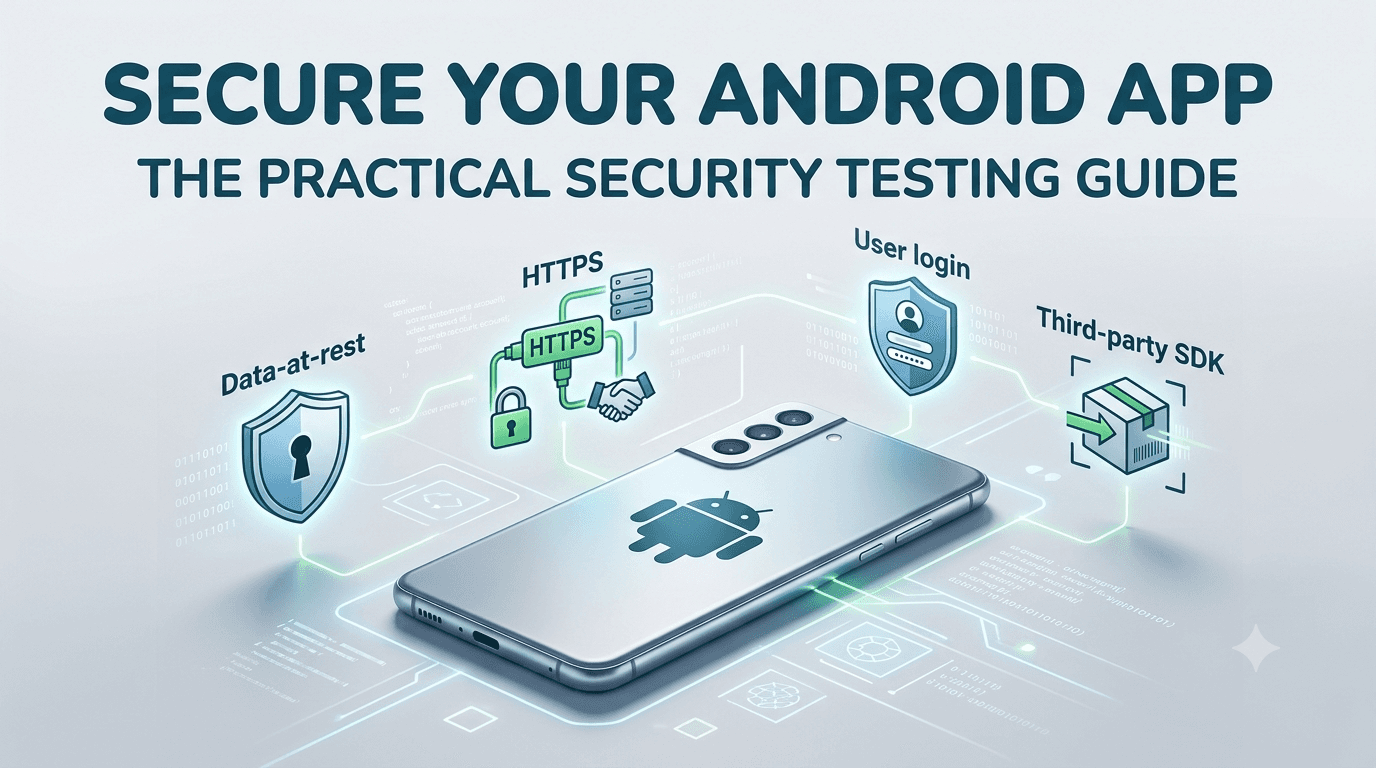
Security problems do not just embarrass you — they endanger your users, damage your reputation, and can trigger policy enforcement on Google Play. Yet security is often the least-tested dimension of an app because its failures are invisible until exploited. This guide covers security testing for Android apps, the practical checks every developer should run before publishing.
Contents
Quick answer
Featured answer: Security testing checks that your app stores data safely, transmits it over encrypted connections, authenticates users securely, requests only the permissions it needs, and does not leak data through third-party SDKs. These checks protect users and align with Google Play's data safety and privacy requirements.
Data storage
Sensitive data stored insecurely is one of the most common Android vulnerabilities. Verify that credentials, tokens, and personal information are never written to world-readable locations, plain-text files, or logs. Use the platform's secure storage mechanisms for secrets, and confirm that nothing sensitive lingers in caches or backups. A quick but revealing test is to inspect what your app writes to storage and logs during normal use — you may be surprised what leaks out.
Network security
All network communication should use encrypted connections (HTTPS/TLS). Test that your app rejects insecure connections and does not fall back to plain HTTP, and confirm that it validates certificates rather than blindly trusting any server. Data sent in the clear can be intercepted on untrusted networks, so treat any unencrypted traffic as a defect to fix before launch.
Authentication and sessions
Authentication is a prime target. Test that passwords and tokens are handled securely, that sessions expire appropriately, and that logging out truly invalidates access. Check that authentication cannot be bypassed by manipulating local state, and that sensitive actions require a valid, current session. For login-specific testing, see OAuth login testing.
Warning: Never ship debug flags, test backdoors, or verbose logging of sensitive data in a release build. These are common, dangerous oversights that real-device testing can help catch.
Permissions and data flows
Every permission your app requests expands its attack surface and its privacy obligations. Audit your permissions and remove anything not strictly required, then verify that the permissions you keep are used only for their stated purpose. This directly supports an accurate data safety declaration — see data safety form — and reduces the risk of a privacy-related rejection. For regional obligations, see GDPR compliance.
Third-party SDKs
The code you did not write can still get you in trouble. Analytics, ads, and utility SDKs may collect and transmit data you are unaware of, which must be disclosed and can introduce vulnerabilities. Review each SDK's data practices, keep them updated, and remove any you no longer use. Undisclosed SDK data collection is a frequent cause of data safety mismatches and rejections.
Key takeaways
- Store secrets in secure storage — never in plain text, logs, or caches.
- Encrypt all network traffic and validate certificates.
- Handle authentication and sessions securely; ensure logout invalidates access.
- Request only necessary permissions and use them only as stated.
- Audit third-party SDKs for data collection and vulnerabilities.
Why security testing is non-negotiable
Security is the one category of bug that can end your app entirely. A functional bug annoys users; a security failure can expose their personal data, get your app suspended from the Play Store, and expose you to legal liability under privacy regulations. Google actively scans apps for security and privacy violations, and mishandling user data is one of the fastest routes to rejection or removal. Beyond compliance, users increasingly care about how apps treat their data, and a breach or a creepy permission request can destroy trust instantly. Security testing is how you confirm your app protects the people who use it.
Security testing checks that your app safeguards user data in three states — at rest (in storage), in transit (over the network), and in use (through authentication, permissions, and third-party SDKs). Each state has its own failure modes, and a weakness in any one can compromise the whole. Unlike some testing that can be deferred, security testing must happen before launch, because a security problem discovered after release is a breach, not a bug.
Protecting data at rest
Data at rest means everything your app stores on the device: user credentials, tokens, cached content, preferences, and any personal information. The core rule is to store as little sensitive data as possible and to protect what you must store. Credentials and tokens should never sit in plain text; use the platform's secure storage mechanisms designed for secrets. Test that sensitive data is not written to logs, not left in world-readable locations, and not exposed in backups where it could leak. A surprising amount of sensitive data ends up in debug logs by accident — check for this specifically.
Also verify what happens to data when the user logs out or uninstalls. Logging out should clear session tokens and personal data, not leave them accessible for the next person who opens the app on a shared device. These lifecycle details are easy to overlook and are exactly the kind of thing an attacker or a curious user might exploit. Testing them explicitly closes a common gap.
Securing data in transit
Every piece of data your app sends or receives over the network is a potential interception point. The baseline requirement is that all network traffic uses HTTPS with proper certificate validation — never plain HTTP, and never disabled certificate checks, even in code paths you think are only for testing. Test that your app refuses to send sensitive data over insecure connections and that it validates the server's identity so it cannot be tricked by a malicious intermediary. Sending anything sensitive in cleartext is one of the most common and most serious mobile security mistakes.
Check your API surface too. Confirm that endpoints require proper authentication, that a user cannot access another user's data by manipulating requests, and that error responses do not leak sensitive details. Many data-exposure incidents come not from broken encryption but from APIs that trust the client too much. Testing these authorization boundaries is a critical part of securing data in transit.
Permissions, authentication, and third-party SDKs
Request only the permissions your app genuinely needs, and be ready to justify each one — Google scrutinizes permission usage, and unnecessary or unexplained permissions are a common rejection cause. Test that your app degrades gracefully when a permission is denied rather than crashing or becoming unusable. On the authentication side, verify that sessions expire appropriately, that tokens are handled securely, and that authentication cannot be bypassed. These are the mechanisms standing between a user's account and anyone who should not have it.
Third-party SDKs deserve particular scrutiny because they can collect and transmit data on your behalf, and their behavior becomes your responsibility in Google's eyes. Audit what data each SDK accesses and sends, ensure your privacy policy and Data Safety declarations accurately reflect it, and remove SDKs you do not actually need. An analytics or ads SDK quietly collecting more than you disclosed is a compliance risk that can get your app pulled. Real testers in your closed test can also help surface unexpected permission prompts or privacy behaviors across devices — another reason a genuine beta with engaged testers adds value before launch.
Key takeaways
- Security failures can end your app — suspension, liability, lost trust.
- Protect data at rest with secure storage; keep secrets out of logs and backups.
- Secure data in transit with HTTPS and proper certificate validation.
- Request minimal permissions and handle denials gracefully.
- Audit third-party SDKs — their data behavior becomes your responsibility.
Security testing is the one area where an ounce of prevention truly is worth a pound of cure, because a problem found before launch is a bug while the same problem found after launch is a breach. By protecting data at rest and in transit, requesting only the permissions you need, keeping your Data Safety declarations honest, and thinking like an attacker before every release, you protect both your users and your standing on the Play Store. That diligence is not just compliance — it is the foundation of the trust that keeps users installing and staying.
Privacy and compliance obligations
Security testing overlaps heavily with privacy compliance, and on the Play Store the two are inseparable. Google requires an accurate Data Safety section describing what data your app collects, how it is used, and whether it is shared — and this declaration must match your app's actual behavior. A mismatch between what you declare and what your app really does is a compliance violation that can get your app rejected or removed, so part of security testing is verifying that your declarations are truthful. Walk through every piece of data your app touches and confirm it is accounted for in your privacy policy and Data Safety form.
Regulations like GDPR and similar laws add further obligations depending on your users' locations: lawful basis for collection, the ability to delete user data on request, and clear consent for tracking. Test the mechanisms that support these — does your account-deletion flow actually remove the user's data, does consent gating actually prevent collection until granted? These are not just legal checkboxes; they are functionality that must work correctly, and they are increasingly scrutinized both by regulators and by Google's review process.
Testing with an attacker's mindset
Effective security testing means thinking like someone trying to break in rather than someone using the app as intended. Ask what an attacker would target: Can I intercept the network traffic and read it? Can I reach another user's data by changing an identifier in a request? Can I find sensitive values in logs, storage, or backups? Can I bypass authentication or reuse an expired session? This adversarial framing surfaces weaknesses that normal use never would, because attackers deliberately do the things legitimate users avoid.
You do not need to be a professional penetration tester to benefit from this mindset — even basic adversarial checks catch the most common and most damaging mistakes, like cleartext traffic, over-broad permissions, and secrets in logs. For apps handling especially sensitive data, a dedicated security review is worth the investment. But at minimum, running through the attacker's questions above before every significant release closes the gaps that account for the majority of real-world mobile security incidents, and protects both your users and your standing on the Play Store.
Frequently asked questions
What is security testing?
Checking that your app protects user data in storage, in transit, and through authentication, permissions, and SDKs.
Do I need to be a security expert to test my app?
No. Basic adversarial checks — confirming HTTPS everywhere, minimal permissions, no secrets in logs, and proper session handling — catch the most common and most damaging mistakes. For apps handling especially sensitive data, a dedicated security review is worth the investment.
Why does Google care so much about security?
Google actively scans apps for security and privacy violations because mishandling user data harms users and the platform's reputation. Violations, including a Data Safety declaration that does not match your app's real behavior, can lead to rejection or removal.
What is the single most common mobile security mistake?
Sending sensitive data over an insecure connection, or disabling certificate validation in code meant only for testing. Enforce HTTPS with proper certificate checks everywhere, with no exceptions left in shipping builds.
Do I need a security expert?
Basic checks are doable by any developer; high-risk apps (finance, health) benefit from a specialist review.
Why does Google care about security?
User safety and privacy are core policy areas; violations can cause rejection or enforcement.
What is the most common issue?
Insecure data storage and undisclosed third-party SDK data collection.
How do SDKs affect security?
They can collect data and introduce vulnerabilities, so audit and update them.
When should I run security testing?
Throughout development and again before every release, since new features, dependencies, or SDKs can introduce fresh vulnerabilities that were not present in earlier builds.
Does security relate to the data safety form?
Yes. Accurate permissions and data handling are the basis for a correct data safety declaration.
Conclusion
Security testing protects your users and your standing on Google Play. Check storage, network encryption, authentication, permissions, and third-party SDKs before you publish, and keep your data safety declaration honest. Real-device testing helps surface leaked logs and debug flags — submit your app to add that coverage today.
Expanded for topical authority — additional practical sections below. Original guide content above is unchanged.
Real-world scenarios: who this matters for
The guidance in this article on Security Testing for Android Apps applies across many Android product types. Use these scenarios to map the advice to your situation.
| Developer type | Typical challenge | Practical focus |
|---|---|---|
| Indie / solo | Limited tester network and time | Start closed testing early; keep a buffer above 12 opted-in testers; parallelize listing + Data safety work |
| Startup | Launch deadline vs 14-day rule | Treat the window as fixed; recruit in parallel with QA; avoid last-minute track setup |
| Agency / white-label | Multiple client apps, each needing its own test | One closed test per app; standardize opt-in onboarding; track eligibility dates per client |
| Flutter / React Native | Cross-platform build + Play Console quirks | Ship a signed AAB to closed testing; verify installs from Play, not sideload; watch vitals on mid-range devices |
| Native Kotlin | Device/API fragmentation | Cover API levels and OEMs in your tester mix; fix crashes before requesting production |
| Game / Unity | Performance + retention during 14 days | Keep testers engaged so count never dips below 12; monitor ANRs and battery |
| E-commerce / fintech | Policy + payment flows | Test checkout, permissions, and declarations carefully before production access |
| Healthcare / kids / education | Sensitive policies (Families, data) | Align listing, privacy, and content rating with real app behavior during the test window |
Visual placeholder: Scenario matrix infographic — Indie / Startup / Agency / Cross-platform paths for Security Testing for Android Apps.
Comparison: DIY recruitment vs managed closed testing
When your goal is Google Play production access, the path you choose for testers affects time, risk, and feedback quality. Use this comparison while deciding how to apply Security Testing for Android Apps.
| Approach | Time to 12 opted-in | Cost | Dropout risk | Feedback quality | Best when |
|---|---|---|---|---|---|
| Friends & family | Days–weeks | $0 | High | Mixed | Tiny MVP, flexible timeline |
| Reddit / Discord / Telegram | Unpredictable | $0–low | High | Variable | You can manage onboarding daily |
| Peer community exchange | Variable | $0 | Medium | Developer-biased | You can test others’ apps in return |
| Managed closed testing (e.g. Fast Testers) | ~1 hour after valid link | $15 one-time / app | Low (buffer of 15) | Real Play installs | You need speed + continuity for 14 days |
Decision tip: If a broken streak would delay revenue or a client deadline, prioritize reliability over $0 recruitment. DIY is fine when you already have engaged testers and can monitor Play Console daily.
Visual placeholder: Comparison diagram — DIY vs community vs managed testing for Security Testing for Android Apps.
Common mistakes (and how to avoid them)
These mistakes repeatedly show up when developers work through Security Testing for Android Apps:
- Confusing invited vs opted-in testers — Only testers who open the opt-in link and install from Play count toward 12. Check the opted-in number in Play Console, not your email list.
- Recruiting exactly 12 with no buffer — One uninstall can break continuity. Aim for ~15 active opted-in testers.
- Starting the counted clock late — Listing assets, Data safety, and privacy work should run during the 14 days, not after.
- Using sideloaded APKs or fake installs — They do not satisfy Play’s closed testing expectations and can create account risk.
- Ignoring tester feedback until day 14 — Crashes that drive uninstalls threaten your streak and your review outcome.
- Requesting production access before the continuous streak completes — Eligibility checks fail even if calendar time has passed.
Troubleshooting checklist
If something feels “stuck” while applying Security Testing for Android Apps, walk this list before changing strategy:
| Symptom | Likely cause | Fix |
|---|---|---|
| Console shows < 12 testers | Invites sent but not opted in | Resend opt-in link; confirm install from Play |
| “Not eligible” after 14 calendar days | Count dipped below 12 mid-window | Restore 12+ and complete a full continuous streak |
| Tester cannot join | Wrong account, Group lag, or track not published | Verify Google account, Group membership, track release |
| App fails to install | Device/API mismatch or signing issue | Check AAB, minSDK, Play App Signing |
| Production still rejected after testing | Policy, declarations, or stability — not the clock | Read the exact reason; fix that category completely |
Visual placeholder: Troubleshooting flowchart for Security Testing for Android Apps.
Action checklist
Use this checklist alongside the rest of this guide on Security Testing for Android Apps:
- ☐ Closed testing track created with a signed release (AAB)
- ☐ Opt-in link tested on a fresh Google account
- ☐ At least 12 testers opted in (prefer ~15)
- ☐ Daily check that opted-in count stays ≥ 12 for 14 continuous days
- ☐ Core flows exercised (login, main feature, permissions, offline/online)
- ☐ Crashes / ANRs triaged from tester reports and vitals
- ☐ Store listing, screenshots, and feature graphic drafted
- ☐ Privacy policy + Data safety + content rating aligned with real behavior
- ☐ Production access requested only after eligibility is green
- ☐ Staged rollout plan ready for first public release
Additional FAQs developers ask about Security Testing for Android Apps
Quick answer: what should I do first?
Confirm you are on a closed testing track with real opted-in installs, keep 12+ testers for 14 continuous days, and fix policy/stability issues in parallel. Then use the detailed sections above for Security Testing for Android Apps.
Does this apply to organization (company) accounts?
The classic 12×14 closed testing gate is primarily associated with new personal developer accounts. Always verify your account type and current Play Console eligibility messaging for your app.
Do friends and family count as testers?
Yes — if they opt in via your closed testing link and install from Google Play. They only help if they stay opted in for the continuous period.
Can I update the app during the 14 days?
You can usually push updates on the closed track, but unstable releases that cause uninstalls can threaten your tester count. Prefer polishing via internal testing first when possible.
What if production access is still rejected?
Read the exact reason. Incomplete testing is only one category — policy, Data safety mismatches, and crashes are common. Fix the cited issue fully before reapplying.
Is paying for testers allowed?
Using real people who install from Play is what matters. Avoid fake install farms. A one-time managed service that supplies real closed testers is a practical option when DIY recruitment is too slow.
How is Fast Testers different from free communities?
Free communities trade time and mutual availability. Fast Testers assigns about 15 real testers after you submit a valid closed testing link (one-time $15 per app) and includes a production access guarantee under its refund terms.
Where should I go next?
Review the related guides below, then either finish DIY recruitment or start closed testing if you need speed and continuity.
Sources, updates, and how to use this guide
This article on Security Testing for Android Apps is maintained for Android developers preparing Google Play closed testing and production access. Always cross-check eligibility text inside your own Play Console, because Google’s UI labels and account rules can vary by account type and date.
- Primary official references: Google Play closed testing help, Developer Program Policies, and Play Console eligibility messaging for your app.
- Practical experience lens: guidance here reflects common failure modes indie developers and agencies hit when recruiting testers, maintaining the 14-day streak, and recovering from production-access rejections.
- Last reviewed focus: 12×14 closed testing continuity, real vs fake testers, and parallel listing/compliance work during the window.
Related guides and next steps
Continue building topical depth around Security Testing for Android Apps with these Fast Testers resources:
- Android Tv Apps And Google Play Testing Tracks
- Ar Vr Android Apps And Closed Testing Requirements
- E Commerce Android Apps Play Store Testing Tips
- Functional Testing For Android Apps
- Google Play Closed Testing For Saas Android Apps
- Kotlin Android Apps Closed Testing Best Practices
- Localization Testing Guide For Android Apps
- Network Condition Testing For Android Apps
- Pricing — $15 closed testing
- How Fast Testers works
- FAQ
- Developer reviews
- Case studies
- Submit your app / start closed testing
Need reliable testers so your 14-day streak does not stall? Educate first with the guides above, then start when you are ready — one-time pricing, real Play installs, dashboard tracking.
Further expansion — case study, decisions, and expert recommendations. Prior sections remain unchanged.
Case study: first Play launch planned around the closed testing window
Problem: A small SaaS team treated Google Play publishing like iOS TestFlight — they expected to upload and go public the same week. They discovered the personal-account closed testing gate mid-sprint.
Solution: They reframed the sprint around Security Testing For Android Apps: internal testing for crash triage first, then closed testing with a buffer of testers, while design finished screenshots and legal finished privacy/Data safety in parallel.
Result: The 14-day requirement stopped feeling like “dead time.” When eligibility flipped green, listing and declarations were already ready, so production review was the only remaining gate.
Lessons learned:
- Start the closed track as soon as the build is stable enough to keep installed.
- Parallelize compliance work inside the window.
- Protect the streak like a production SLA.
Decision guide: what should you do next?
Use this decision path when applying Security Testing For Android Apps:
- Is your account a new personal developer account that still needs production access?
If yes, plan for closed testing with 12+ opted-in testers for 14 continuous days. If no, still test — but confirm the exact eligibility text in Play Console. - Do you already have 12+ reliable people who will install from Play and stay for two weeks?
If yes, DIY can work — add a buffer and monitor daily. If no, use community exchange or a managed closed testing service. - Is your build stable enough that testers will not churn?
If no, run internal testing first. Entering the counted window with crash loops is how streaks die. - Are Data safety, privacy policy, permissions, and listing aligned with real behavior?
If no, fix during the window so production review does not bounce you after the clock. - Has production access been rejected?
Classify: eligibility vs policy vs declarations vs stability. Fix that category completely, then re-test / re-request.
Visual placeholder: Decision tree diagram for Security Testing For Android Apps (DIY vs managed vs fix-and-retry).
Expert recommendations
- Instrument the streak: Check opted-in count daily for the first week; replace dropouts same day.
- Brief testers once: Send a short checklist (install from Play, open app daily, try core flow, report crashes). Silent testers still count if opted in — engaged testers protect quality.
- Never “solve” recruitment with fake installs: It fails the intent of closed testing and can create account risk.
- Ship a boring-stable build to closed testing: Save experimental features for internal tracks.
- Educate first, then accelerate: If your blocker is simply finding real testers fast, a one-time managed option (Fast Testers: 15 testers, $15/app) is often cheaper than slipping a launch.
For hands-on setup after reading about Security Testing For Android Apps, see how it works and pricing, or submit your closed testing link when you are ready.
Internal navigation hub — added to strengthen topical connections. Original article content above is unchanged.
Continue learning
- Functional Testing for Android Apps — A practical guide to functional testing for Android apps: what to test, how to structure test cases, common pi.
- Localization Testing Guide for Android Apps — A localization testing guide for Android apps: translations, layouts, formats, RTL languages, and cultural fit.
- Network Condition Testing for Android Apps — Learn about offline network QA for Google Play closed testing. Complete guide for Android developers publishin.
- Performance Testing Guide for Android Apps — A performance testing guide for Android apps: startup time, responsiveness, memory, battery, and network — plu.
- Regression Testing for Android Apps — A guide to regression testing for Android apps: why updates break things, what to re-test, how to prioritize, .
- Finance Apps: Google Play Testing and Compliance — Learn about finance app requirements for Google Play closed testing. Complete guide for Android developers pub.
Next steps
- Ready to run closed testing with real Android testers? Submit your app or see pricing ($15 one-time).
- Compare options on our testing service comparison page, or read developer reviews and case studies.
- Still deciding? Review how Fast Testers works and the FAQ.