
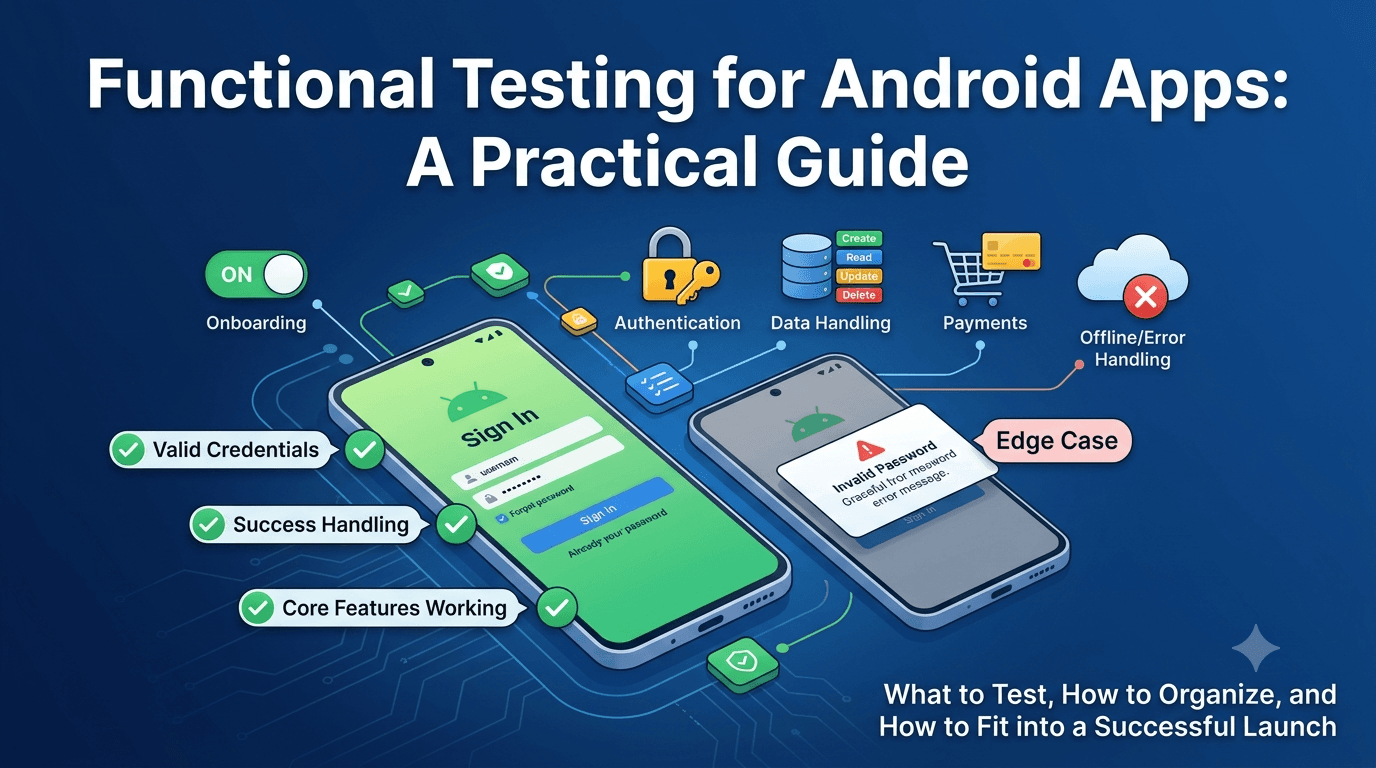
Functional testing answers the most basic and important question about your app: does it actually do what it is supposed to do? Before you worry about polish, performance, or scale, every core feature must work correctly under normal and abnormal conditions. This guide covers functional testing for Android apps — what to test, how to organize it, and how it fits into a successful Google Play launch.
Contents
Quick answer
Featured answer: Functional testing verifies that each feature behaves correctly against its requirements — inputs produce the right outputs, flows complete, and errors are handled gracefully. It covers happy paths and edge cases across authentication, core actions, data handling, and payments, and it is the foundation every other type of testing builds on.
What functional testing covers
Functional testing evaluates behavior against expected outcomes. You feed the app a set of inputs and confirm it produces the correct result — a successful login, a saved record, a completed purchase, or a clear error when something goes wrong. It is deliberately concerned with what the app does rather than how fast or how pretty it is; those belong to performance and UI testing respectively.
Good functional testing covers both the "happy path" (everything works as intended) and the "unhappy paths" (invalid input, lost connectivity, interrupted flows). Real apps fail most often at the edges, so testing only the happy path gives a false sense of security.
Writing good test cases
A strong test case is specific and repeatable. It states the preconditions, the exact steps, the input data, and the expected result, so anyone can run it and agree on whether it passed. Ambiguous cases like "check that login works" lead to inconsistent testing; precise cases like "enter a valid email and wrong password, expect an inline error and no navigation" produce reliable, comparable results.
Organize cases by feature and by priority. Critical flows — sign-up, login, payments, and core actions — deserve the most thorough coverage, including their edge cases, while minor screens need only basic verification.
Key areas to test
| Area | What to verify |
|---|---|
| Onboarding | First run, permissions, account creation |
| Authentication | Login, logout, password reset, sessions |
| Core features | Primary actions and their edge cases |
| Data | Create, read, update, delete, and sync |
| Payments | Purchases, subscriptions, restore |
| Error handling | Invalid input, offline, timeouts |
For flows with external dependencies, dig deeper: see OAuth login testing and billing testing.
Common pitfalls
The most frequent mistake is testing only the happy path and shipping bugs that appear the moment a user does something unexpected. Another is testing on a single device, which hides behavior that differs across Android versions and manufacturers. A third is neglecting offline and poor-network conditions — many apps assume perfect connectivity and break badly without it. See offline-first testing and network condition testing.
Tip: Real testers naturally exercise edge cases and diverse devices you would never think to try. Submit your app to complement your test cases with real-world functional coverage.
How it fits your launch
Functional testing is the first quality gate. A functionally broken app will fail your own review, frustrate testers, and risk rejection during Google's review. Get functionality solid before layering on UI, performance, and security testing, and before your closed test begins — see the full pre-release checklist.
Key takeaways
- Functional testing confirms features work against their requirements.
- Test both happy paths and edge cases — real apps fail at the edges.
- Write specific, repeatable test cases prioritized by importance.
- Test across devices and network conditions, not just one setup.
- Solid functionality is the foundation for all other testing.
Why functional testing comes first
Functional testing answers the most basic question about your app: does it do what it is supposed to do? Every other kind of testing — performance, security, usability — assumes the features actually work, so functional testing is the foundation everything else builds on. If your login is broken, no amount of polish elsewhere matters, because users cannot get past the front door. This is why functional testing should be your first and most thorough layer: it verifies that each feature behaves correctly against its requirements, for both the happy path and the messy realities of real use.
The scope of functional testing is broader than many developers assume. It is not just checking that a button does something when tapped; it is confirming that the button does the right thing, that it handles bad input gracefully, that it behaves correctly when the network is slow or absent, and that it leaves the app in a sensible state afterward. Thorough functional testing means thinking adversarially about every feature — not just "does this work?" but "how could this fail, and does it fail safely?"
What to cover
Start by listing your app's core user flows — the paths that deliver its main value, such as signing up, creating content, making a purchase, or completing whatever core task your app exists for. These flows must work flawlessly, so test them first and test them hard. For each flow, verify the normal case, then deliberately try to break it: empty fields, invalid data, canceled steps, and interruptions like an incoming call or a lost connection midway through. A feature is only truly done when it handles these abnormal cases as gracefully as the happy path.
Beyond core flows, cover the boundaries and transitions: what happens at the edges of input ranges, when data is missing, when the user navigates backward, or when two features interact. Also test state persistence — does the app remember what it should when backgrounded and reopened, and forget what it should when logged out? These transitional and state-related bugs are among the most common sources of poor reviews because they surface during normal, everyday use rather than exotic scenarios.
Handling inputs and errors well
How your app handles bad input is often more revealing than how it handles good input. Every field that accepts user data is an opportunity for something unexpected: emojis in a name field, a wildly long string, a negative number, a malformed email. Robust functional testing pushes on all of these and confirms the app responds with a clear, helpful message rather than a crash or silent failure. Good error handling is a feature in itself — it is the difference between a user who recovers and continues versus one who gives up and uninstalls.
Pay special attention to error states that depend on the environment, like network failures. Turn off connectivity mid-action and confirm the app recovers cleanly when it returns, without losing the user's work or getting stuck in a broken state. These conditions are common in real use — people use apps on trains, in elevators, on spotty connections — and an app that handles them gracefully feels dramatically more solid than one that does not.
Functional testing in your closed test
Your own functional testing is essential but inherently limited: you know how the app is "supposed" to be used, so you unconsciously avoid the paths that break it. Real testers do not share your assumptions, which is exactly why they find functional bugs you never would. During your closed test, a group of genuine testers exercising your app across real devices will surface functional issues — a flow that breaks on a specific Android version, an input your code did not anticipate — that no amount of solo testing uncovers. This is one of the most valuable outputs of a proper beta.
Because this real-world functional coverage is so valuable, it is worth ensuring your closed test actually has enough engaged testers to provide it. If recruiting them is a hurdle, a professional service can supply verified real testers on diverse devices quickly, giving your app the broad functional exercise it needs before launch. Combine that external coverage with your own systematic testing of core flows and error cases, and you enter production with genuine confidence that your features work.
Key takeaways
- Functional testing is the foundation — features must work before anything else matters.
- Test core flows first and hardest, covering both happy and abnormal paths.
- Push on bad input and error states; graceful failure is a feature.
- Test network failures and state transitions — common sources of real-world bugs.
- Real testers find functional bugs you cannot because they do not share your assumptions.
A practical functional testing checklist
Turning the principles above into a repeatable routine keeps functional testing from becoming ad hoc. Before each release, walk a written checklist that covers your core flows end to end, your error and edge cases, and the areas you most recently changed. The value of a written checklist is consistency: it ensures you test the same critical paths every time rather than relying on memory, which inevitably skips the very flow that breaks. Keep the checklist short enough to actually use but complete enough to cover what matters.
| Category | What to verify |
|---|---|
| Core flows | Sign-up, login, main task, checkout all complete |
| Input handling | Empty, invalid, and extreme inputs handled gracefully |
| Interruptions | Calls, backgrounding, and connection loss mid-flow |
| State | Data persists and clears correctly across sessions |
| Navigation | Back, deep links, and transitions behave |
The interruptions row deserves emphasis because it is the most commonly skipped and the most representative of real use. People do not use apps in a vacuum; they get calls, switch apps, and lose signal constantly. An app that loses the user's work or gets stuck when interrupted feels fragile, while one that recovers smoothly feels solid and trustworthy.
Common functional testing mistakes
The biggest functional testing mistake is testing only the happy path — confirming a feature works when everything goes right while never checking what happens when it does not. Real users constantly do the "wrong" thing, and the app's response to those cases is what determines whether they stay. A second common mistake is testing only on your own device and account, which hides device-specific behavior and edge cases tied to fresh or unusual data. A third is treating "no crash" as "works correctly" — a feature can run without crashing while still producing wrong results, which is arguably worse because it goes unnoticed. Guard against these by deliberately testing failure cases, using varied devices and accounts, and verifying outcomes rather than just absence of crashes.
Frequently asked questions
What is functional testing?
Verifying that each feature behaves correctly against its requirements, for both normal and abnormal inputs.
Isn't "no crash" the same as "works correctly"?
No. A feature can run without crashing while still producing the wrong result, which is arguably worse because it goes unnoticed. Functional testing verifies outcomes, not just the absence of crashes.
Why do real testers find bugs I can't?
Because you know how the app is "supposed" to be used, so you unconsciously avoid the paths that break it. Real testers do not share your assumptions and use the app in ways you never would, surfacing functional issues that solo testing consistently misses.
How is it different from UI testing?
Functional testing checks behavior and outcomes; UI testing checks appearance, layout, and interaction quality.
Can functional testing be automated?
Yes, stable flows are good automation candidates, but human testing still catches unexpected edge cases.
What should I test first?
Critical flows — sign-up, login, payments, and core actions — including their edge cases.
Do I need multiple devices?
Yes. Behavior varies across Android versions and manufacturers, so test a range of tiers.
Does functional testing satisfy closed testing?
It is your own QA. Closed testing is the separate Google requirement with 12 real testers.
Conclusion
Functional testing is where quality begins: precise test cases covering happy and unhappy paths, run across real devices and network conditions. Get it right and everything downstream — UI, performance, review, and launch — goes more smoothly. To add real-world functional coverage from actual users, submit your app today.
Expanded for topical authority — additional practical sections below. Original guide content above is unchanged.
Real-world scenarios: who this matters for
The guidance in this article on Functional Testing for Android Apps applies across many Android product types. Use these scenarios to map the advice to your situation.
| Developer type | Typical challenge | Practical focus |
|---|---|---|
| Indie / solo | Limited tester network and time | Start closed testing early; keep a buffer above 12 opted-in testers; parallelize listing + Data safety work |
| Startup | Launch deadline vs 14-day rule | Treat the window as fixed; recruit in parallel with QA; avoid last-minute track setup |
| Agency / white-label | Multiple client apps, each needing its own test | One closed test per app; standardize opt-in onboarding; track eligibility dates per client |
| Flutter / React Native | Cross-platform build + Play Console quirks | Ship a signed AAB to closed testing; verify installs from Play, not sideload; watch vitals on mid-range devices |
| Native Kotlin | Device/API fragmentation | Cover API levels and OEMs in your tester mix; fix crashes before requesting production |
| Game / Unity | Performance + retention during 14 days | Keep testers engaged so count never dips below 12; monitor ANRs and battery |
| E-commerce / fintech | Policy + payment flows | Test checkout, permissions, and declarations carefully before production access |
| Healthcare / kids / education | Sensitive policies (Families, data) | Align listing, privacy, and content rating with real app behavior during the test window |
Visual placeholder: Scenario matrix infographic — Indie / Startup / Agency / Cross-platform paths for Functional Testing for Android Apps.
Comparison: DIY recruitment vs managed closed testing
When your goal is Google Play production access, the path you choose for testers affects time, risk, and feedback quality. Use this comparison while deciding how to apply Functional Testing for Android Apps.
| Approach | Time to 12 opted-in | Cost | Dropout risk | Feedback quality | Best when |
|---|---|---|---|---|---|
| Friends & family | Days–weeks | $0 | High | Mixed | Tiny MVP, flexible timeline |
| Reddit / Discord / Telegram | Unpredictable | $0–low | High | Variable | You can manage onboarding daily |
| Peer community exchange | Variable | $0 | Medium | Developer-biased | You can test others’ apps in return |
| Managed closed testing (e.g. Fast Testers) | ~1 hour after valid link | $15 one-time / app | Low (buffer of 15) | Real Play installs | You need speed + continuity for 14 days |
Decision tip: If a broken streak would delay revenue or a client deadline, prioritize reliability over $0 recruitment. DIY is fine when you already have engaged testers and can monitor Play Console daily.
Visual placeholder: Comparison diagram — DIY vs community vs managed testing for Functional Testing for Android Apps.
Common mistakes (and how to avoid them)
These mistakes repeatedly show up when developers work through Functional Testing for Android Apps:
- Confusing invited vs opted-in testers — Only testers who open the opt-in link and install from Play count toward 12. Check the opted-in number in Play Console, not your email list.
- Recruiting exactly 12 with no buffer — One uninstall can break continuity. Aim for ~15 active opted-in testers.
- Starting the counted clock late — Listing assets, Data safety, and privacy work should run during the 14 days, not after.
- Using sideloaded APKs or fake installs — They do not satisfy Play’s closed testing expectations and can create account risk.
- Ignoring tester feedback until day 14 — Crashes that drive uninstalls threaten your streak and your review outcome.
- Requesting production access before the continuous streak completes — Eligibility checks fail even if calendar time has passed.
Troubleshooting checklist
If something feels “stuck” while applying Functional Testing for Android Apps, walk this list before changing strategy:
| Symptom | Likely cause | Fix |
|---|---|---|
| Console shows < 12 testers | Invites sent but not opted in | Resend opt-in link; confirm install from Play |
| “Not eligible” after 14 calendar days | Count dipped below 12 mid-window | Restore 12+ and complete a full continuous streak |
| Tester cannot join | Wrong account, Group lag, or track not published | Verify Google account, Group membership, track release |
| App fails to install | Device/API mismatch or signing issue | Check AAB, minSDK, Play App Signing |
| Production still rejected after testing | Policy, declarations, or stability — not the clock | Read the exact reason; fix that category completely |
Visual placeholder: Troubleshooting flowchart for Functional Testing for Android Apps.
Action checklist
Use this checklist alongside the rest of this guide on Functional Testing for Android Apps:
- ☐ Closed testing track created with a signed release (AAB)
- ☐ Opt-in link tested on a fresh Google account
- ☐ At least 12 testers opted in (prefer ~15)
- ☐ Daily check that opted-in count stays ≥ 12 for 14 continuous days
- ☐ Core flows exercised (login, main feature, permissions, offline/online)
- ☐ Crashes / ANRs triaged from tester reports and vitals
- ☐ Store listing, screenshots, and feature graphic drafted
- ☐ Privacy policy + Data safety + content rating aligned with real behavior
- ☐ Production access requested only after eligibility is green
- ☐ Staged rollout plan ready for first public release
Additional FAQs developers ask about Functional Testing for Android Apps
Quick answer: what should I do first?
Confirm you are on a closed testing track with real opted-in installs, keep 12+ testers for 14 continuous days, and fix policy/stability issues in parallel. Then use the detailed sections above for Functional Testing for Android Apps.
Does this apply to organization (company) accounts?
The classic 12×14 closed testing gate is primarily associated with new personal developer accounts. Always verify your account type and current Play Console eligibility messaging for your app.
Do friends and family count as testers?
Yes — if they opt in via your closed testing link and install from Google Play. They only help if they stay opted in for the continuous period.
Can I update the app during the 14 days?
You can usually push updates on the closed track, but unstable releases that cause uninstalls can threaten your tester count. Prefer polishing via internal testing first when possible.
What if production access is still rejected?
Read the exact reason. Incomplete testing is only one category — policy, Data safety mismatches, and crashes are common. Fix the cited issue fully before reapplying.
Is paying for testers allowed?
Using real people who install from Play is what matters. Avoid fake install farms. A one-time managed service that supplies real closed testers is a practical option when DIY recruitment is too slow.
How is Fast Testers different from free communities?
Free communities trade time and mutual availability. Fast Testers assigns about 15 real testers after you submit a valid closed testing link (one-time $15 per app) and includes a production access guarantee under its refund terms.
Where should I go next?
Review the related guides below, then either finish DIY recruitment or start closed testing if you need speed and continuity.
Sources, updates, and how to use this guide
This article on Functional Testing for Android Apps is maintained for Android developers preparing Google Play closed testing and production access. Always cross-check eligibility text inside your own Play Console, because Google’s UI labels and account rules can vary by account type and date.
- Primary official references: Google Play closed testing help, Developer Program Policies, and Play Console eligibility messaging for your app.
- Practical experience lens: guidance here reflects common failure modes indie developers and agencies hit when recruiting testers, maintaining the 14-day streak, and recovering from production-access rejections.
- Last reviewed focus: 12×14 closed testing continuity, real vs fake testers, and parallel listing/compliance work during the window.
Related guides and next steps
Continue building topical depth around Functional Testing for Android Apps with these Fast Testers resources:
- Android Tv Apps And Google Play Testing Tracks
- Ar Vr Android Apps And Closed Testing Requirements
- E Commerce Android Apps Play Store Testing Tips
- Google Play Closed Testing For Saas Android Apps
- Kotlin Android Apps Closed Testing Best Practices
- Localization Testing Guide For Android Apps
- Network Condition Testing For Android Apps
- Oauth Login Testing For Android Apps
- Pricing — $15 closed testing
- How Fast Testers works
- FAQ
- Developer reviews
- Case studies
- Submit your app / start closed testing
Need reliable testers so your 14-day streak does not stall? Educate first with the guides above, then start when you are ready — one-time pricing, real Play installs, dashboard tracking.
Further expansion — case study, decisions, and expert recommendations. Prior sections remain unchanged.
Case study: first Play launch planned around the closed testing window
Problem: A small SaaS team treated Google Play publishing like iOS TestFlight — they expected to upload and go public the same week. They discovered the personal-account closed testing gate mid-sprint.
Solution: They reframed the sprint around Functional Testing For Android Apps: internal testing for crash triage first, then closed testing with a buffer of testers, while design finished screenshots and legal finished privacy/Data safety in parallel.
Result: The 14-day requirement stopped feeling like “dead time.” When eligibility flipped green, listing and declarations were already ready, so production review was the only remaining gate.
Lessons learned:
- Start the closed track as soon as the build is stable enough to keep installed.
- Parallelize compliance work inside the window.
- Protect the streak like a production SLA.
Decision guide: what should you do next?
Use this decision path when applying Functional Testing For Android Apps:
- Is your account a new personal developer account that still needs production access?
If yes, plan for closed testing with 12+ opted-in testers for 14 continuous days. If no, still test — but confirm the exact eligibility text in Play Console. - Do you already have 12+ reliable people who will install from Play and stay for two weeks?
If yes, DIY can work — add a buffer and monitor daily. If no, use community exchange or a managed closed testing service. - Is your build stable enough that testers will not churn?
If no, run internal testing first. Entering the counted window with crash loops is how streaks die. - Are Data safety, privacy policy, permissions, and listing aligned with real behavior?
If no, fix during the window so production review does not bounce you after the clock. - Has production access been rejected?
Classify: eligibility vs policy vs declarations vs stability. Fix that category completely, then re-test / re-request.
Visual placeholder: Decision tree diagram for Functional Testing For Android Apps (DIY vs managed vs fix-and-retry).
Expert recommendations
- Instrument the streak: Check opted-in count daily for the first week; replace dropouts same day.
- Brief testers once: Send a short checklist (install from Play, open app daily, try core flow, report crashes). Silent testers still count if opted in — engaged testers protect quality.
- Never “solve” recruitment with fake installs: It fails the intent of closed testing and can create account risk.
- Ship a boring-stable build to closed testing: Save experimental features for internal tracks.
- Educate first, then accelerate: If your blocker is simply finding real testers fast, a one-time managed option (Fast Testers: 15 testers, $15/app) is often cheaper than slipping a launch.
For hands-on setup after reading about Functional Testing For Android Apps, see how it works and pricing, or submit your closed testing link when you are ready.
Internal navigation hub — added to strengthen topical connections. Original article content above is unchanged.
Continue learning
- Localization Testing Guide for Android Apps — A localization testing guide for Android apps: translations, layouts, formats, RTL languages, and cultural fit.
- Network Condition Testing for Android Apps — Learn about offline network QA for Google Play closed testing. Complete guide for Android developers publishin.
- Performance Testing Guide for Android Apps — A performance testing guide for Android apps: startup time, responsiveness, memory, battery, and network — plu.
- Regression Testing for Android Apps — A guide to regression testing for Android apps: why updates break things, what to re-test, how to prioritize, .
- Security Testing for Android Apps — A security testing guide for Android apps: data storage, network security, authentication, permissions, and th.
- Finance Apps: Google Play Testing and Compliance — Learn about finance app requirements for Google Play closed testing. Complete guide for Android developers pub.
Next steps
- Ready to run closed testing with real Android testers? Submit your app or see pricing ($15 one-time).
- Compare options on our testing service comparison page, or read developer reviews and case studies.
- Still deciding? Review how Fast Testers works and the FAQ.