
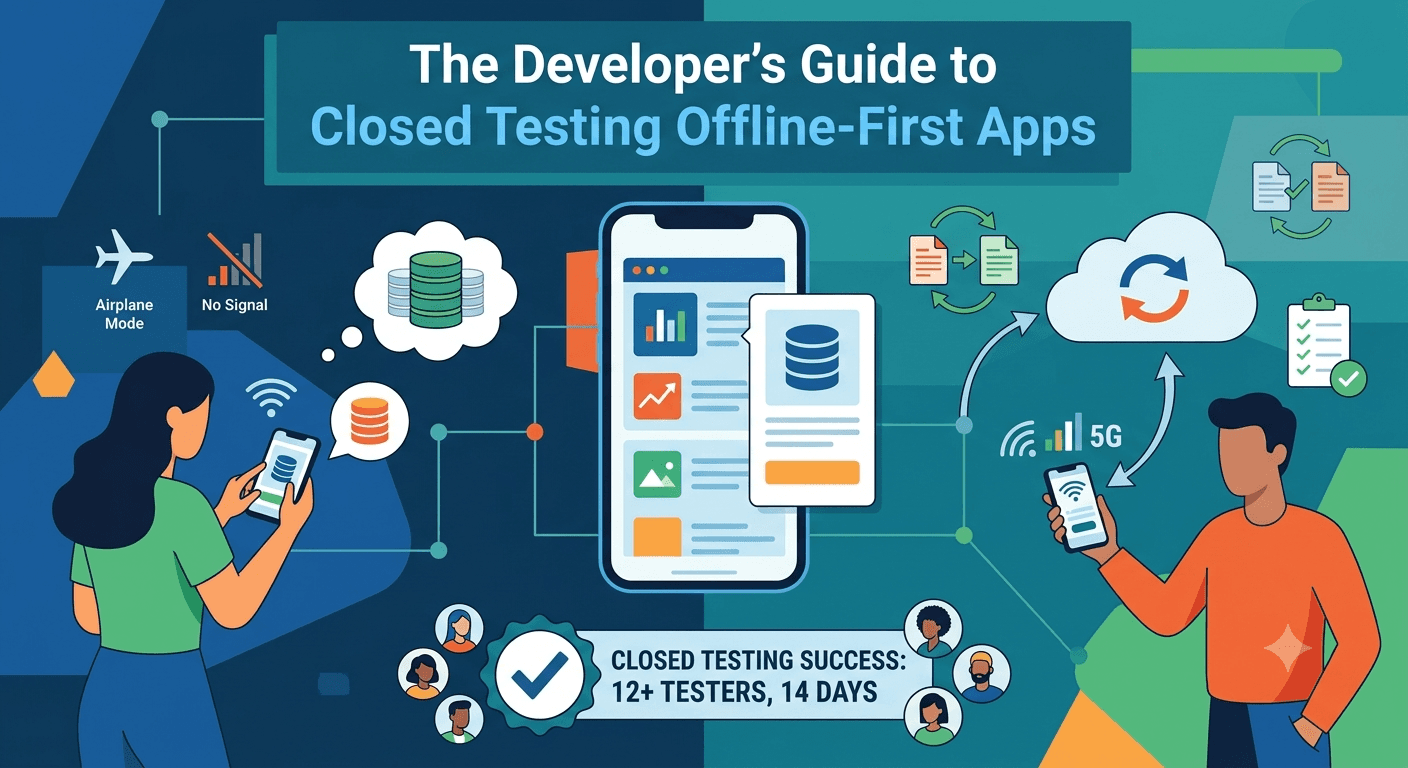
Offline-first apps are built to work regardless of connectivity, storing data locally and syncing when a connection is available. This architecture delivers a great experience but introduces complex behavior around data storage, synchronization, and conflict resolution that must be tested carefully. Before an offline-first app published from a new personal account can reach production, it must complete a closed test with at least 12 testers opted in for 14 continuous days. This guide covers best practices for testing offline-first apps during your closed-testing window.
The closed-testing process is the same as for any app, but offline-first apps depend on behavior — offline operation, sync, conflict handling — that only reveals its bugs under real, varied network conditions. Using your testing window to exercise these across real devices and connections turns the mandatory wait into genuine assurance for your app's defining feature.
The requirement applies to offline-first apps
There is no exemption for offline-first apps. The closed-testing requirement is tied to your developer account type, so an offline-first app on a new personal account must complete a closed test with 12+ testers for 14 continuous days before production access. See the closed testing guide. For offline-first apps, network-diverse testing is especially valuable.
Standard advice applies: recruit committed, device-diverse testers, keep your count above 12, and prepare your listing in parallel. Offline-first apps additionally need testers who will use the app across real, varied, and unreliable connections.
Testing offline behavior
The core promise of an offline-first app is that it works without a connection, so this must be tested thoroughly. Confirm that all core functionality is available offline, that data created or edited offline is stored reliably, and that the app never loses work when there is no connection. Test starting the app offline, using it extensively offline, and the full range of operations users perform, since anything that silently requires connectivity breaks the offline-first promise and frustrates users who expected the app to work anywhere.
| Offline-first test focus | Why it matters |
|---|---|
| Full offline functionality | Core promise of the app |
| Local data reliability | Offline work must never be lost |
| Sync on reconnect | Changes must upload correctly |
| Conflict resolution | Concurrent edits must resolve safely |
| Intermittent networks | Flaky connections are the hard case |
Real testers on varied and unreliable networks reveal the offline and sync bugs that matter. See network condition testing.
Testing synchronization
Synchronization is the hardest part of an offline-first app. When connectivity returns, locally stored changes must upload correctly, remote changes must download, and the app must reconcile the two without losing data. Test that sync triggers reliably on reconnection, that it handles large queues of offline changes, and that it recovers from interruptions mid-sync. Sync failures — changes that never upload, data that disappears, or duplicates — are among the most damaging bugs an offline-first app can have, and they undermine the trust the architecture is meant to build.
During your window, have testers work offline, accumulate changes, then reconnect, and confirm everything syncs correctly. Test interrupting sync partway (by killing the connection or the app) and verify it resumes cleanly. Because sync behavior depends on timing, network conditions, and real usage, it is exactly the kind of thing that only reveals its bugs with real testers on real networks — which is why the closed-testing window is so valuable for these apps. See SDK behavior testing.
Conflict resolution
When the same data is edited in multiple places — on different devices, or offline on one device while changed on the server — conflicts arise, and how your app resolves them is critical. A naive approach that simply overwrites can silently destroy a user's work. Test concurrent-edit scenarios deliberately: edit the same item on two devices, or offline and online, and confirm your conflict resolution behaves sensibly and preserves data rather than losing it. Users must never lose work to a conflict they did not even know occurred.
The right conflict strategy depends on your app, but whatever you choose must be tested with real multi-device scenarios during your closed test. Have testers deliberately create conflicts and report any lost or unexpectedly overwritten data. Conflict bugs are subtle and easy to miss in single-device development, so real testers using multiple devices are the reliable way to surface them before they cost your users their work. See productivity app testing for related data-integrity practices.
Setting up your closed-testing track
Once your signed release build is ready, create a closed-testing track in the Play Console and upload it, add testers by email or Google Group, and share the opt-in link each tester must use before installing. Correct configuration matters because the 14-day clock counts only opted-in testers, and a misconfigured track is a common reason developers realize late that their timer never started. Install from the listing on a real device and confirm offline operation and sync work before inviting your full group. See how to create a closed testing track.
Give testers clear onboarding instructions and ask them to use the app offline, on flaky connections, and across devices, and to try creating conflicts. Every failed opt-in is a tester who does not count toward your 12, so smooth guidance maximizes active testers from day one and gives you the network- and device-diverse coverage an offline-first app needs.
Recruiting and managing the window
You need 12+ committed, device-diverse testers for 14 continuous days, and for offline-first apps, testers who will genuinely use the app across varied and unreliable networks add the most value. Recruit a buffer above 12, keep testers engaged with clear tasks and quick responses, and direct them to exercise offline, sync, and conflict scenarios. Monitor your active count in the Play Console and recruit replacements early if it slips.
If assembling a reliable, network- and device-diverse group is your bottleneck, a service that supplies verified real testers solves it quickly. You can submit your app to get started, and read where to find real testers and how to keep testers engaged.
Why real-network testing matters
Offline-first behavior is impossible to validate properly without real, varied, and unreliable network conditions. The hardest cases — intermittent connectivity, sync interrupted mid-transfer, conflicts from concurrent edits — arise precisely from the messy reality of mobile networks, which a stable lab connection never reproduces. A developer testing on solid office Wi-Fi will miss the sync failures and data-loss bugs that appear when a real user's connection drops in and out. Real testers on real networks are the only reliable way to see these.
This is why the closed-testing window, built on real opt-in testers, delivers genuine value for offline-first apps. Testers using your app across varied connections surface the offline, sync, and conflict bugs that define whether users can trust your app with their data. The window is your structured chance to validate your defining feature under realistic conditions, and network and device diversity in your tester group is what makes that validation trustworthy.
From closed testing to production
When your 14 continuous days with 12+ testers complete, request production access in the Play Console. For an offline-first app, confirm full offline functionality, reliable sync, and safe conflict resolution across devices and networks before you submit. Preparing your listing in parallel during the window lets you submit immediately rather than losing more time. See what happens after 14 days.
Making the 14-day window count
Because the requirement forces you to test anyway, extract genuine value from the window rather than treating it as a formality. For an offline-first app, that means proving full offline functionality, reliable sync, and safe conflict resolution with real testers on real, unreliable networks. Brief your testers clearly, ask them to work offline and on flaky connections and to deliberately create conflicts, and treat their reports as a chance to harden the defining feature your app is built around.
A well-run window turns a mandatory delay into a materially more trustworthy product. Enter production having resolved the offline, sync, and conflict issues your testers surfaced, and you avoid the data-loss reports that destroy trust in an app whose whole promise is working anywhere. The 14 days are an investment in the reliability that justifies your offline-first architecture. See the testing checklist.
Turning tester feedback into fixes
The value of your closed test scales with how well you capture and act on feedback. Give testers a frictionless way to report problems and ask specific questions: did everything work offline, did your changes sync when you reconnected, did anything get lost or duplicated, did a conflict ever overwrite your work? Concrete questions produce the actionable reports that let you fix the offline and sync issues most likely to hurt an offline-first app.
Then close the loop: when you ship a build addressing reported issues, tell testers what changed and ask them to reconfirm across their networks and devices. This validates fixes across varied connectivity and hardware and keeps testers engaged. An offline-first app that enters production having already resolved its sync and conflict problems launches with the reliability its data-centric users demand. See fixing crashes before production.
A realistic timeline for your launch
Plan backward from the 14-day minimum. Expect a few days up front to finalize your build, recruit and onboard network- and device-diverse testers, and confirm opt-ins before your continuous window truly begins. The 14 days then run while you fix issues and ship updates, and production review takes additional days. Budgeting three to four weeks end to end, rather than exactly 14, keeps your offline-first launch aligned with reality.
Developers who hit their dates front-load recruitment so nothing blocks them when the window closes. Because offline-first apps need testers on varied, unreliable networks and that coverage is hard to assemble alone, resolving your tester source early through your network or a service supplying verified real testers is the highest-leverage step for keeping your launch on schedule. See getting 12 testers without friends or family.
Use internal testing before your closed test
The Play Console's internal testing track is faster than the closed track and ideal for a first pass. For an offline-first app, use it to shake out obvious offline and sync problems with a small trusted group before your counted 14-day window begins. Catching a sync bug that loses data privately, rather than during your closed test, protects your testers' goodwill and prevents losing days of your continuous window to a build that risks users' work.
A practical rhythm is to validate each release candidate on the internal track, confirm offline operation and sync on a couple of real devices, then promote it to the closed track where your counted testers live. This staging discipline keeps the closed track stable and your feedback focused on real reliability. Treating internal testing as staging and closed testing as the requirement keeps your window productive. See internal vs closed testing.
Key takeaways
- Offline-first apps must meet the 12-tester, 14-day requirement like any app.
- Test full offline functionality — never silently require connectivity.
- Validate sync on reconnection, including interrupted and large-queue cases.
- Test conflict resolution so concurrent edits never lose data.
- Prioritize network-diverse testers on real, unreliable connections.
Frequently asked questions
Do offline-first apps need closed testing?
Yes. On a new personal account, the 12-tester, 14-day requirement applies to offline-first apps.
What's the hardest thing to test in an offline-first app?
Synchronization and conflict resolution, since they depend on timing, real network conditions, and concurrent edits across devices.
How do I test sync properly?
Have testers work offline, accumulate changes, reconnect, and interrupt sync mid-transfer, confirming nothing is lost or duplicated.
Why do I need real, unreliable networks?
The worst bugs arise from intermittent connectivity, which stable lab Wi-Fi never reproduces. Real testers on flaky networks reveal them.
How do I handle edit conflicts?
Choose a resolution strategy suited to your app and test concurrent-edit scenarios so conflicts resolve safely without losing user work.
Should I use internal testing first?
Yes. Shake out offline and sync bugs on the faster internal track before your counted closed-testing window begins, so you do not risk users' data or waste days.
Expanded for topical authority — additional practical sections below. Original guide content above is unchanged.
Quick answer
Offline-First Apps and Closed Testing Best Practices matters because Google Play production access for many new personal developer accounts depends on a successful closed test: at least 12 real testers opted in for 14 continuous days, plus a policy-compliant, stable app. Use this guide to execute the steps correctly, avoid streak-breaking mistakes, and decide whether DIY recruitment or a managed closed testing service is the better path for your deadline.
Real-world scenarios: who this matters for
The guidance in this article on Offline-First Apps and Closed Testing Best Practices applies across many Android product types. Use these scenarios to map the advice to your situation.
| Developer type | Typical challenge | Practical focus |
|---|---|---|
| Indie / solo | Limited tester network and time | Start closed testing early; keep a buffer above 12 opted-in testers; parallelize listing + Data safety work |
| Startup | Launch deadline vs 14-day rule | Treat the window as fixed; recruit in parallel with QA; avoid last-minute track setup |
| Agency / white-label | Multiple client apps, each needing its own test | One closed test per app; standardize opt-in onboarding; track eligibility dates per client |
| Flutter / React Native | Cross-platform build + Play Console quirks | Ship a signed AAB to closed testing; verify installs from Play, not sideload; watch vitals on mid-range devices |
| Native Kotlin | Device/API fragmentation | Cover API levels and OEMs in your tester mix; fix crashes before requesting production |
| Game / Unity | Performance + retention during 14 days | Keep testers engaged so count never dips below 12; monitor ANRs and battery |
| E-commerce / fintech | Policy + payment flows | Test checkout, permissions, and declarations carefully before production access |
| Healthcare / kids / education | Sensitive policies (Families, data) | Align listing, privacy, and content rating with real app behavior during the test window |
Visual placeholder: Scenario matrix infographic — Indie / Startup / Agency / Cross-platform paths for Offline-First Apps and Closed Testing Best Practices.
Comparison: DIY recruitment vs managed closed testing
When your goal is Google Play production access, the path you choose for testers affects time, risk, and feedback quality. Use this comparison while deciding how to apply Offline-First Apps and Closed Testing Best Practices.
| Approach | Time to 12 opted-in | Cost | Dropout risk | Feedback quality | Best when |
|---|---|---|---|---|---|
| Friends & family | Days–weeks | $0 | High | Mixed | Tiny MVP, flexible timeline |
| Reddit / Discord / Telegram | Unpredictable | $0–low | High | Variable | You can manage onboarding daily |
| Peer community exchange | Variable | $0 | Medium | Developer-biased | You can test others’ apps in return |
| Managed closed testing (e.g. Fast Testers) | ~1 hour after valid link | $15 one-time / app | Low (buffer of 15) | Real Play installs | You need speed + continuity for 14 days |
Decision tip: If a broken streak would delay revenue or a client deadline, prioritize reliability over $0 recruitment. DIY is fine when you already have engaged testers and can monitor Play Console daily.
Visual placeholder: Comparison diagram — DIY vs community vs managed testing for Offline-First Apps and Closed Testing Best Practices.
Common mistakes (and how to avoid them)
These mistakes repeatedly show up when developers work through Offline-First Apps and Closed Testing Best Practices:
- Confusing invited vs opted-in testers — Only testers who open the opt-in link and install from Play count toward 12. Check the opted-in number in Play Console, not your email list.
- Recruiting exactly 12 with no buffer — One uninstall can break continuity. Aim for ~15 active opted-in testers.
- Starting the counted clock late — Listing assets, Data safety, and privacy work should run during the 14 days, not after.
- Using sideloaded APKs or fake installs — They do not satisfy Play’s closed testing expectations and can create account risk.
- Ignoring tester feedback until day 14 — Crashes that drive uninstalls threaten your streak and your review outcome.
- Requesting production access before the continuous streak completes — Eligibility checks fail even if calendar time has passed.
Troubleshooting checklist
If something feels “stuck” while applying Offline-First Apps and Closed Testing Best Practices, walk this list before changing strategy:
| Symptom | Likely cause | Fix |
|---|---|---|
| Console shows < 12 testers | Invites sent but not opted in | Resend opt-in link; confirm install from Play |
| “Not eligible” after 14 calendar days | Count dipped below 12 mid-window | Restore 12+ and complete a full continuous streak |
| Tester cannot join | Wrong account, Group lag, or track not published | Verify Google account, Group membership, track release |
| App fails to install | Device/API mismatch or signing issue | Check AAB, minSDK, Play App Signing |
| Production still rejected after testing | Policy, declarations, or stability — not the clock | Read the exact reason; fix that category completely |
Visual placeholder: Troubleshooting flowchart for Offline-First Apps and Closed Testing Best Practices.
Action checklist
Use this checklist alongside the rest of this guide on Offline-First Apps and Closed Testing Best Practices:
- ☐ Closed testing track created with a signed release (AAB)
- ☐ Opt-in link tested on a fresh Google account
- ☐ At least 12 testers opted in (prefer ~15)
- ☐ Daily check that opted-in count stays ≥ 12 for 14 continuous days
- ☐ Core flows exercised (login, main feature, permissions, offline/online)
- ☐ Crashes / ANRs triaged from tester reports and vitals
- ☐ Store listing, screenshots, and feature graphic drafted
- ☐ Privacy policy + Data safety + content rating aligned with real behavior
- ☐ Production access requested only after eligibility is green
- ☐ Staged rollout plan ready for first public release
Additional FAQs developers ask about Offline-First Apps and Closed Testing Best Practices
Quick answer: what should I do first?
Confirm you are on a closed testing track with real opted-in installs, keep 12+ testers for 14 continuous days, and fix policy/stability issues in parallel. Then use the detailed sections above for Offline-First Apps and Closed Testing Best Practices.
Does this apply to organization (company) accounts?
The classic 12×14 closed testing gate is primarily associated with new personal developer accounts. Always verify your account type and current Play Console eligibility messaging for your app.
Do friends and family count as testers?
Yes — if they opt in via your closed testing link and install from Google Play. They only help if they stay opted in for the continuous period.
Can I update the app during the 14 days?
You can usually push updates on the closed track, but unstable releases that cause uninstalls can threaten your tester count. Prefer polishing via internal testing first when possible.
What if production access is still rejected?
Read the exact reason. Incomplete testing is only one category — policy, Data safety mismatches, and crashes are common. Fix the cited issue fully before reapplying.
Is paying for testers allowed?
Using real people who install from Play is what matters. Avoid fake install farms. A one-time managed service that supplies real closed testers is a practical option when DIY recruitment is too slow.
How is Fast Testers different from free communities?
Free communities trade time and mutual availability. Fast Testers assigns about 15 real testers after you submit a valid closed testing link (one-time $15 per app) and includes a production access guarantee under its refund terms.
Where should I go next?
Review the related guides below, then either finish DIY recruitment or start closed testing if you need speed and continuity.
Sources, updates, and how to use this guide
This article on Offline-First Apps and Closed Testing Best Practices is maintained for Android developers preparing Google Play closed testing and production access. Always cross-check eligibility text inside your own Play Console, because Google’s UI labels and account rules can vary by account type and date.
- Primary official references: Google Play closed testing help, Developer Program Policies, and Play Console eligibility messaging for your app.
- Practical experience lens: guidance here reflects common failure modes indie developers and agencies hit when recruiting testers, maintaining the 14-day streak, and recovering from production-access rejections.
- Last reviewed focus: 12×14 closed testing continuity, real vs fake testers, and parallel listing/compliance work during the window.
Related guides and next steps
Continue building topical depth around Offline-First Apps and Closed Testing Best Practices with these Fast Testers resources:
- Kotlin Android Apps Closed Testing Best Practices
- Analytics Sdk Testing During Closed Testing
- Android Beta Testing Best Practices
- Ar Vr Android Apps And Closed Testing Requirements
- Closed Testing Vs Open Testing On Google Play
- Google Play Closed Testing For Flutter Apps
- Google Play Closed Testing For React Native Apps
- Google Play Closed Testing For Saas Android Apps
- Pricing — $15 closed testing
- How Fast Testers works
- FAQ
- Developer reviews
- Case studies
- Submit your app / start closed testing
Need reliable testers so your 14-day streak does not stall? Educate first with the guides above, then start when you are ready — one-time pricing, real Play installs, dashboard tracking.
Internal navigation hub — added to strengthen topical connections. Original article content above is unchanged.
Continue learning
- AR/VR Android Apps and Closed Testing Requirements — Learn about AR VR testing for Google Play closed testing. Complete guide for Android developers publishing on .
- Social Apps and Google Play Closed Testing Volume — Learn about social app testing for Google Play closed testing. Complete guide for Android developers publishin.
- Kotlin Android Apps: Closed Testing Best Practices — Learn about native Android testing for Google Play closed testing. Complete guide for Android developers publi.
- Android TV Apps and Google Play Testing Tracks — Learn about Android TV testing for Google Play closed testing. Complete guide for Android developers publishin.
- E-commerce Android Apps: Play Store Testing Tips — Learn about e-commerce testing for Google Play closed testing. Complete guide for Android developers publishin.
- Education Apps and Google Play Compliance Testing — Learn about EdTech app testing for Google Play closed testing. Complete guide for Android developers publishin.
Next steps
- Ready to run closed testing with real Android testers? Submit your app or see pricing ($15 one-time).
- Compare options on our testing service comparison page, or read developer reviews and case studies.
- Still deciding? Review how Fast Testers works and the FAQ.