
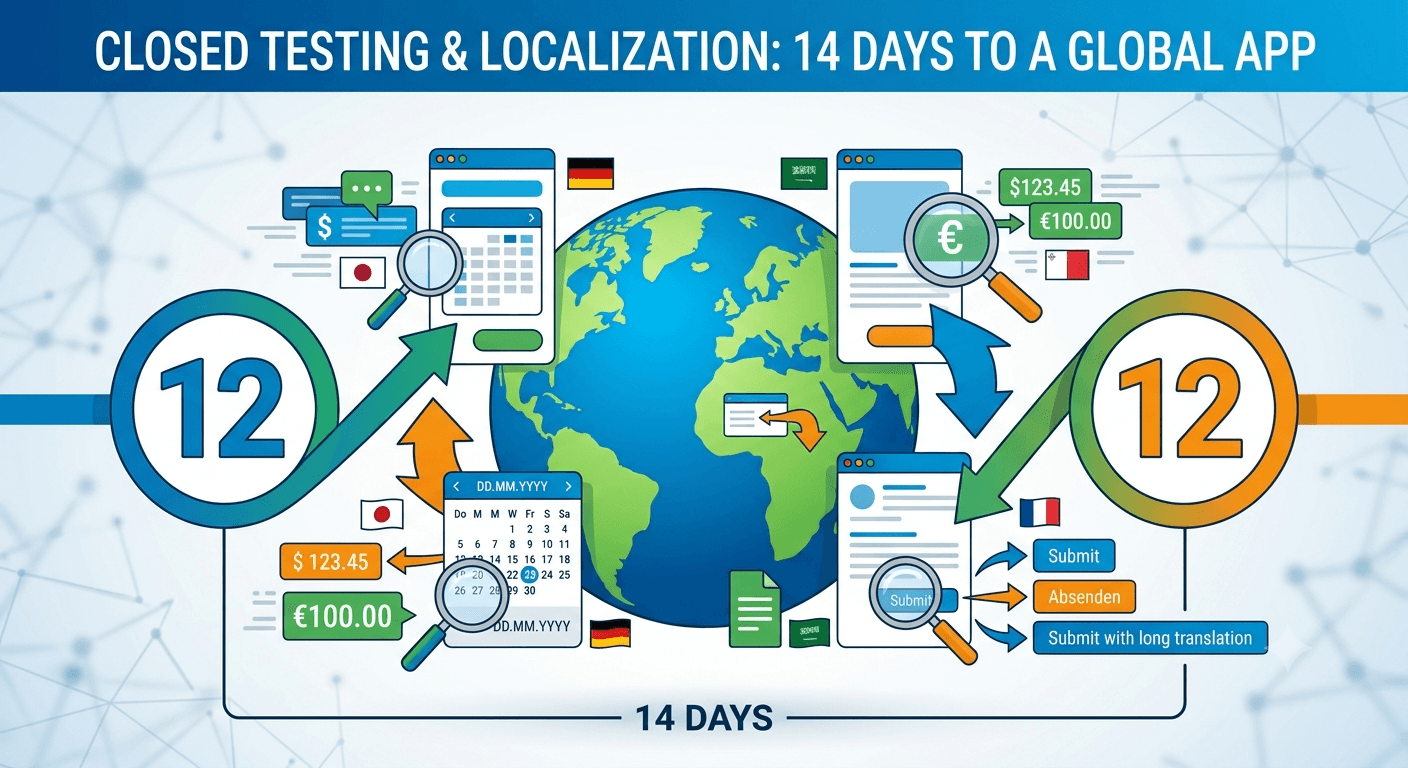
Apps that support multiple languages open themselves to a global audience, but localization introduces a whole class of bugs that single-language apps never face — from text that overflows its buttons to dates and numbers formatted wrongly for a locale. Before a multi-language app published from a new personal account can reach production, it must complete a closed test with at least 12 testers opted in for 14 continuous days. This guide covers closed testing for multi-language apps and the localization-specific issues to prioritize during your window.
The closed-testing process is the same as for any app, but multi-language apps need testing across their supported languages and locales, ideally with testers who actually read those languages. Using your testing window to validate localization thoroughly turns the mandatory wait into real quality assurance for your global launch.
The requirement applies to multi-language apps
There is no exemption for multi-language apps. The closed-testing requirement is tied to your developer account type, so a multi-language app on a new personal account must complete a closed test with 12+ testers for 14 continuous days before production access. See the closed testing guide. For localization coverage, testers who read your supported languages are especially valuable.
Standard advice applies: recruit committed, device-diverse testers, keep your count above 12, and prepare your listing in parallel. Multi-language apps additionally benefit from language-diverse testers and from localizing your store listing itself.
Common localization bugs
Localization introduces bugs that are easy to miss if you only test in your own language. Translated text is often longer or shorter than the original, causing overflow, truncation, or awkward layouts; dates, times, numbers, and currencies must format correctly per locale; and some languages have specific typographic and pluralization rules. An app that looks perfect in English can have broken buttons and clipped labels in German or Finnish, where words are longer. Testing each supported language on real devices is the only reliable way to catch these. See Google's localization documentation.
| Localization test focus | Why it matters |
|---|---|
| Text expansion/truncation | Longer translations break layouts |
| Date/number/currency format | Must match each locale |
| Pluralization | Rules differ across languages |
| Missing translations | Untranslated strings look broken |
| Right-to-left languages | Layout must mirror correctly |
Language-diverse testers catch mistranslations and layout breaks you cannot. See RTL support testing.
Right-to-left language support
If you support right-to-left languages like Arabic or Hebrew, your entire layout must mirror correctly: text alignment, navigation direction, icons, and the flow of the interface all reverse. RTL support is a common source of subtle bugs, since elements that were not built with mirroring in mind can end up misaligned or backwards. Testing RTL languages on real devices, ideally with testers who read them, is essential to confirm the mirrored layout is correct and natural rather than merely translated.
During your window, have testers who read RTL languages use the app and report anything that feels wrong — misaligned elements, incorrect navigation direction, or text that does not flow naturally. RTL issues are frequently invisible to developers who do not read the language, which is exactly why real, language-competent testers are so valuable. Getting RTL right signals real quality to users in those markets and avoids the broken-feeling experience of a half-mirrored interface. See UI testing before publishing.
Translation quality and context
Beyond layout, the quality of your translations matters. Machine translation without review often produces awkward, incorrect, or embarrassing text, and words that are ambiguous out of context can be mistranslated. Testers who natively read a language can catch translations that are technically correct but unnatural, culturally off, or wrong in context — the kind of issue that makes an app feel foreign and untrustworthy to native speakers. This qualitative feedback is something only competent human testers provide.
During your closed test, ask language-competent testers to review the app's text critically, not just check that it functions. Have them flag anything that reads unnaturally or seems mistranslated. Good localization is a competitive advantage in global markets, and poor localization is a quick way to lose users who feel the app was not truly made for them. Your testing window is the ideal time to gather and act on this native-speaker feedback before launch. See listing optimization.
Setting up your closed-testing track
Once your signed release build is ready, create a closed-testing track in the Play Console and upload it, add testers by email or Google Group, and share the opt-in link each tester must use before installing. Correct configuration matters because the 14-day clock counts only opted-in testers, and a misconfigured track is a common reason developers realize late that their timer never started. Consider localizing your store listing for your key markets too, and install on a real device to verify language switching before inviting your group. See how to create a closed testing track.
Give testers clear onboarding instructions and ask them to test in specific languages, ideally ones they read natively. Every failed opt-in is a tester who does not count toward your 12, so smooth guidance maximizes active testers from day one and gives you the language- and device-diverse coverage a multi-language app needs.
Recruiting and managing the window
You need 12+ committed, device-diverse testers for 14 continuous days, and for multi-language apps, testers who read your supported languages add disproportionate value. Recruit a buffer above 12, keep testers engaged with clear tasks and quick responses, and assign languages to testers so each supported locale gets real coverage. Monitor your active count in the Play Console and recruit replacements early if it slips.
If assembling a language- and device-diverse group is your bottleneck, a service with access to diverse testers can help, supplemented by your own network of language-competent contacts. You can submit your app to get started, and read where to find real testers.
Why real-device testing matters here
Localization bugs are notoriously hard to catch without real devices and real language competence. Text expansion depends on the actual rendered font and screen, locale formatting depends on device settings, and RTL mirroring must be seen to be verified. A developer testing only in their own language on one device will miss the overflow, truncation, and mirroring issues that plague other locales. Real testers switching to their languages on their devices are the only reliable way to see the app as those users will.
This is why the closed-testing window, built on real opt-in testers, is genuinely valuable for multi-language apps. Language-diverse testers surface the layout breaks, formatting errors, and translation problems that would otherwise reach international users and undermine your global launch. The window is your structured chance to validate every supported language before release, and language and device diversity in your tester group is what makes that validation trustworthy.
From closed testing to production
When your 14 continuous days with 12+ testers complete, request production access in the Play Console. For a multi-language app, confirm every supported language renders correctly, formats properly, and reads naturally, and that RTL support is solid, before you submit. Localizing your listing in parallel during the window strengthens your global launch. See what happens after 14 days.
Making the 14-day window count
Because the requirement forces you to test anyway, extract genuine value from the window rather than treating it as a formality. For a multi-language app, that means proving every supported language renders, formats, and reads correctly with testers who actually read those languages. Brief your testers clearly, assign languages so each locale gets coverage, and treat their reports as a chance to polish the localization that determines whether international users feel the app was truly made for them.
A well-run window turns a mandatory delay into a materially better global product. Enter production having resolved the overflow, truncation, formatting, and translation issues your testers surfaced, and you avoid the broken-feeling experience that drives away users in markets you worked hard to reach. The 14 days are an investment in a launch that works everywhere, not just in your own language. See the testing checklist.
Turning tester feedback into fixes
The value of your closed test scales with how well you capture and act on feedback. Give testers a frictionless way to report problems and ask specific questions in each language: did any text overflow or get cut off, did dates and numbers look right, did anything read unnaturally, did the layout mirror correctly for RTL? Concrete questions produce the actionable reports that let you fix the localization issues most likely to hurt your app in international markets.
Then close the loop: when you ship a build addressing reported issues, tell testers what changed and ask them to reconfirm in their language on their device. This validates fixes across locales and hardware and keeps testers engaged. A multi-language app that enters production having already resolved its localization problems launches ready for a global audience rather than embarrassing itself in half its markets. See fixing crashes before production.
A realistic timeline for your launch
Plan backward from the 14-day minimum. Expect a few days up front to finalize your build, recruit and onboard language- and device-diverse testers, and confirm opt-ins before your continuous window truly begins. The 14 days then run while you fix issues and ship updates, and production review takes additional days. Budgeting three to four weeks end to end, rather than exactly 14, keeps your multi-language launch aligned with reality.
Developers who hit their dates front-load recruitment — including finding testers for each language — and localize their listing in parallel. If assembling language-competent testers is your bottleneck, resolving it early through your network or a service with access to diverse testers is the highest-leverage step for keeping your launch on schedule. See getting 12 testers without friends or family.
Use internal testing before your closed test
The Play Console's internal testing track is faster than the closed track and ideal for a first pass. For a multi-language app, use it to shake out obvious layout breaks and missing translations across languages with a small trusted group before your counted 14-day window begins. Catching an overflowing button or an untranslated screen privately, rather than during your closed test, protects your testers' goodwill and keeps your continuous window focused on quality.
A practical rhythm is to validate each release candidate on the internal track, switch through your supported languages on a couple of real devices, then promote it to the closed track where your counted, language-competent testers live. This staging discipline keeps the closed track stable and your feedback focused on real localization quality. Treating internal testing as staging and closed testing as the requirement keeps your window productive. See internal vs closed testing.
Key takeaways
- Multi-language apps must meet the 12-tester, 14-day requirement like any app.
- Test every language for expansion, truncation, and formatting.
- Verify RTL mirroring with testers who read those languages.
- Check translation quality and context, not just function.
- Prioritize language-competent testers for real localization coverage.
Frequently asked questions
Do multi-language apps need closed testing?
Yes. On a new personal account, the 12-tester, 14-day requirement applies to multi-language apps.
What are the most common localization bugs?
Text overflow or truncation from expansion, wrong date/number/currency formatting, missing translations, and broken RTL layouts.
Why do I need language-competent testers?
They catch mistranslations, unnatural phrasing, and RTL problems that developers who do not read the language cannot see.
Should I localize my store listing too?
Yes. Localizing your listing for key markets improves discoverability and conversion alongside a localized app.
How do I cover many languages with 12 testers?
Assign specific languages to testers who read them, so each supported locale gets genuine coverage during the window.
Does text expansion really break layouts?
Yes. Translations are often much longer than the original, so buttons and labels that fit in English can overflow or truncate in languages like German or Finnish.
Should I localize before or during testing?
Localize before, then use the window to verify each language on real devices with native readers, fixing overflow, formatting, and translation issues you find.
Expanded for topical authority — additional practical sections below. Original guide content above is unchanged.
Quick answer
Multi-Language Apps and Google Play Closed Testing matters because Google Play production access for many new personal developer accounts depends on a successful closed test: at least 12 real testers opted in for 14 continuous days, plus a policy-compliant, stable app. Use this guide to execute the steps correctly, avoid streak-breaking mistakes, and decide whether DIY recruitment or a managed closed testing service is the better path for your deadline.
Real-world scenarios: who this matters for
The guidance in this article on Multi-Language Apps and Google Play Closed Testing applies across many Android product types. Use these scenarios to map the advice to your situation.
| Developer type | Typical challenge | Practical focus |
|---|---|---|
| Indie / solo | Limited tester network and time | Start closed testing early; keep a buffer above 12 opted-in testers; parallelize listing + Data safety work |
| Startup | Launch deadline vs 14-day rule | Treat the window as fixed; recruit in parallel with QA; avoid last-minute track setup |
| Agency / white-label | Multiple client apps, each needing its own test | One closed test per app; standardize opt-in onboarding; track eligibility dates per client |
| Flutter / React Native | Cross-platform build + Play Console quirks | Ship a signed AAB to closed testing; verify installs from Play, not sideload; watch vitals on mid-range devices |
| Native Kotlin | Device/API fragmentation | Cover API levels and OEMs in your tester mix; fix crashes before requesting production |
| Game / Unity | Performance + retention during 14 days | Keep testers engaged so count never dips below 12; monitor ANRs and battery |
| E-commerce / fintech | Policy + payment flows | Test checkout, permissions, and declarations carefully before production access |
| Healthcare / kids / education | Sensitive policies (Families, data) | Align listing, privacy, and content rating with real app behavior during the test window |
Visual placeholder: Scenario matrix infographic — Indie / Startup / Agency / Cross-platform paths for Multi-Language Apps and Google Play Closed Testing.
Closed testing vs other Play tracks (quick reference)
Context for Multi-Language Apps and Google Play Closed Testing: choose the right track so you do not waste the 14-day window on the wrong workflow.
| Track | Purpose | Counts toward 12×14? | Typical use |
|---|---|---|---|
| Internal testing | Fast private builds | No | Shake out bugs before the counted window |
| Closed testing | Private / invite testers | Yes (for new personal accounts) | Meet production-access requirement + QA |
| Open testing | Public beta | Not a substitute for the closed requirement | Broader feedback after closed eligibility |
| Production | Public release | N/A | After access approved + review |
Visual placeholder: Timeline — Internal → Closed (14 days) → Production request → Staged rollout.
Common mistakes (and how to avoid them)
These mistakes repeatedly show up when developers work through Multi-Language Apps and Google Play Closed Testing:
- Confusing invited vs opted-in testers — Only testers who open the opt-in link and install from Play count toward 12. Check the opted-in number in Play Console, not your email list.
- Recruiting exactly 12 with no buffer — One uninstall can break continuity. Aim for ~15 active opted-in testers.
- Starting the counted clock late — Listing assets, Data safety, and privacy work should run during the 14 days, not after.
- Using sideloaded APKs or fake installs — They do not satisfy Play’s closed testing expectations and can create account risk.
- Ignoring tester feedback until day 14 — Crashes that drive uninstalls threaten your streak and your review outcome.
- Requesting production access before the continuous streak completes — Eligibility checks fail even if calendar time has passed.
Troubleshooting checklist
If something feels “stuck” while applying Multi-Language Apps and Google Play Closed Testing, walk this list before changing strategy:
| Symptom | Likely cause | Fix |
|---|---|---|
| Console shows < 12 testers | Invites sent but not opted in | Resend opt-in link; confirm install from Play |
| “Not eligible” after 14 calendar days | Count dipped below 12 mid-window | Restore 12+ and complete a full continuous streak |
| Tester cannot join | Wrong account, Group lag, or track not published | Verify Google account, Group membership, track release |
| App fails to install | Device/API mismatch or signing issue | Check AAB, minSDK, Play App Signing |
| Production still rejected after testing | Policy, declarations, or stability — not the clock | Read the exact reason; fix that category completely |
Visual placeholder: Troubleshooting flowchart for Multi-Language Apps and Google Play Closed Testing.
Action checklist
Use this checklist alongside the rest of this guide on Multi-Language Apps and Google Play Closed Testing:
- ☐ Closed testing track created with a signed release (AAB)
- ☐ Opt-in link tested on a fresh Google account
- ☐ At least 12 testers opted in (prefer ~15)
- ☐ Daily check that opted-in count stays ≥ 12 for 14 continuous days
- ☐ Core flows exercised (login, main feature, permissions, offline/online)
- ☐ Crashes / ANRs triaged from tester reports and vitals
- ☐ Store listing, screenshots, and feature graphic drafted
- ☐ Privacy policy + Data safety + content rating aligned with real behavior
- ☐ Production access requested only after eligibility is green
- ☐ Staged rollout plan ready for first public release
Additional FAQs developers ask about Multi-Language Apps and Google Play Closed Testing
Quick answer: what should I do first?
Confirm you are on a closed testing track with real opted-in installs, keep 12+ testers for 14 continuous days, and fix policy/stability issues in parallel. Then use the detailed sections above for Multi-Language Apps and Google Play Closed Testing.
Does this apply to organization (company) accounts?
The classic 12×14 closed testing gate is primarily associated with new personal developer accounts. Always verify your account type and current Play Console eligibility messaging for your app.
Do friends and family count as testers?
Yes — if they opt in via your closed testing link and install from Google Play. They only help if they stay opted in for the continuous period.
Can I update the app during the 14 days?
You can usually push updates on the closed track, but unstable releases that cause uninstalls can threaten your tester count. Prefer polishing via internal testing first when possible.
What if production access is still rejected?
Read the exact reason. Incomplete testing is only one category — policy, Data safety mismatches, and crashes are common. Fix the cited issue fully before reapplying.
Is paying for testers allowed?
Using real people who install from Play is what matters. Avoid fake install farms. A one-time managed service that supplies real closed testers is a practical option when DIY recruitment is too slow.
How is Fast Testers different from free communities?
Free communities trade time and mutual availability. Fast Testers assigns about 15 real testers after you submit a valid closed testing link (one-time $15 per app) and includes a production access guarantee under its refund terms.
Where should I go next?
Review the related guides below, then either finish DIY recruitment or start closed testing if you need speed and continuity.
Sources, updates, and how to use this guide
This article on Multi-Language Apps and Google Play Closed Testing is maintained for Android developers preparing Google Play closed testing and production access. Always cross-check eligibility text inside your own Play Console, because Google’s UI labels and account rules can vary by account type and date.
- Primary official references: Google Play closed testing help, Developer Program Policies, and Play Console eligibility messaging for your app.
- Practical experience lens: guidance here reflects common failure modes indie developers and agencies hit when recruiting testers, maintaining the 14-day streak, and recovering from production-access rejections.
- Last reviewed focus: 12×14 closed testing continuity, real vs fake testers, and parallel listing/compliance work during the window.
Related guides and next steps
Continue building topical depth around Multi-Language Apps and Google Play Closed Testing with these Fast Testers resources:
- Closed Testing Vs Open Testing On Google Play
- Google Play Closed Testing For Flutter Apps
- Google Play Closed Testing For React Native Apps
- Google Play Closed Testing For Saas Android Apps
- Google Play Closed Testing For White Label Apps
- Google Play Internal Testing Vs Closed Testing
- Social Apps And Google Play Closed Testing Volume
- Vpn Apps And Google Play Closed Testing Challenges
- Pricing — $15 closed testing
- How Fast Testers works
- FAQ
- Developer reviews
- Case studies
- Submit your app / start closed testing
Need reliable testers so your 14-day streak does not stall? Educate first with the guides above, then start when you are ready — one-time pricing, real Play installs, dashboard tracking.
Further expansion — case study, decisions, and expert recommendations. Prior sections remain unchanged.
Case study: first Play launch planned around the closed testing window
Problem: A small SaaS team treated Google Play publishing like iOS TestFlight — they expected to upload and go public the same week. They discovered the personal-account closed testing gate mid-sprint.
Solution: They reframed the sprint around Multi Language Apps And Google Play Closed Testing: internal testing for crash triage first, then closed testing with a buffer of testers, while design finished screenshots and legal finished privacy/Data safety in parallel.
Result: The 14-day requirement stopped feeling like “dead time.” When eligibility flipped green, listing and declarations were already ready, so production review was the only remaining gate.
Lessons learned:
- Start the closed track as soon as the build is stable enough to keep installed.
- Parallelize compliance work inside the window.
- Protect the streak like a production SLA.
Decision guide: what should you do next?
Use this decision path when applying Multi Language Apps And Google Play Closed Testing:
- Is your account a new personal developer account that still needs production access?
If yes, plan for closed testing with 12+ opted-in testers for 14 continuous days. If no, still test — but confirm the exact eligibility text in Play Console. - Do you already have 12+ reliable people who will install from Play and stay for two weeks?
If yes, DIY can work — add a buffer and monitor daily. If no, use community exchange or a managed closed testing service. - Is your build stable enough that testers will not churn?
If no, run internal testing first. Entering the counted window with crash loops is how streaks die. - Are Data safety, privacy policy, permissions, and listing aligned with real behavior?
If no, fix during the window so production review does not bounce you after the clock. - Has production access been rejected?
Classify: eligibility vs policy vs declarations vs stability. Fix that category completely, then re-test / re-request.
Visual placeholder: Decision tree diagram for Multi Language Apps And Google Play Closed Testing (DIY vs managed vs fix-and-retry).
Expert recommendations
- Instrument the streak: Check opted-in count daily for the first week; replace dropouts same day.
- Brief testers once: Send a short checklist (install from Play, open app daily, try core flow, report crashes). Silent testers still count if opted in — engaged testers protect quality.
- Never “solve” recruitment with fake installs: It fails the intent of closed testing and can create account risk.
- Ship a boring-stable build to closed testing: Save experimental features for internal tracks.
- Educate first, then accelerate: If your blocker is simply finding real testers fast, a one-time managed option (Fast Testers: 15 testers, $15/app) is often cheaper than slipping a launch.
For hands-on setup after reading about Multi Language Apps And Google Play Closed Testing, see how it works and pricing, or submit your closed testing link when you are ready.
Internal navigation hub — added to strengthen topical connections. Original article content above is unchanged.
Continue learning
- Closed Testing vs Open Testing on Google Play — Learn about testing track differences for Google Play closed testing. Complete guide for Android developers pu.
- Google Play Closed Testing for Flutter Apps — Learn about Flutter app testing for Google Play closed testing. Complete guide for Android developers publishi.
- Google Play Closed Testing for React Native Apps — Learn about React Native testing for Google Play closed testing. Complete guide for Android developers publish.
- Google Play Closed Testing for SaaS Android Apps — Learn about SaaS app testing for Google Play closed testing. Complete guide for Android developers publishing .
- Google Play Closed Testing for White-Label Apps — Learn about white-label testing for Google Play closed testing. Complete guide for Android developers publishi.
- Google Play Internal Testing vs Closed Testing — Learn about internal vs closed tracks for Google Play closed testing. Complete guide for Android developers pu.
Next steps
- Ready to run closed testing with real Android testers? Submit your app or see pricing ($15 one-time).
- Compare options on our testing service comparison page, or read developer reviews and case studies.
- Still deciding? Review how Fast Testers works and the FAQ.