
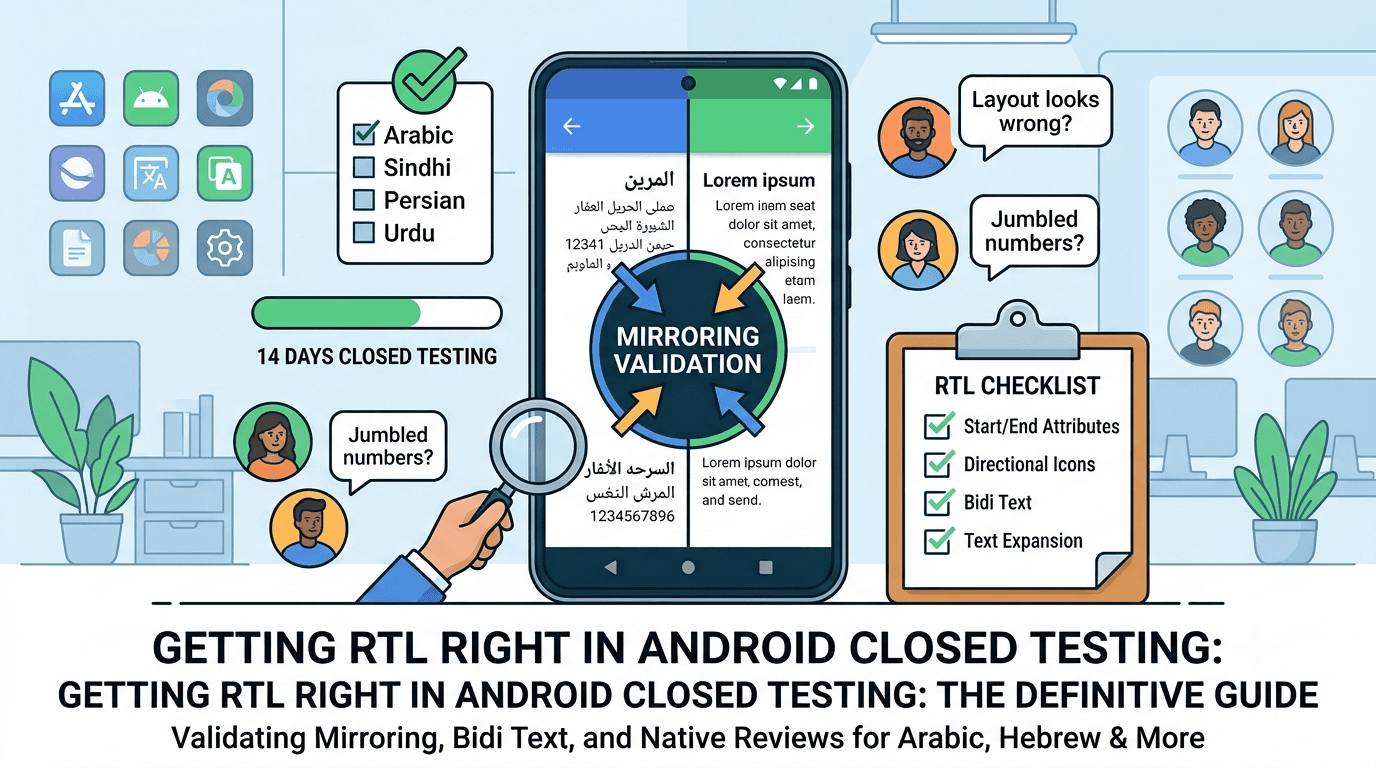
If you plan to reach users who read right-to-left — Arabic, Hebrew, Persian, Urdu, and others — your app must mirror its layout correctly, and RTL support is one of the most commonly botched areas of Android localization. A left-to-right layout shown to an RTL user with text crammed against the wrong edge, arrows pointing the wrong way, and broken alignment feels immediately foreign and low-quality. Testing RTL support properly is essential for these markets, and, like any app published from a new personal account, yours must complete a closed test with at least 12 testers opted in for 14 continuous days before production access. This guide covers RTL language support testing during your window.
The closed-testing process is the same as for any app, but RTL problems only become obvious when the app is actually run in an RTL locale, ideally reviewed by someone who reads the language, so real testing matters. Using your window to validate RTL turns the mandatory wait into a genuinely usable experience for a large global audience.
The requirement and RTL
The closed-testing requirement is tied to your developer account type, so any app on a new personal account must complete a closed test with 12+ testers for 14 continuous days before production access, regardless of language support. See the closed testing guide. If you target RTL markets, your window is the ideal time to validate mirroring, ideally with testers who read the language natively.
Standard advice applies: recruit committed, device-diverse testers, keep your count above 12, and prepare your listing in parallel. For RTL, testers who read Arabic, Hebrew, or another RTL language provide feedback that no tool can substitute.
Layout mirroring fundamentals
Android supports RTL layouts natively when you build correctly: declare RTL support in your manifest, use start/end attributes instead of left/right for margins, padding, and alignment, and the framework mirrors your layout automatically in RTL locales. The most common cause of broken RTL is hardcoded left/right values, which do not flip and leave elements stranded on the wrong side. Audit your layouts to use start/end throughout, and test that your UI mirrors properly when the device is set to an RTL language. Follow Google's localization guidance.
Test by switching your device to an RTL language (or enabling the RTL layout developer option) and reviewing every screen: navigation should flow right-to-left, text should align to the right, back arrows and directional icons should point the correct way, and lists and forms should mirror sensibly. Getting the mirroring foundation right is what makes the rest of RTL support fall into place. See multi-language app testing.
Text, numbers, and mixed content
RTL is more than flipping the layout; text handling has subtleties. Mixed content — RTL text containing LTR elements like numbers, URLs, or Latin brand names — must render in the correct order (bidirectional text), and getting this wrong produces jumbled, unreadable strings. Numbers, dates, and times may follow different conventions, and some directional icons (like a "next" arrow) should mirror while others (like a play button or a logo) should not. Test that mixed strings read correctly and that only the icons that should mirror do so.
| RTL test focus | Common problem |
|---|---|
| Layout mirroring | Hardcoded left/right doesn't flip |
| Bidirectional text | Numbers/URLs jumbled in RTL text |
| Directional icons | Arrows point the wrong way — or wrongly mirror |
| Text expansion | Translations overflow or clip |
| Alignment | Text stuck to the wrong edge |
A native reader spots these instantly; a non-reader often misses them. See UI testing before publishing.
Why native-reader review is essential
You can catch structural RTL problems yourself by running the app in an RTL locale, but you cannot judge whether the language actually reads correctly unless you read it. Awkward line breaks, mistranslations, jumbled bidirectional text, and culturally inappropriate phrasing are invisible to someone who does not read the language but glaring to someone who does. This is why having at least one tester who reads your target RTL language natively is so valuable — they will catch issues that pass every automated check and every non-reader's review.
During your window, ask native-reading testers to go through the app carefully and report anything that reads wrong, looks misaligned, or feels unnatural, not just outright bugs. Their feedback elevates your RTL support from "technically mirrored" to "genuinely good," which is the difference between an app that RTL users tolerate and one they trust. Because this judgment is inherently human, real native testers are irreplaceable for RTL quality. See testing requirements by country.
Setting up your closed-testing track
Once your signed release build is ready, create a closed-testing track in the Play Console and upload it, add testers by email or Google Group, and share the opt-in link each tester must use before installing. Correct configuration matters because the 14-day clock counts only opted-in testers, and a misconfigured track is a common reason developers realize late that their timer never started. Install on a real device set to an RTL language and check a few screens before inviting your full group. See how to create a closed testing track.
Give testers clear onboarding instructions and ask RTL-reading testers to review the app in their language and report mirroring and text issues. Every failed opt-in is a tester who does not count toward your 12, so smooth guidance maximizes active testers from day one and gives you the native-language coverage RTL testing needs.
Recruiting and managing the window
You need 12+ committed, device-diverse testers for 14 continuous days, and for RTL, testers who read your target language are the key resource. Recruit a buffer above 12, keep testers engaged with clear tasks and quick responses, and direct RTL-reading testers to review the app carefully. Monitor your active count in the Play Console and recruit replacements early if it slips.
If finding native RTL-reading testers is your bottleneck, a service that supplies verified real testers from your target regions solves it quickly. You can submit your app to get started, and read where to find real testers and how to keep testers engaged.
Why real testing matters here
RTL support can only be validated by running the app in an RTL locale on a real device and, crucially, having it read by someone who understands the language. Structural mirroring bugs and jumbled bidirectional text appear only when the app is actually set to RTL, and quality judgments about whether the language reads well require a native reader. Neither a design mockup nor an automated check substitutes for this, which is why the closed-testing window with the right testers is such a good fit for RTL work.
This is why the window, built on real opt-in testers, is valuable for RTL when you can recruit native readers. Real testers experiencing your app in their language surface both the technical mirroring failures and the subtle readability issues that determine whether RTL users take your app seriously. The window is your structured chance to validate a large global audience's experience before launch, and native-reading testers are what make that validation trustworthy. See global device testing.
Making the 14-day window count
Because the requirement forces you to test anyway, use the window to get RTL genuinely right rather than merely mirrored. Run the app in an RTL locale yourself to fix structural issues, then rely on native-reading testers to catch the readability and bidirectional-text problems only they can see. A well-run window turns a mandatory delay into an app that RTL users experience as native rather than a poorly flipped afterthought.
Enter production having confirmed your layout mirrors correctly, mixed text reads properly, icons point the right way, and native readers approve, and you unlock large RTL markets with credibility. The 14 days are an investment in a global audience many apps serve poorly. See the Play Console beginner guide.
Turning tester feedback into fixes
Give RTL-reading testers a frictionless way to report problems and ask specific questions: did the layout mirror correctly, did any text stick to the wrong edge, were numbers or Latin words jumbled, did any arrow point the wrong way, did anything read unnaturally? Concrete questions produce the actionable reports that let you fix the mirroring and text issues most likely to hurt RTL quality.
Then close the loop: when you ship a build addressing reported issues, tell testers what changed and ask them to reconfirm in their language. This validates fixes with native readers and keeps testers engaged. An app that enters production having already refined its RTL support launches credible in markets where most competitors get it wrong. See fixing crashes before production.
Use internal testing before your closed test
The Play Console's internal testing track is faster than the closed track and ideal for a first pass. For RTL, use it to switch a couple of devices to an RTL locale and fix obvious mirroring bugs before your counted 14-day window begins. Catching hardcoded left/right layout issues privately, rather than during your closed test, lets your window focus on the native-reader feedback that elevates RTL quality rather than basic structural breakage.
A practical rhythm is to validate each release candidate on the internal track in an RTL locale, fix the structural issues, then promote it to the closed track where native-reading testers judge the language and bidirectional text. This staging discipline keeps the closed track stable and your feedback focused on genuine readability. See internal vs closed testing.
After launch: maintaining RTL quality
Your closed test is the start of quality assurance, not the end. After launch, keep RTL in mind as you add features, since a new screen built with hardcoded left/right values or an untranslated string can quietly degrade the experience for RTL users. Watch reviews from RTL markets and re-check mirroring with each significant update. An app that sustains its RTL quality as it grows keeps the trust of these large markets; one that lets it slip with each new feature loses it. See post-launch monitoring.
Key takeaways
- The 12-tester, 14-day requirement applies regardless of language support.
- Use start/end attributes, not hardcoded left/right, so layouts mirror.
- Test bidirectional text — numbers and Latin words in RTL strings.
- Mirror directional icons correctly, and leave others alone.
- Have native readers review — they catch what tools and non-readers miss.
Frequently asked questions
Do RTL apps need closed testing?
Yes. On a new personal account, the 12-tester, 14-day requirement applies regardless of language support.
Why is my RTL layout broken?
Usually hardcoded left/right values that do not flip. Use start/end attributes for margins, padding, and alignment so Android mirrors automatically.
What is bidirectional text?
RTL text containing LTR elements like numbers or URLs. It must render in the correct order, or strings appear jumbled and unreadable.
Should all icons mirror in RTL?
No. Directional icons like arrows should mirror, but logos, play buttons, and similar should not. Test each.
Why do I need a native reader to test RTL?
Only someone who reads the language can judge whether it reads correctly, catching mistranslations and jumbled text that tools and non-readers miss.
Should I use internal testing first?
Yes. Fix structural mirroring in an RTL locale on the faster internal track before your counted closed-testing window begins.
How do I preview RTL without changing my language?
Enable the "Force RTL layout direction" developer option, which mirrors layouts so you can catch structural issues without reading the language.
Does text expand in RTL translations?
Translations often differ in length, so test that RTL strings do not overflow or clip, especially in buttons and constrained labels.
Do RTL users expect their own number formats?
Sometimes. Numbers, dates, and currency may follow local conventions, so verify formatting matches expectations in your target market.
Do I declare RTL support anywhere?
Yes. Set supportsRtl to true in your manifest and use start/end attributes so Android mirrors your layouts automatically in RTL locales.
Do custom drawn views mirror automatically?
Not always. Standard layouts mirror when you use start/end, but custom-drawn views and canvas rendering may need explicit handling, so test them in an RTL locale.
Expanded for topical authority — additional practical sections below. Original guide content above is unchanged.
Quick answer
RTL Language Support Testing for Android Apps matters because Google Play production access for many new personal developer accounts depends on a successful closed test: at least 12 real testers opted in for 14 continuous days, plus a policy-compliant, stable app. Use this guide to execute the steps correctly, avoid streak-breaking mistakes, and decide whether DIY recruitment or a managed closed testing service is the better path for your deadline.
Real-world scenarios: who this matters for
The guidance in this article on RTL Language Support Testing for Android Apps applies across many Android product types. Use these scenarios to map the advice to your situation.
| Developer type | Typical challenge | Practical focus |
|---|---|---|
| Indie / solo | Limited tester network and time | Start closed testing early; keep a buffer above 12 opted-in testers; parallelize listing + Data safety work |
| Startup | Launch deadline vs 14-day rule | Treat the window as fixed; recruit in parallel with QA; avoid last-minute track setup |
| Agency / white-label | Multiple client apps, each needing its own test | One closed test per app; standardize opt-in onboarding; track eligibility dates per client |
| Flutter / React Native | Cross-platform build + Play Console quirks | Ship a signed AAB to closed testing; verify installs from Play, not sideload; watch vitals on mid-range devices |
| Native Kotlin | Device/API fragmentation | Cover API levels and OEMs in your tester mix; fix crashes before requesting production |
| Game / Unity | Performance + retention during 14 days | Keep testers engaged so count never dips below 12; monitor ANRs and battery |
| E-commerce / fintech | Policy + payment flows | Test checkout, permissions, and declarations carefully before production access |
| Healthcare / kids / education | Sensitive policies (Families, data) | Align listing, privacy, and content rating with real app behavior during the test window |
Visual placeholder: Scenario matrix infographic — Indie / Startup / Agency / Cross-platform paths for RTL Language Support Testing for Android Apps.
Comparison: DIY recruitment vs managed closed testing
When your goal is Google Play production access, the path you choose for testers affects time, risk, and feedback quality. Use this comparison while deciding how to apply RTL Language Support Testing for Android Apps.
| Approach | Time to 12 opted-in | Cost | Dropout risk | Feedback quality | Best when |
|---|---|---|---|---|---|
| Friends & family | Days–weeks | $0 | High | Mixed | Tiny MVP, flexible timeline |
| Reddit / Discord / Telegram | Unpredictable | $0–low | High | Variable | You can manage onboarding daily |
| Peer community exchange | Variable | $0 | Medium | Developer-biased | You can test others’ apps in return |
| Managed closed testing (e.g. Fast Testers) | ~1 hour after valid link | $15 one-time / app | Low (buffer of 15) | Real Play installs | You need speed + continuity for 14 days |
Decision tip: If a broken streak would delay revenue or a client deadline, prioritize reliability over $0 recruitment. DIY is fine when you already have engaged testers and can monitor Play Console daily.
Visual placeholder: Comparison diagram — DIY vs community vs managed testing for RTL Language Support Testing for Android Apps.
Common mistakes (and how to avoid them)
These mistakes repeatedly show up when developers work through RTL Language Support Testing for Android Apps:
- Confusing invited vs opted-in testers — Only testers who open the opt-in link and install from Play count toward 12. Check the opted-in number in Play Console, not your email list.
- Recruiting exactly 12 with no buffer — One uninstall can break continuity. Aim for ~15 active opted-in testers.
- Starting the counted clock late — Listing assets, Data safety, and privacy work should run during the 14 days, not after.
- Using sideloaded APKs or fake installs — They do not satisfy Play’s closed testing expectations and can create account risk.
- Ignoring tester feedback until day 14 — Crashes that drive uninstalls threaten your streak and your review outcome.
- Requesting production access before the continuous streak completes — Eligibility checks fail even if calendar time has passed.
Troubleshooting checklist
If something feels “stuck” while applying RTL Language Support Testing for Android Apps, walk this list before changing strategy:
| Symptom | Likely cause | Fix |
|---|---|---|
| Console shows < 12 testers | Invites sent but not opted in | Resend opt-in link; confirm install from Play |
| “Not eligible” after 14 calendar days | Count dipped below 12 mid-window | Restore 12+ and complete a full continuous streak |
| Tester cannot join | Wrong account, Group lag, or track not published | Verify Google account, Group membership, track release |
| App fails to install | Device/API mismatch or signing issue | Check AAB, minSDK, Play App Signing |
| Production still rejected after testing | Policy, declarations, or stability — not the clock | Read the exact reason; fix that category completely |
Visual placeholder: Troubleshooting flowchart for RTL Language Support Testing for Android Apps.
Action checklist
Use this checklist alongside the rest of this guide on RTL Language Support Testing for Android Apps:
- ☐ Closed testing track created with a signed release (AAB)
- ☐ Opt-in link tested on a fresh Google account
- ☐ At least 12 testers opted in (prefer ~15)
- ☐ Daily check that opted-in count stays ≥ 12 for 14 continuous days
- ☐ Core flows exercised (login, main feature, permissions, offline/online)
- ☐ Crashes / ANRs triaged from tester reports and vitals
- ☐ Store listing, screenshots, and feature graphic drafted
- ☐ Privacy policy + Data safety + content rating aligned with real behavior
- ☐ Production access requested only after eligibility is green
- ☐ Staged rollout plan ready for first public release
Additional FAQs developers ask about RTL Language Support Testing for Android Apps
Quick answer: what should I do first?
Confirm you are on a closed testing track with real opted-in installs, keep 12+ testers for 14 continuous days, and fix policy/stability issues in parallel. Then use the detailed sections above for RTL Language Support Testing for Android Apps.
Does this apply to organization (company) accounts?
The classic 12×14 closed testing gate is primarily associated with new personal developer accounts. Always verify your account type and current Play Console eligibility messaging for your app.
Do friends and family count as testers?
Yes — if they opt in via your closed testing link and install from Google Play. They only help if they stay opted in for the continuous period.
Can I update the app during the 14 days?
You can usually push updates on the closed track, but unstable releases that cause uninstalls can threaten your tester count. Prefer polishing via internal testing first when possible.
What if production access is still rejected?
Read the exact reason. Incomplete testing is only one category — policy, Data safety mismatches, and crashes are common. Fix the cited issue fully before reapplying.
Is paying for testers allowed?
Using real people who install from Play is what matters. Avoid fake install farms. A one-time managed service that supplies real closed testers is a practical option when DIY recruitment is too slow.
How is Fast Testers different from free communities?
Free communities trade time and mutual availability. Fast Testers assigns about 15 real testers after you submit a valid closed testing link (one-time $15 per app) and includes a production access guarantee under its refund terms.
Where should I go next?
Review the related guides below, then either finish DIY recruitment or start closed testing if you need speed and continuity.
Sources, updates, and how to use this guide
This article on RTL Language Support Testing for Android Apps is maintained for Android developers preparing Google Play closed testing and production access. Always cross-check eligibility text inside your own Play Console, because Google’s UI labels and account rules can vary by account type and date.
- Primary official references: Google Play closed testing help, Developer Program Policies, and Play Console eligibility messaging for your app.
- Practical experience lens: guidance here reflects common failure modes indie developers and agencies hit when recruiting testers, maintaining the 14-day streak, and recovering from production-access rejections.
- Last reviewed focus: 12×14 closed testing continuity, real vs fake testers, and parallel listing/compliance work during the window.
Related guides and next steps
Continue building topical depth around RTL Language Support Testing for Android Apps with these Fast Testers resources:
- Android Tv Apps And Google Play Testing Tracks
- Ar Vr Android Apps And Closed Testing Requirements
- E Commerce Android Apps Play Store Testing Tips
- Functional Testing For Android Apps
- Google Play Closed Testing For Saas Android Apps
- Kotlin Android Apps Closed Testing Best Practices
- Localization Testing Guide For Android Apps
- Multi Language Apps And Google Play Closed Testing
- Pricing — $15 closed testing
- How Fast Testers works
- FAQ
- Developer reviews
- Case studies
- Submit your app / start closed testing
Need reliable testers so your 14-day streak does not stall? Educate first with the guides above, then start when you are ready — one-time pricing, real Play installs, dashboard tracking.
Internal navigation hub — added to strengthen topical connections. Original article content above is unchanged.
Continue learning
- Android TV Apps and Google Play Testing Tracks — Learn about Android TV testing for Google Play closed testing. Complete guide for Android developers publishin.
- AR/VR Android Apps and Closed Testing Requirements — Learn about AR VR testing for Google Play closed testing. Complete guide for Android developers publishing on .
- E-commerce Android Apps: Play Store Testing Tips — Learn about e-commerce testing for Google Play closed testing. Complete guide for Android developers publishin.
- Testing IoT Companion Android Apps — Learn about IoT app testing for Google Play closed testing. Complete guide for Android developers publishing o.
- Education Apps and Google Play Compliance Testing — Learn about EdTech app testing for Google Play closed testing. Complete guide for Android developers publishin.
- Offline-First Apps and Closed Testing Best Practices — Learn about offline app testing for Google Play closed testing. Complete guide for Android developers publishi.
Next steps
- Ready to run closed testing with real Android testers? Submit your app or see pricing ($15 one-time).
- Compare options on our testing service comparison page, or read developer reviews and case studies.
- Still deciding? Review how Fast Testers works and the FAQ.