
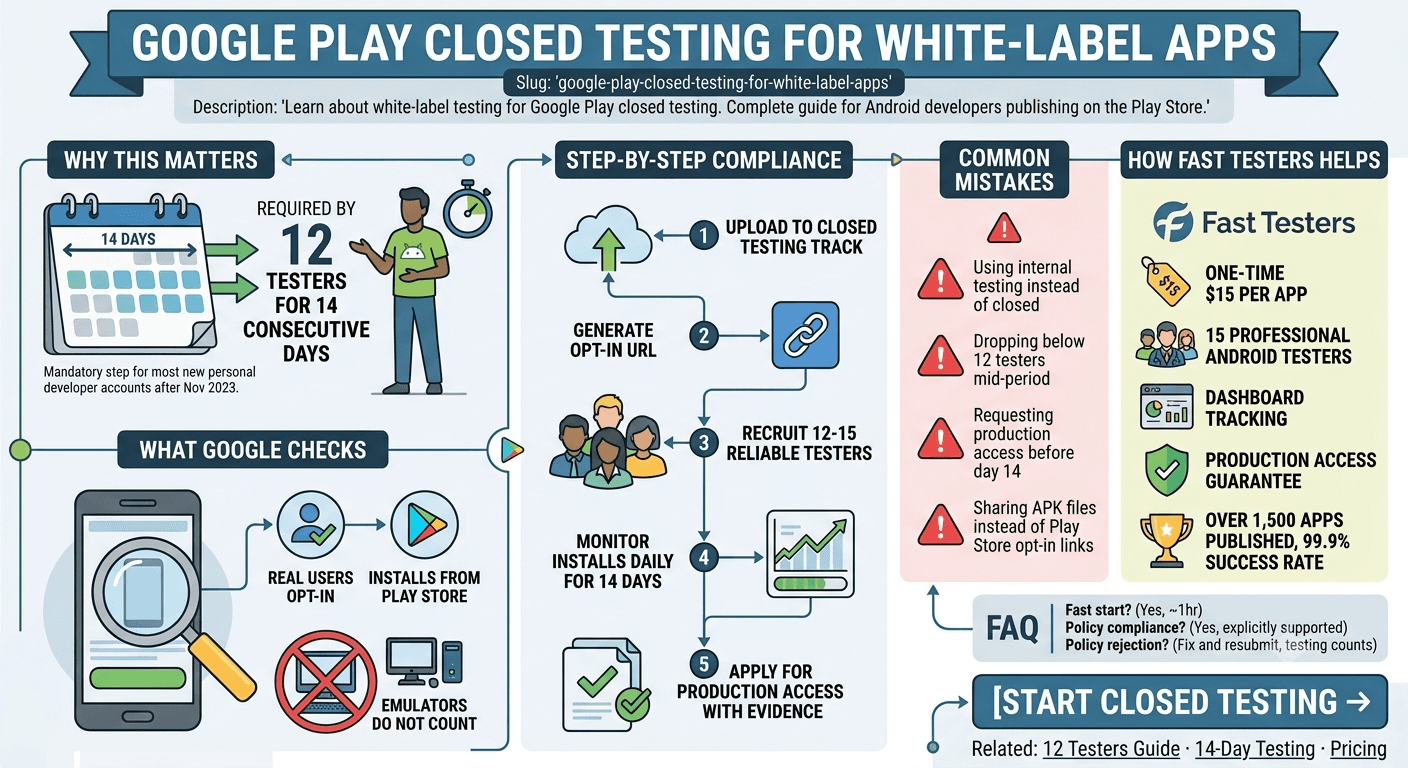
Launching a new app on the Google Play Store has become significantly more challenging for independent creators. For developers managing white-label apps—where a single software base is customized, branded, and deployed multiple times for different clients—navigating the updated Google Play closed testing requirements demands strict operational execution. Skipping or rushing this compliance phase will result in instant rejection when applying for production access.
Why Google Play Closed Testing Challenges White-Label Workflows
White-label app development thrives on volume and speed. However, Google’s verification processes aim to filter out automated spam, copycat frameworks, and low-quality code. When you replicate a white-label architecture across multiple developer consoles, Google tracks structural similarities.
If you fail to run real, organic user tests for each specific white-label variant, Google’s automated review flagging treats the app as a placeholder or a policy-violating clone. To protect your portfolio, every single client build requires a localized, isolated closed testing environment with unique real-user interactions.
Figure 1: Standard Google Play Console Compliance Pipeline
What Google's Quality Verification System Checks
Google relies heavily on telemetry analytics gathered straight from Android devices via Play Services. If you try to bypass the system with shortcuts, your production access review will fail. Google validates compliance using several distinct signals:
- Unique Device Identifiers: Automated testing environments, device emulators, and virtual machines are automatically detected and omitted from your official counts.
- Opt-In Consistency: Testers must follow your web or Android app-based opt-in link and remain continuously joined. If a tester opts out during the 14 days, the internal clock resets.
- Active Engagement Signals: Google tracks if the application is opened, interacted with, and kept on the device. Sideloaded APKs or instant uninstalls flag your account for suspicious activity.
Step-by-Step Closed Testing Deployment Strategy
Follow this exact pipeline to successfully pass your white-label application review:
- Prepare the Google Play Console Track: Navigate to Release > Testing > Closed testing. Create a dedicated track and upload your secure AAB (Android App Bundle).
- Configure the Web Opt-In URL: Go to the "Testers" sub-tab, select your testing group (via Google Groups or individual emails), and save the configuration. Retrieve the unique web opt-in link provided by Google.
- Onboard Compliant Testers: Gather a minimum of 20 to 25 unique testers. Targeting slightly higher numbers guarantees you stay comfortably over the 20-tester minimum threshold if someone uninstalls early.
- Maintain Analytical Tracking: Keep a close eye on your Play Console dashboard metrics for a minimum of 14 continuous days. Encourage your user group to trigger feedback loops and bug reporting tools.
- Submit the Production Application Form: Once day 15 arrives, answer the design feedback questionnaires provided in the console thoroughly, highlighting your explicit testing data, and request final verification.
Common Pitfalls in White-Label App Testing
Understanding where other Android developers stumble will save you weeks of delayed deployment schedules:
- Confusing Internal Testing with Closed Tracks: Internal testing tracks do not have a 14-day rule, but they also do not count toward fulfilling the production verification prerequisites.
- Branding Overlaps: Publishing white-label variants without changing package IDs, asset strings, or localized metadata triggers Google's automated "Repetitive Content" system filters.
- Rushing the Submission Windows: Applying for final production review precisely on the 14th day frequently fails. Allow a safety buffer of 15-16 days to ensure telemetry fully updates on Google's backend servers.
Streamlining Compliance with Fast Testers
Recruiting and managing over 20 independent Android users for every white-label build quickly scales into an operational bottleneck. Fast Testers eliminates this friction completely by providing an isolated, human-backed testing team designed specifically for independent indie creators and white-label design firms.
For a straightforward, flat fee of $15 per app—completely free of hidden monthly subscription plans—Fast Testers connects your release candidate with 25 certified human Android testers in under one hour. You receive clean analytics tracking, transparent progression updates, and a dedicated safety net ensuring your production application gets fully approved.
Frequently Asked Questions
The requirement applies to each app
White-label businesses ship many near-identical apps, but Google's closed-testing requirement is assessed per app and per account, not per codebase. If each client app is published from a new personal account, each must complete a closed test with 12 testers opted in for 14 continuous days before production. Understanding this is essential to scoping timelines and pricing, because "we already tested the base app" does not exempt a new white-label instance published under a fresh account. See our closed testing guide and agency guide to testing client apps.
This makes a repeatable tester pipeline the backbone of a white-label operation. Recruiting fresh testers per client through personal networks does not scale; a dependable source of verified real testers does. You can submit each app to run its window reliably. See testing multiple apps on one account.
Account and signing strategy
Decide deliberately whether client apps live under your account or the client's, because it affects who bears the closed-testing requirement, who owns the listing, and how signing keys are managed. Publishing many apps under one established organization account can change which rules apply compared with many new personal accounts, so plan this before you start. Keep Play App Signing and version management clean across instances so updates install correctly for every client. See app signing and transferring apps between accounts.
Also mind uniqueness: near-duplicate white-label apps must still each provide genuine value and accurate metadata, or they risk spam and duplicate-content enforcement. Differentiate listings, declarations, and content per client rather than cloning blindly. See Google's developer policies.
Running many windows in parallel
The operational challenge is managing several 14-day windows at once across clients. Track each app's window start, active tester count, and readiness in a shared system so none stalls unnoticed — a single tester count dipping below 12 can silently reset a client's progress. Standardize your process: the same checklist, tester pipeline, and monitoring for every instance turns launches into a predictable production line. See keeping testers engaged and post-launch monitoring.
Bake the mandatory window into every client timeline and price the testing phase explicitly, since it is real, unavoidable work per app. A white-label shop that treats testing as a standardized, priced deliverable stays profitable and on schedule; one that hides it scrambles per launch. See staged rollouts.
Related guides and resources
- Agency guide to testing client apps
- Testing multiple apps on one account
- App signing and closed testing
- Google Play developer policies
Differentiating instances to avoid spam flags
The biggest policy risk in white-label publishing is that near-identical apps look like spam to Google's systems. To stay safe, each instance must be genuinely differentiated: distinct branding, tailored store listings, client-specific content, and accurate per-app declarations. A portfolio of clearly distinct apps serving different clients is legitimate; a wall of clones with swapped logos invites duplicate-content enforcement. Build differentiation into your pipeline so every client app stands on its own. See Google's developer policies and account termination risks.
Differentiation also improves each client's outcomes, since a tailored listing converts better than a generic one. Treating per-client customization as both a compliance safeguard and a quality investment aligns your interests with your clients' and with Google's. See title and description SEO.
Maintaining a portfolio over time
White-label work does not end at launch — every client app needs updates, and each update should pass through your standardized testing and staged rollout pipeline. Managing many live apps means tracking each one's health (vitals, reviews, policy notices) centrally so a problem in one does not go unnoticed while you focus on others. A dashboard view across all client apps turns portfolio maintenance from chaos into routine. See post-launch monitoring and updating after release.
Policy changes affect the whole portfolio at once, so stay current and be ready to update many apps together when Google shifts requirements such as target API levels. A white-label operation that maintains its fleet proactively protects every client relationship it depends on. See policy changes to watch.
White-label testing FAQ
Does each white-label app need its own closed test?
If each is published from a new personal account, yes. The requirement is assessed per app and account, not per shared codebase.
How do white-label shops source testers at scale?
They standardize on a reliable service, since recruiting fresh testers per client through personal networks does not scale.
Can near-identical apps risk enforcement?
Yes. Each must provide genuine value with accurate, differentiated metadata, or risk spam and duplicate-content enforcement.
How do I keep white-label apps from looking like spam?
Differentiate each instance with distinct branding, tailored listings, client-specific content, and accurate per-app declarations.
How do I maintain many client apps?
Track each app's vitals, reviews, and policy notices centrally, and push every update through your standardized testing and staged-rollout pipeline.
Should the testing phase be priced separately?
Yes. It is real, unavoidable per-app work, so make it an explicit scope and pricing line in every client engagement.
Bottom line
White-label publishing scales only if testing scales, because the closed-testing requirement applies per app and per new account. Standardize a repeatable pipeline — a reliable tester source, a consistent checklist, centralized monitoring, and clear per-client pricing — and differentiate each instance to stay clear of spam enforcement. That turns many parallel 14-day windows from chaos into a predictable production line. To source verified real testers for each client app on demand, you can submit your app. See our agency guide for the operational details.
Expanded for topical authority — additional practical sections below. Original guide content above is unchanged.
Quick answer
Google Play Closed Testing for White-Label Apps matters because Google Play production access for many new personal developer accounts depends on a successful closed test: at least 12 real testers opted in for 14 continuous days, plus a policy-compliant, stable app. Use this guide to execute the steps correctly, avoid streak-breaking mistakes, and decide whether DIY recruitment or a managed closed testing service is the better path for your deadline.
Key takeaways
- Google Play Closed Testing for White-Label Apps should be treated as a practical Play Console workflow, not just theory.
- For many new personal accounts, 12 opted-in testers × 14 continuous days on closed testing gates production access.
- Opt-in + install from Play beats “emails invited” every time — verify counts in Console.
- Use the window for QA, listing, and compliance work so review is the only remaining gate.
- Prefer real testers and a buffer above 12; avoid anything that looks like fake engagement.
Real-world scenarios: who this matters for
The guidance in this article on Google Play Closed Testing for White-Label Apps applies across many Android product types. Use these scenarios to map the advice to your situation.
| Developer type | Typical challenge | Practical focus |
|---|---|---|
| Indie / solo | Limited tester network and time | Start closed testing early; keep a buffer above 12 opted-in testers; parallelize listing + Data safety work |
| Startup | Launch deadline vs 14-day rule | Treat the window as fixed; recruit in parallel with QA; avoid last-minute track setup |
| Agency / white-label | Multiple client apps, each needing its own test | One closed test per app; standardize opt-in onboarding; track eligibility dates per client |
| Flutter / React Native | Cross-platform build + Play Console quirks | Ship a signed AAB to closed testing; verify installs from Play, not sideload; watch vitals on mid-range devices |
| Native Kotlin | Device/API fragmentation | Cover API levels and OEMs in your tester mix; fix crashes before requesting production |
| Game / Unity | Performance + retention during 14 days | Keep testers engaged so count never dips below 12; monitor ANRs and battery |
| E-commerce / fintech | Policy + payment flows | Test checkout, permissions, and declarations carefully before production access |
| Healthcare / kids / education | Sensitive policies (Families, data) | Align listing, privacy, and content rating with real app behavior during the test window |
Visual placeholder: Scenario matrix infographic — Indie / Startup / Agency / Cross-platform paths for Google Play Closed Testing for White-Label Apps.
Comparison: DIY recruitment vs managed closed testing
When your goal is Google Play production access, the path you choose for testers affects time, risk, and feedback quality. Use this comparison while deciding how to apply Google Play Closed Testing for White-Label Apps.
| Approach | Time to 12 opted-in | Cost | Dropout risk | Feedback quality | Best when |
|---|---|---|---|---|---|
| Friends & family | Days–weeks | $0 | High | Mixed | Tiny MVP, flexible timeline |
| Reddit / Discord / Telegram | Unpredictable | $0–low | High | Variable | You can manage onboarding daily |
| Peer community exchange | Variable | $0 | Medium | Developer-biased | You can test others’ apps in return |
| Managed closed testing (e.g. Fast Testers) | ~1 hour after valid link | $15 one-time / app | Low (buffer of 15) | Real Play installs | You need speed + continuity for 14 days |
Decision tip: If a broken streak would delay revenue or a client deadline, prioritize reliability over $0 recruitment. DIY is fine when you already have engaged testers and can monitor Play Console daily.
Visual placeholder: Comparison diagram — DIY vs community vs managed testing for Google Play Closed Testing for White-Label Apps.
Common mistakes (and how to avoid them)
These mistakes repeatedly show up when developers work through Google Play Closed Testing for White-Label Apps:
- Confusing invited vs opted-in testers — Only testers who open the opt-in link and install from Play count toward 12. Check the opted-in number in Play Console, not your email list.
- Recruiting exactly 12 with no buffer — One uninstall can break continuity. Aim for ~15 active opted-in testers.
- Starting the counted clock late — Listing assets, Data safety, and privacy work should run during the 14 days, not after.
- Using sideloaded APKs or fake installs — They do not satisfy Play’s closed testing expectations and can create account risk.
- Ignoring tester feedback until day 14 — Crashes that drive uninstalls threaten your streak and your review outcome.
- Requesting production access before the continuous streak completes — Eligibility checks fail even if calendar time has passed.
Troubleshooting checklist
If something feels “stuck” while applying Google Play Closed Testing for White-Label Apps, walk this list before changing strategy:
| Symptom | Likely cause | Fix |
|---|---|---|
| Console shows < 12 testers | Invites sent but not opted in | Resend opt-in link; confirm install from Play |
| “Not eligible” after 14 calendar days | Count dipped below 12 mid-window | Restore 12+ and complete a full continuous streak |
| Tester cannot join | Wrong account, Group lag, or track not published | Verify Google account, Group membership, track release |
| App fails to install | Device/API mismatch or signing issue | Check AAB, minSDK, Play App Signing |
| Production still rejected after testing | Policy, declarations, or stability — not the clock | Read the exact reason; fix that category completely |
Visual placeholder: Troubleshooting flowchart for Google Play Closed Testing for White-Label Apps.
Action checklist
Use this checklist alongside the rest of this guide on Google Play Closed Testing for White-Label Apps:
- ☐ Closed testing track created with a signed release (AAB)
- ☐ Opt-in link tested on a fresh Google account
- ☐ At least 12 testers opted in (prefer ~15)
- ☐ Daily check that opted-in count stays ≥ 12 for 14 continuous days
- ☐ Core flows exercised (login, main feature, permissions, offline/online)
- ☐ Crashes / ANRs triaged from tester reports and vitals
- ☐ Store listing, screenshots, and feature graphic drafted
- ☐ Privacy policy + Data safety + content rating aligned with real behavior
- ☐ Production access requested only after eligibility is green
- ☐ Staged rollout plan ready for first public release
Additional FAQs developers ask about Google Play Closed Testing for White-Label Apps
Quick answer: what should I do first?
Confirm you are on a closed testing track with real opted-in installs, keep 12+ testers for 14 continuous days, and fix policy/stability issues in parallel. Then use the detailed sections above for Google Play Closed Testing for White-Label Apps.
Does this apply to organization (company) accounts?
The classic 12×14 closed testing gate is primarily associated with new personal developer accounts. Always verify your account type and current Play Console eligibility messaging for your app.
Do friends and family count as testers?
Yes — if they opt in via your closed testing link and install from Google Play. They only help if they stay opted in for the continuous period.
Can I update the app during the 14 days?
You can usually push updates on the closed track, but unstable releases that cause uninstalls can threaten your tester count. Prefer polishing via internal testing first when possible.
What if production access is still rejected?
Read the exact reason. Incomplete testing is only one category — policy, Data safety mismatches, and crashes are common. Fix the cited issue fully before reapplying.
Is paying for testers allowed?
Using real people who install from Play is what matters. Avoid fake install farms. A one-time managed service that supplies real closed testers is a practical option when DIY recruitment is too slow.
How is Fast Testers different from free communities?
Free communities trade time and mutual availability. Fast Testers assigns about 15 real testers after you submit a valid closed testing link (one-time $15 per app) and includes a production access guarantee under its refund terms.
Where should I go next?
Review the related guides below, then either finish DIY recruitment or start closed testing if you need speed and continuity.
Sources, updates, and how to use this guide
This article on Google Play Closed Testing for White-Label Apps is maintained for Android developers preparing Google Play closed testing and production access. Always cross-check eligibility text inside your own Play Console, because Google’s UI labels and account rules can vary by account type and date.
- Primary official references: Google Play closed testing help, Developer Program Policies, and Play Console eligibility messaging for your app.
- Practical experience lens: guidance here reflects common failure modes indie developers and agencies hit when recruiting testers, maintaining the 14-day streak, and recovering from production-access rejections.
- Last reviewed focus: 12×14 closed testing continuity, real vs fake testers, and parallel listing/compliance work during the window.
Related guides and next steps
Continue building topical depth around Google Play Closed Testing for White-Label Apps with these Fast Testers resources:
- Closed Testing Vs Open Testing On Google Play
- Google Play Closed Testing For Flutter Apps
- Google Play Closed Testing For React Native Apps
- Google Play Closed Testing For Saas Android Apps
- Google Play Internal Testing Vs Closed Testing
- Multi Language Apps And Google Play Closed Testing
- Social Apps And Google Play Closed Testing Volume
- Vpn Apps And Google Play Closed Testing Challenges
- Pricing — $15 closed testing
- How Fast Testers works
- FAQ
- Developer reviews
- Case studies
- Submit your app / start closed testing
Need reliable testers so your 14-day streak does not stall? Educate first with the guides above, then start when you are ready — one-time pricing, real Play installs, dashboard tracking.
Internal navigation hub — added to strengthen topical connections. Original article content above is unchanged.
Continue learning
- Google Play Closed Testing for Flutter Apps — Learn about Flutter app testing for Google Play closed testing. Complete guide for Android developers publishi.
- Google Play Closed Testing for React Native Apps — Learn about React Native testing for Google Play closed testing. Complete guide for Android developers publish.
- Google Play Closed Testing for SaaS Android Apps — Learn about SaaS app testing for Google Play closed testing. Complete guide for Android developers publishing .
- VPN Apps and Google Play Closed Testing Challenges — Learn about VPN app testing for Google Play closed testing. Complete guide for Android developers publishing o.
- Common Google Play Closed Testing Mistakes to Avoid — The most common Google Play closed testing mistakes — wrong track, too few testers, dropouts, sideloading — an.
- Google Play Android Vitals During Closed Testing — Learn about vitals monitoring for Google Play closed testing. Complete guide for Android developers publishing.
Next steps
- Ready to run closed testing with real Android testers? Submit your app or see pricing ($15 one-time).
- Compare options on our testing service comparison page, or read developer reviews and case studies.
- Still deciding? Review how Fast Testers works and the FAQ.